Bird flu spreads in Australia: will egg prices rise again?




The last outbreak led to bare shelves and a spike in the cost of this kitchen staple. Now, a new highly transmissible strain of bird flu has cracked Australia and is putting our favourite eggs under threat.
Aussies eat on average around 260 eggs a year, but this popular protein is under threat, with a new strain of bird flu that has caused mass chicken culls overseas now spreading here.
As of today, Australia has recorded 123 cases of H5 bird flu - the same strain of the virus that has caused birds and seals to die en masse overseas.
All of the local cases have been detected in wild birds, but the ability of the virus to tear through chicken populations has the $4.2 billion poultry industry on tenterhooks.
As with other types of highly-pathogenic bird flu, birds infected with H5 can die at a rate of 75 to 100%.
Free-range egg-laying chickens are at particular risk because the time they spend outside often brings them into contact with the wild birds that spread the disease.
How does bird flu affect egg prices?
These open-air operations are the mainstay of Australia's egg industry: free range has been Australia's favourite type of egg for the last 10 years and now makes up 56% of supermarket sales, according to NSW's Department of Primary Industries.
The ability of bird influenzas like H5 to spread quickly means farmers who detect a case will often cull a large number of their birds in an attempt to contain the virus.
The time it takes to raise a new flock of chickens to the point where they'll be able to lay, means it can take several months before a farm can produce eggs again.
It's something Australia has grappled with before: between 2024 and 2025, poultry farms across Victoria, New South Wales and the ACT were infected by multiple strains of a different subtype of bird flu: H7.
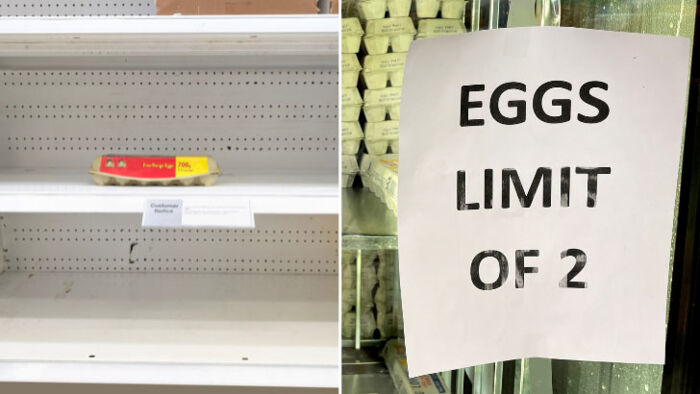
"Around 10% of Australia's laying hens were culled, between 1.8 and 2.4 million birds," says Michael Whitehead, executive director of food, beverage and agribusiness insights at ANZ. "We saw egg shortages, price increases and purchase limits."
Some supermarkets limited customers to two egg cartons each throughout early 2025. By June that year, the Australian Bureau of Statistics (ABS) reported the H7 outbreak had caused egg prices to rise 19.1% in 12 months.
New threat emerging
Australia was one of the last places on earth to be reached by the current H5 virus and experts watching it spread overseas were spooked by how it had caused birds and some mammals like seals to die suddenly in large numbers.
Writing for The Conversation, poultry health expert Dr Jose Quinteros noted this hadn't happened with the H7 strains that hit Australia in 2024.
Government agencies and agricultural specialists expect the H5 virus to impact local poultry at some stage and fear the effect could be as bad as the 2024 H7 outbreak.
Angus Gidley-Baird, senior animal proteins analyst with agricultural lender Rabobank says the chance of chickens catching the virus will increase as it spreads locally among wild birds, not just migratory species.
"Once it gets into our permanent local wild bird population, it's going to be very hard to eradicate [it] and from there it'll be a matter of time until it potentially is transmitted to a poultry operation," he explains.
As of this week, H5 has already been detected in several local wild birds, including sea gulls and a magpie.
How expensive could eggs become?
If a virus-induced cull drove up egg prices again, it'd come after the ABS noted they had gone down in price 5% in the second half of last year.
This week, the average price for a 700g carton of 12 free range eggs sold under homebrand at Coles, Woolworth and Aldi was $6.40 - a 20% rise like that seen after the last bird flu outbreak would push the mean cost to almost $7.70.
But experts are quick to point out that Australian farmers have had lots of time to prepare for the H5 virus.
"We are one of the last countries in the world to contract it, so there are a lot of lessons we can learn from other places," says Rabobank's Gidley-Baird.
Chief veterinary officers in several states have recommended free range chicken farmers move their flocks inside to limit their contact with wild birds.
The ACCC is allowing them to keep labelling their eggs as free range if they do follow this guidance.
What about chicken meat?
The prices of chicken meat are unlikely to be affected by any bird flu outbreaks, due to where broiler birds are kept and their relatively short lifespan.
"More poultry meat operations are housed in sheds in a controlled environment, so the chance of [H5] spreading there is lower," says Gidley-Baird. "The other thing is that broiler birds have a very short life of 30 days, whereas an egg-laying hen is alive for more than a year."
Is there a vaccine?
There is a vaccine chickens can be given to protect them from H5 bird flu, but its use in Australia is currently very limited.
Experts say this has been due to concerns that vaccinating chickens or even just keeping the vaccine in the country could affect Australia's status regarding the H5 virus and farmers' ability to export poultry products.
Are humans safe?
The Australian Centre for Disease Control says the risk to human health from H5 bird flu is low and is only likely to emerge if you're in close contact with dead birds.
Authorities say chicken and eggs that are properly cooked and handled will still be safe to eat.
Get stories like this in our newsletters.