The hidden costs of owning an Airbnb in 2026




Holiday homes can still generate rental income, but higher costs, tougher council rules and closer ATO scrutiny mean owners need to be realistic about the returns.
The holiday home, the great Australian aspiration. A discretionary purchase that promises long-term capital growth, weekends away with family and friends and, increasingly, an income stream to help cover the mortgage.
Summers on the beach in Noosa, Byron Bay or Lorne. Winter school holidays at Mt Hotham. A week of wine and solitude on Tasmania's East Coast.

For years, a few weeks of short-term rentals helped offset the holding costs. But that equation has become more complicated.
Short-term rentals rebounded strongly after the pandemic, reaching more than 174,000 active listings nationally by the end of 2024.
As the sector has grown, governments, councils and the ATO have tightened the rules, while higher interest rates and rising operating costs have made holiday homes more expensive to own.
So, does a holiday home still stack up as an investment in 2026?
Why investors still love holiday homes
Wisebuy Home Loans founder Brad East says whether short-term rentals still make financial sense had been under scrutiny well before the Budget and the ATO's renewed focus on holiday home deductions.
Many buyers are attracted to the flexibility of owning a holiday home they can enjoy themselves while earning income when they're not using it.
"A lot of the time it's for more personal reasons as opposed to investing reasons," he says.
"They might buy an apartment on the Gold Coast and say it's an investment, but they're also staying there every month. It's really a lifestyle purchase."
East says buyers need to separate those two objectives before they purchase because that's how lenders assess the property.
Rather than using projected nightly rates to assess borrowing capacity, lenders generally rely on a long-term rental appraisal.
Once a property has been operating as a short-term rental for around 12 months, they may also consider the income declared in the owner's tax return.
"You can't tell the bank it's going to earn $1000 a night. They'll use the lower long-term rental appraisal figure instead," he says.
That means buyers need to be confident that they can afford the property without relying on projected short-term rental income.
East says short-term accommodation is also far from a passive investment.
"If it is a proper investment, then it almost needs to be run as a business," he says.

The Airbnb tax traps every owner needs to know
Borrowing capacity is only one consideration.
The tax treatment of holiday homes can also have a significant impact on the investment's overall return.
Since July 2023, booking platforms, including Airbnb, Stayz and Booking.com, have reported host income directly to the tax office under the Sharing Economy Reporting Regime.
From July 1 this year, the ATO introduced new guidance spelling out exactly how holiday homeowners should apportion expenses between private holidays and paying guests.
The ATO is paying attention to whether a property is genuinely available for rent, whether below-market rentals to family and friends have been treated correctly and whether a holiday home is being operated as a legitimate income-producing investment rather than kept primarily for private use.
DSR Partners partner and tax specialist Taylor Hulls says anyone buying a holiday home with plans to rent it out should understand those rules before making assumptions about what they can claim.
East recommends doing two things before committing to investing in a holiday rental property:
1. Check the ATO's website
The examples they provide leave no room for ambiguity over primary use and legitimate claims.
"Often the most common mistakes or misconceptions clients have are related to the deductibility of their expenses and the private use apportionment. We also commonly see issues with claiming deductions for repairs or capital improvements," says East.
"Clients often spend a potentially large sum on renovations, or even replacing a hot water heater, oven or air conditioner, and expect immediate tax relief in the year they spend it.
"Even though these may appear to be repairs, the vast majority of expenditure above $300 needs to be depreciated over a period of up to 40 years.
2. Prepare a cashflow forecast
Before committing, East recommends preparing a detailed cashflow forecast covering mortgage repayments, strata, council and water rates, insurance and other holding costs, then stress testing the investment against seasonal income and longer-than-expected vacancies.
"Planning out the potential best and worst-case scenarios for the timing and amount of income received from your investment ensures you have a plan in place to meet these holding costs when they are due," he says.
"It's awesome to have a fully booked property over the Christmas holidays bringing in a premium, but you still have to pay the mortgage in July."

Why location matters more than ever
Research from The University of Sydney found that short-term rentals accounted for almost one in five homes in Byron Bay at the end of 2024, compared with 3.2% on the Sunshine Coast and much lower levels across most metropolitan areas.
In the past three years, that concentration of short-term rentals has prompted many councils to tighten local planning rules to return more homes to the long-term rental market.
Home Scouts founder Bronwen Stacey specialises in helping buyers purchase holiday homes in Noosa on Queensland's Sunshine Coast, with many intending to offset holding costs through short-term rental before eventually relocating or retiring.
"There's a lot of due diligence that we undertake for any shortlisted property, but short-term letting approval is definitely one of the early deal breakers that can eliminate a property before it even reaches the inspection stage," she says.
Noosa Council tightened its short-term letting rules in February 2022 to ease pressure on the long-term rental market.
Many holiday rentals now require council approval before they can operate, and are subject to ongoing conditions and annual fees.
Since the rules were introduced, more than 3100 properties have been approved to operate as short-term rentals.
At the same time, the council has refused 103 applications and issued 180 infringement notices against owners breaching the rules.
Stacey says that the changes haven't stopped buyers looking for holiday homes.
"It's important that buyers are educated from the outset about the limited supply of approved properties, the areas where short-term letting is permitted and the likely returns, so they have realistic expectations," she says.
Stacey says the restrictions have prompted some buyers to rethink their plans where achieving strong holiday rental income is fundamental to the purchase.
"For the majority of our clients, the primary motivation is securing the right property in a tightly held market.
Lifestyle is usually the driver. Rental income simply helps cover the holding costs until they're ready to move."
The reality of running a holiday rental
So will the property perform as a short-term rental?
Nesty co-founders Sally Broad and Felicity Lewis have spent almost a decade managing holiday homes across Victoria's Surf Coast. They offer this advice:
Be realistic
The biggest misconception they see is how much income owners expect the property to generate.
"People often think they're going to make more money than they actually will. Once upon a time that was probably the case, but markets have changed and there are so many more variables," says Broad.
"You have to be realistic about how much money a short-term rental will make you.
You can't enter with the mindset that you're going to make a profit because you may not even cover all your costs."
Work out your goal
Before Broad agrees to manage a property, the first thing she asks is what the goal is.
"If you have a holiday home and need it to generate a certain amount of income every year, we can't guarantee a return because the market is always changing. We can't make those promises," she says.
Most clients use the properties themselves as well as renting them out.
About half block out peak holiday periods for family use, while the remainder leave the calendar open to maximise bookings.
Be prepared for the costs
Even after the ATO's announcement on greater scrutiny of holiday home usage and deductions, Broad says few changed the way they use their properties because rental income was never the primary reason they bought.
"They're fortunate enough to own a holiday home. Any income they make in between is a bonus."
However, almost all owners underestimate the work, and costs, involved before the first guest arrives.
Avoid doing it on the cheap
"Invest in good mattresses, make the property feel welcoming and get a stylist in if you need to.
If you start well and get good reviews early, you'll make more money," she says.
Presentation, professional photography and thoughtful furnishings all influence bookings, while a distinctive feature such as a spa, fire pit or family-friendly outdoor space can help a property stand out in a crowded market.
Get the pricing right
Broad says successful short-term rentals require constant revenue management and owners who refuse to adjust prices during quieter periods often end up with empty calendars that ultimately reduce annual returns.
"You've got to be flexible.
There are months when prices are lower, but filling those quieter periods can produce a better return across the year than holding out for one expensive booking," she says.
How one family made their holiday home pay
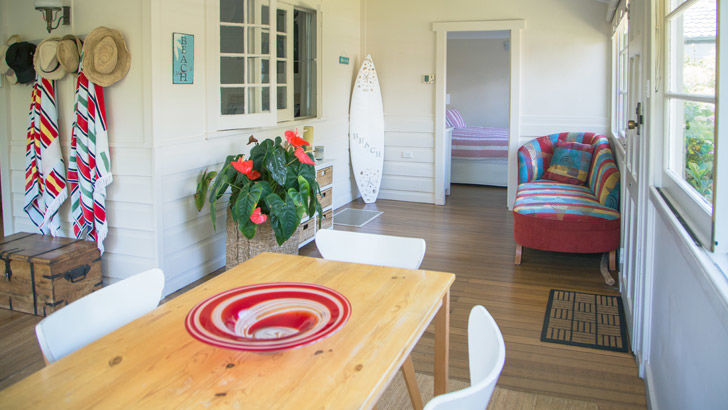
It's the advice Sarah Hamilton and her family took when leasing out The Soak House, now one of Nesty's best-performing properties.
The Lorne holiday home, purchased in August 2025, is walking distance to the beach.
The three-bedroom property sleeps eight and rents for more than $1500 a night during the peak summer season.
Following Broad's advice, the family hired a stylist on settlement to refresh the interiors and installed a spa on the deck for guests to enjoy while taking in ocean views.
The changes doubled the property's nightly rate and significantly increased occupancy.
Hamilton says after their experience with their first short-term rental in Aireys Inlet, the family was realistic about the intention of the purchase and never expected the property to fund their lifestyle.
"It's not a big money maker," she says.
"It does a good job of covering most of the costs while we're not there."
They're now considering adding a Euca-built two-bedroom modular home on the large block to help maximise the return and provide extra space for their growing family.
But the income isn't the biggest driver.
Instead, Hamilton says one of the benefits of short-term renting is that the house is maintained year-round, professionally cleaned between guests and ready for the family to enjoy whenever they arrive.
The verdict: Are holiday rentals still worth it?
Despite the tighter regulation, higher holding costs and increased scrutiny from the ATO, Cotality research director Tim Lawless says short-term rentals can still outperform traditional leases, albeit in the right locations.
"The maths of short-term renting has become more nuanced and much more geographically specific," he says.
"They can still stack up where the property is in a high-demand tourism market, occupancy is consistently strong and the rental premium is sufficient to offset higher operating and compliance costs."
Lawless says the challenge is that investors can no longer assume those conditions exist simply because of a property's address.
He points to Queensland's patchwork of council rules that vary between local government areas and even individual suburbs depending on zoning and dwelling type.
That makes due diligence critical, he says, particularly as councils continue to look for ways to protect long-term rental supply.
"Some investors may decide the additional compliance burden, risk and uncertainty aren't worth it, particularly if they were relying on year-round short-term letting to make the investment stack up," he says.
"For some investors, a traditional long-term rental may now look more attractive, particularly where the gap between short-term and long-term rental returns has narrowed."
Short-term rentals haven't become a bad investment and can still make sense for investors prepared to do their due diligence.
But they're not a set-and-forget investment or source of passive income.
Lending policies, council rules, tax obligations, operating costs and seasonal demand all need to be considered before taking the plunge, not after.
Get stories like this in our newsletters.