Sky high: How to profit from the air above your home




Most homeowners assume the value of their property runs from the front yard to the back fence or apartment door to their balcony.
What they may not be aware of is that the air above their home is theirs too, and in a country starved of housing, it could be worth real money.
Thanks to new planning rules and a growing market in 'airspace rights', homeowners can now lease or sell the right to build in the unused space above their homes.
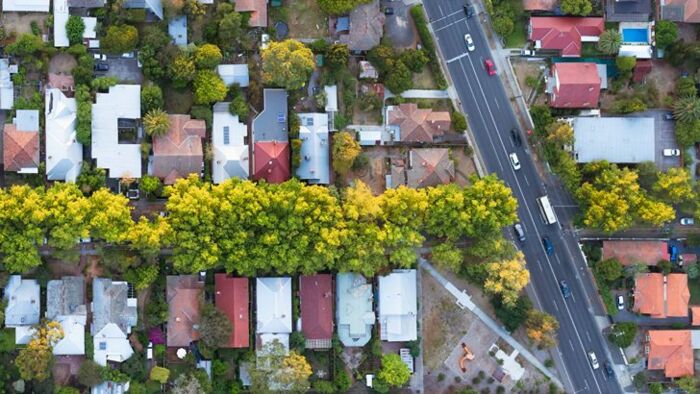
The money made from developing that space could be used to pay for major repairs, boost property values and, in some cases, deliver a windfall while staying put.
It's time for homeowners to start looking up.
Australia's airspace potential
Leading the push is Buy Airspace, founded by accountant Warren Livesey who worked on rooftop projects in the US and Europe.
"Airspace real estate has taken off overseas. It's the fastest growing housing solution in New York, London and Paris," he says. "Sydney's next."
The London experience shows what's possible. Independent research has found rooftop developments could deliver 42% of the city's new housing needs.
Livesey puts the value of that at around £50 billion ($102 billion). Australia's opportunity is larger.
"Sydney has some of the most expensive real estate in the world. So we have some of the most expensive airspace in the world," says Livesey.
What does he think it's worth? Livesley estimates:
- Rooftop airspace in Australia typically sells for between $2500 and $10,000 per square metre (sqm), depending on the location.
- Australia has 340,000 strata schemes, typically three-storey walk ups with about 10 units and a 300sqm roof.
- "The average value added is $5000/sqm," he says. That could add up to more than $500 billion in untapped value.
From 'heaven to hell'
If you own land in Australia - whether individually or through a strata - Livesey says you own everything from "heaven to hell".
"You basically have all the airspace above you, but the caveat is that governments and councils can decide how much of that sky you can use."
For example, if your building stands at 10 meters high but the limit is 15 metres, that's five metres of unused potential.
That is the situation thousands of NSW homeowners now face after the State government reformed its low- and mid-rise housing policy in March.
The reforms change planning controls within 800 metres of 171 town centres and train stations.
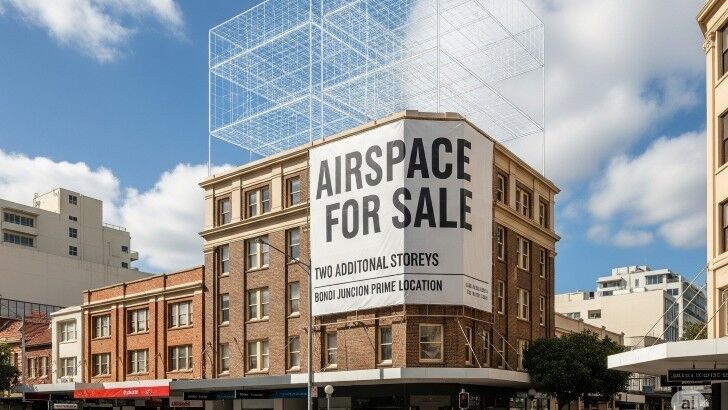
In those areas, dual-occupancies, terraces, townhouses and low-rise apartment buildings can now be built across metro Sydney, the Central Coast, Illawarra-Shoalhaven and the Hunter.
According to NSW Premier Chris Minns, these homes played an important part in providing housing over the past century but, in the past few decades, councils have effectively banned them.
This reform means buildings that couldn't go above three storeys can now reach six.
"Only one in four buildings will be knocked down and rebuilt because existing owners don't want to go anywhere," he says.
"It's the three out of four that we can build on top of," says Livesey.
How to make money from your airspace
It's usually a four-step process, says Livesey.
1. Assessment
The first step is to work out whether your building has usable airspace.
"Many people don't know their building's height," says Livesey. "It's about three metres per storey plus the roofline. Then check what you're allowed on your council website."
If there's room, a town planner will need to confirm if the rules allow for extra levels, while an engineer checks if the building can take the weight.
"If they both say yes, then we've identified airspace that can be built on," he says. This assessment costs $2000-$5000. If the property is deemed not to have usable airspace, the process ends.
2. Tender
Once usable airspace is confirmed, Buy Airspace takes the proposal to developers.
"They respond with a one-pager: how they would build, the profits and the split," says Livesey. Rather than selling their roof, homeowners then grant developers access under what's called a "call option contract".
"It means the homeowners still own the airspace," says Livesey. "The developer only has the right to build on it. That way there's no stamp duty upfront, no massive holding costs, and no one's forced out."
3. Development
"The developer will fund the whole project," says Livesey. "They will plan it, submit the development application to council, they will build it, then sell it, splitting the profit with existing owners.
To keep costs down and reduce disruption, most projects use prefabricated homes made from crosslaminated timber (CLT).
"CLT is compressed timber that becomes stronger than steel but lighter than concrete," says Livesey.
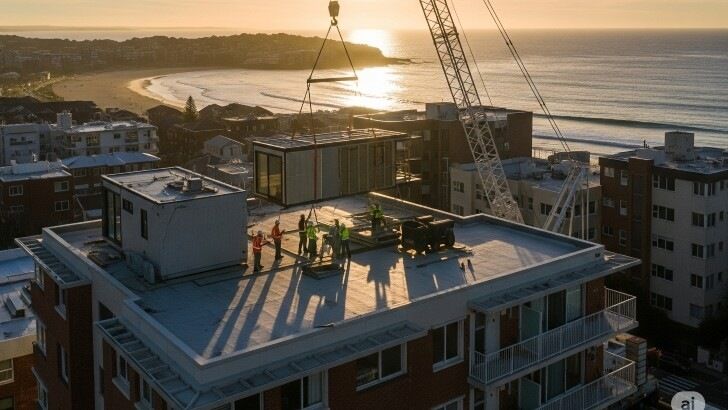
"We build the home off-site, then crane it in to replace the old roof. In narrow streets like those in Bondi, we even do it in panels so it can be lifted in and assembled on the roof."
4. Profit share
Profits are usually split 50/50. "The owners don't put any money into the project, but they are financially compensated for selling their airspace," says Livesey.
The profit can be reinvested into the building to cover repairs and upgrades.
"If they make $1 million, but they spend $800,000 fixing the building - new windows, electrics, brickwork - that $800,000 is tax-free," he says.
"Only the rest is taxed if taken as income." Livesey says the benefits can be huge. "First, the strata doesn't need to create a capital works fund anymore. The building is repaired using the profit.
"Second, both the developers and owners profit. We had one project where an apartment worth $600,000 ended up selling for $1.2 million after the works were done."
The importance of advice
Others aren't so sure. Stuart Ayres, NSW chief executive of the Urban Development Institute of Australia, told The Australian Financial Review in June he is not convinced there will be a rush towards securing airspace rights across the city.
"You've got to have some pretty uniquely wealthy individuals to be able to participate in that type of exercise," Ayres said.
Robert Anderson, president of the Strata Community Association NSW, urges homeowners to seek independent tax advice before committing to anything.
"I reckon it's a goer with a caveat of understanding the tax implications, such as capital gains tax and stamp duty," he says.
He also notes the potential disruption homeowners may face due to the remedial works going on.
Can owners do it without a developer?
It's not always developers who sell the airspace. "In half of the 77 projects I've managed, a resident bought the airspace themselves," says Livesey.
"They've sold their ground floor apartment, bought the airspace, developed it, and now they've got the penthouse."
Airspace development sounds simple, but coordinating dozens of homeowners isn't. "I'm kind of the conduit between owners and developers," he says.
"Owners don't have the time, money or experience to develop it. That's why so many apartment blocks are non-compliant and in disarray."
Under strata law, 75% of homeowners need to vote yes. If they don't, the building still needs repairs, usually funded by each owner forking out thousands to a sinking fund.
"Owners managing it themselves need 14 separate votes of 75% approval. But a developer deal needs just one," says Livesey.
Beyond housing and profits
Airspace builds can also work above shops or commercial buildings, according to Livesey.
"We can build green rooftops, gyms, public spaces and more businesses," he says.
Overseas it's also common to open the airspace up for public housing. Buy Airspace is working with Homes NSW, Landcom and Shelter NSW on pilots.
With supply the name of the game for fixing Australia's housing crisis, the message is clear:
"We already have eight of the 10 buildings we need by 2050. The challenge is keeping them standing - and we can pay for that by going up."
Get stories like this in our newsletters.