Cherry's Goods reveals what success looks like beyond TikTok




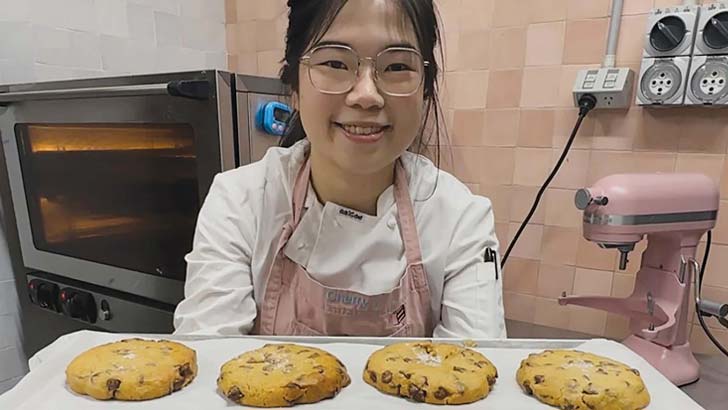
Cherry's Goods became a sensation on the back of matcha white chocolate cookies, and the craft behind them led to a TikTok Business of the Year award in 2025. With 650,000-plus likes on Instagram and nearly 11 million on TikTok, 28-year-old founder Cherilynn Yap has turned that heat into a compact portfolio: Cherry's Goods, Up South in Bondi, Kaska in Darlinghurst and a Macquarie Park site. When the original kiosk in The Galeries, in Sydney's CBD, closed after 13 days of overwhelming demand, she regrouped and reopened nearby with a larger corner space and all-day baking to meet the crowd. Beneath the gloss, Yap runs a tight operation: clear systems, fast pivots and product discipline in a trade of thin margins and fickle customers.
Tell us about your early years. What shaped your attitude toward money and independence?
I grew up in a family that valued hard work and practicality. One of my earliest memories is spending what felt like hours wandering through Toys"R"Us fixated on a pretend cash register. My mum didn't say 'no' instead, she said, "If you think it's worth it, we'll buy it".
As a little girl, that question made me pause and think. I'd imagine what my life would look like with the toy and without it, and more often than not I'd end up deciding it wasn't worth it and walking away.
That simple lesson shaped my entire relationship with money: respect it, don't fear it, and treat it as a tool rather than a measure of who you are. From there, independence came naturally.
I grew to love the freedom of making choices, not just the ability to buy things, but the ability to choose not to, even when I could.
Growing up, did you always imagine yourself as an entrepreneur?
Not in the traditional sense. I didn't grow up thinking I'd run a business, but I did always have the instincts, like selling baked treats at school, coming up with ideas, being obsessed with creating.
I just didn't know back then that it was entrepreneurship. Looking back, it makes perfect sense.
What was the first financial risk you took to bring your brand to life?
The first real risk was spending my savings on equipment, ingredients and a logo before I had any certainty that people would buy my product.
It wasn't a small amount to me at the time and there was a very real 'this could flop' moment. In fact, I started multiple businesses that flopped before Cherry's Goods.
Did you fund the business yourself or seek investors?
Self-funding meant slower growth at the start, but it also meant every decision aligned with my vision; also, I don't know any investors, ha ha.
You have more than 300,000 social media followers on TikTok. How does that translate into financial opportunity?
TikTok and other social media platforms have opened a lot of doors. Strong social presence means fewer barriers between
me and my customers; I can launch new products directly to an engaged audience.
TikTok is not just numbers; it's a community that actively supports what I create and that brings me so much joy because
I love baking and hosting others in my own space.
Does the size of that audience create pressure to constantly perform or monetise?
Absolutely. There's a constant, unspoken pressure to always be on, to keep creating, keep evolving, keep feeding the algorithm. And on the days I'm not posting, it can feel like I'm somehow slipping behind.
But I've had to remind myself that my real passion isn't in the performative side of it; it's in hospitality, in baking, and in crafting videos that feel thoughtful and high quality, not just constant.
What's the biggest misconception people have about influencer income?
That it's easy or passive. People assume you just post content and money appears.
In reality, it's strategy, deadlines and negotiations. And income isn't consistent; it can be amazing one month and quiet the next. I'm just grateful I can still call this a hobby while I focus on my day job.
What's the toughest money decision you've made since starting your brand?
Choosing to reinvest almost everything back into the business, rather than paying myself more, has been the toughest decision. It's never easy watching money come in only to send it straight back out into growth, especially when you're relying entirely on your own ideas to carry things forward.
But in a way, that's also the thrill of entrepreneurship: betting on your own ideas and building something bigger than the moment you're in.
How do you balance reinvesting in the business versus personal spending?
I think this brings me back to my first answer. The same question I asked myself as a little girl at Toys"R"Us: do I want to spend
my money for this or keep it for something more worthwhile.
I don't think you're truly an entrepreneur if you put yourself before your business.
What's the best money advice you've ever received? Did you follow it?
'If the problem can be solved with money, it isn't really a problem.'
At first, I didn't fully embrace this; I've always had a naturally thrifty mindset. But once I did, it brought me both relief and a sense of freedom.
Suddenly, I felt less guilty about spending on solutions and more empowered to act on things I had been putting off.
Finish this sentence: Money is good for...
...creating freedom. Freedom to choose to build the life you want on your own terms.
Get stories like this in our newsletters.