He spent 20 years studying the mind then AI changed everything




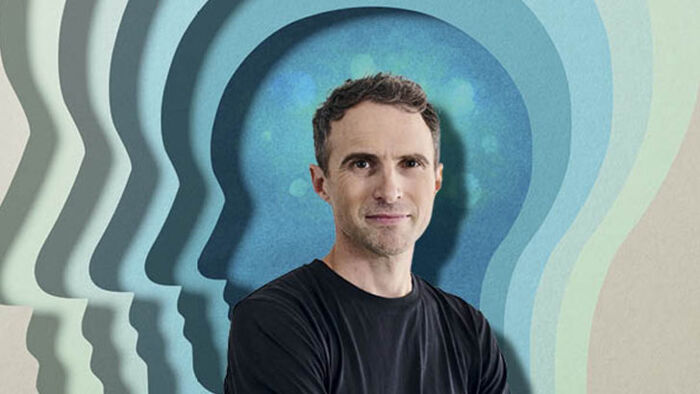
Professor Joel Pearson, 48, is a cognitive neuroscientist, author and self-described neurofuturist at UNSW. Known for his research into intuition, imagination and consciousness, he is one of Australia's leading voices on the human impacts of AI. Today, he helps governments, businesses and individuals prepare for the AI age. He lives on Sydney's Northern Beaches with his wife and two young children.
For most of his career, Professor Joel Pearson was fascinated by things that seemed impossible to measure.
Intuition. Imagination. Consciousness. Creativity.
They were topics that sat somewhere between neuroscience, philosophy and art, intriguing but rarely the stuff of everyday conversation.
Then AI arrived.
Suddenly, the neuroscientist who had spent two decades studying the human mind found himself asking not just how we think, but what happens when machines can think too.
Today, Pearson is one of Australia's leading voices on the human impacts of AI. But his path there began far from Silicon Valley.
Born in Balmain, Sydney, and raised in the Blue Mountains by "hippie parents", he attended an alternative Steiner-type school that was all about creativity and independent thinking.
"I loved it there," he says. "I was either in the art room painting and drawing or in the science lab. It was a very small school. In Year 12 physics and chemistry there were only two or three of us. We'd rip through the material, then spend time on other cool things."
From art and architecture to neuroscience
After school he enrolled in architecture, seeing it as the perfect combination of creativity and technical thinking.
Then came a six-month solo trip through Europe, a science degree, fine arts, filmmaking and eventually a return to science through an obsession with consciousness and how we experience reality.
"I ripped through my PhD in two years, which was a record at the time. My academic background is all over the place," he says, laughing. "But looking back, it's always been about science and art."
What linked the two wasn't a career plan, but curiosity.
"In art, it might be discovering how music and visuals combine to make someone feel something. In science, it was discovering how imagination works, or how intuition works, or how we experience the world."
Studying consciousness, intuition and imagination
Pearson has spent much of his career studying topics many scientists considered too difficult, "too fluffy" or too subjective to tackle.
"Things we don't understand are often the most interesting to me because they have the biggest potential pay-off," he says.
His work has explored everything from mental imagery and intuition to hallucinations and aphantasia, a condition where people cannot visualise images in their mind.
"What I've become known for is taking topics people think are too ephemeral and creating objective ways to measure them," he says.
How ChatGPT changed his career
For years, that work attracted academic attention and research grants.
Then ChatGPT arrived.
Like many of us, Pearson was equal parts fascinated and alarmed.
"I felt it was going to change everything in our lives and people just didn't realise how big it was going to be," he says.
At first, he assumed someone would step forward to explain the broader implications of AI.
"I thought someone like [psychologist] Adam Grant in the US would start talking about the psychological and societal impacts."
Instead, journalists were turning to computer scientists for answers.
"These are the godfathers of AI, they're world experts. But they don't know about schools. They don't know about consciousness. They don't know about human behaviour," he says.
One day, something clicked.
"I realised nobody was talking about the human side of this," he says.
What is a neurofuturist?
As his work expanded into the societal impacts of AI, Pearson coined a new title for himself: neurofuturist.
"A lot of futurism is about technology. But technology doesn't exist in a vacuum. Humans have to live with it."
For Pearson, neurofuturism is about understanding how people think and respond to change, and using that knowledge to navigate what's coming next.
He believes many are making the same mistake with AI that previous generations made with electricity.
"When electricity first arrived, people thought it was just about better candles. But electricity wasn't a lighting revolution, it was an energy revolution.
Think electric motors, refrigeration, cinema.
We keep calling AI a technology revolution, but what's actually being scaled up is intelligence."
AI is an intelligence revolution, not a technology revolution
When intelligence becomes abundant, cheap and non-human, Pearson argues, the implications extend far beyond software or productivity.
Jobs. Education. Relationships. Politics. The economy. Everything.
The conversation needs to shift from whether AI is good or bad to how society navigates the disruption, he says.
"If companies bring in change specialists when they're changing one system, what do we do when we're going through the biggest change in human history?"
He has spent the past two years briefing politicians, advising organisations and advocating for a national change framework.
"We're going to need better psychological toolkits. Better ways of dealing with uncertainty. Better habits. The people who adapt best won't necessarily be the most technical, they'll be the most resilient."
Why resilience will matter more than technical skills
These days, Pearson's lab at UNSW still runs projects exploring imagination, intuition and consciousness, but much of his focus has shifted to what he sees as an urgent national challenge.
"I've pivoted. I feel duty-bound to do this work," he says.
Part of that mission involves helping people prepare for an uncertain future.
Another starts at home.
Pearson and his wife homeschool their children, aged six and eight, and limit screens and social media.
"I want my kids to learn how to learn," he says. "I want them to be curious about the world and to have agency."
He believes qualities such as curiosity, adaptability and initiative will become increasingly valuable as AI takes over routine tasks.
"We don't need people who can just memorise facts. What matters is being able to learn new things, change your mind and think critically," he says.
The skills AI can't easily replace
He also places huge value on emotional intelligence and human connection.
"Soft skills are more important than ever. They build resilience, creativity and emotional intelligence," he says.
It's one reason the family places such an emphasis on socialising.
"We spend a lot of time helping our kids learn how to interact with people," he says. "Because in an AI world, being a good human is becoming more valuable."
Why emotional intelligence is becoming more valuable
For all the anxiety surrounding AI, Pearson is an optimist.
"I think we're going to get to some kind of AI utopia," he says. "AI is going to help solve problems we've struggled with for decades, climate change, rare diseases, cancer, all kinds of things."
The challenge is what happens in between.
How to use AI without losing critical thinking skills
One concern is what he calls "AI brain rot", the risk that people outsource too much thinking to machines.
"As we outsource our thinking and decisions to AI, we're getting dumber," he says. "It's like going to the gym wearing a robotic exoskeleton that lifts all the weights for you. Your muscles don't grow because the robot is doing the lifting."
His solution is what he calls "cognitive upsizing".
"Use AI. Outsource what you can, but then take on bigger, more complex problems yourself. Keep that pressure on your brain. Keep thinking."
The same principle applies to work, money and purpose.
What AI could mean for jobs, investing and the economy
Pearson believes AI could challenge some of the economic assumptions that have shaped society for generations.
"We're going into a weird period where a lot of the traditional financial models are no longer going to work," he says. "Things like GDP could keep rising while unemployment rises as well. That's not something we've really seen before."
While Pearson still invests through broad-based ETFs and keeps an eye on developments in AI and energy, he's less interested in picking the next winning stock than understanding the bigger forces reshaping the economy.
"In the long run, I think AI is going to change capitalism itself," he says. "We're heading towards what some people call an age of abundance, where the cost of producing goods and services will fall dramatically. But getting from here to there is going to be messy."
Finding purpose in a world of intelligent machines
Ultimately, though, Pearson believes the biggest challenge won't be financial, but human.
He points to research showing that people who lose a sense of purpose often experience poorer mental and physical health, even when money isn't an issue.
That's why he believes the future of work isn't just an economic question, but a human one.
"What are people going to do? How are they going to contribute? How are they going to find meaning?" he asks. "Those questions are just as important as the technology itself."
For Pearson, they're also personal.
He could easily retreat into academia, continue his research and leave the AI debate to others.
The biggest challenge humans will face this century
Instead, he finds himself travelling the country, briefing governments and trying to help people prepare for what's around the corner.
"I could easily coast out to retirement, but this is too important. The next decade or two is the biggest challenge humans are going to face. I don't feel like I have a choice."
Get stories like this in our newsletters.