How Katherine Bennell-Pegg became Australia's first female astronaut




It's almost a given that at some point in their formative years, children will be asked the question: 'What do you want to be when you grow up?'
Among the more common answers, such as doctor or firefighter, is a profession that so many aspire to but so few
achieve: astronaut.
Katherine Bennell-Pegg was one of those kids.
'I want to be an astronaut'
Growing up on Sydney's Northern Beaches, Bennell-Pegg remembers lying on the grass in her backyard looking up at the night sky.
"When my mum told me that some of those bright lights were not stars, but actually planets that nobody had ever seen with their own eyes or walked on, I wanted to be the one to explore them.
"It's that same feeling that has driven us to want to explore the world since the earliest humans. It's that feeling you get when you want to look under a rock or climb up a tree, or that sense of awe you get when you look out at the horizon from a mountain top."
This wasn't a passing fancy, though.
Turning the astronaut dream into reality
It was a dream that she clearly wasn't going to surrender. So rather than just humouring her, Bennell-Pegg, now 40, says that her school and parents encouraged her to find out what it would take to turn that dream into a reality.
After researching online, however, she found out that there wasn't actually a set path. "To be an astronaut, you can be ascientist, an engineer, a pilot - you can have almost any career your passion takes you down.
"But you should also be someone that has done expeditions, has operational skills and has lived in other countries. All of that sounded great to me and got me more excited."
Overseas and home again
After finishing school, Bennell-Pegg took on a double degree in advanced science and physics and aeronautical space engineering at The University of Sydney.
She chuckles while talking about her decision at the time and freely admits that she didn't really know what engineering was at that point. In truth, 'space' was the word that attracted her to the degree. Even though it was a slog at times, she says that seeing it through was a great decision, because it ended up underpinning her career as a space engineer.
On graduating in 2007, Bennell-Pegg knew that to carve out a career in the space sector, she'd have to move abroad. And that she did, pursuing postgraduate study in Europe and completing a number of internships before landing a job at Airbus Defence and Space.
"There I got to work on mission systems, which is basically developing mission concepts to figure out what scientists want to know. One mission was looking at the world's oceans, which was incredible, and it taught me about how space goes beyond science and exploration.
"So, my interest in space evolved from that childhood curiosity and sense of adventure to how it critically underpins humanity and the way we take care of our world."
In 2017, things took an exciting turn.
For the first time in her life, Bennell-Pegg realised that she might be able to pursue her passion in Australia.
"I was actually in Adelaide at the International Astronautical Congress in 2017 when it was announced that Australia was going to set up a space agency.
"The atmosphere was electric. Global leaders of space were all there and everyone was so excited that Australia was stepping forth in the space arena.
Lift-off down under
Bennell-Pegg landed a role at the Australian Space Agency, which brought her and her husband, spacecraft systems engineer Campbell Pegg, to Adelaide. This wasn't just a huge step for the couple - it was a huge step for Australia.
"We've had a long and proud history in space, but the breadth of activities has expanded in recent years, so having an agency is critically important for Australia to realise its potential," she explains.
"At its core, while space is quite industrialised, governments are the market makers in creating opportunities. I think McKinsey estimated that the global space sector will triple from $US630 billion ($920 billion) in 2023 to $US1.8 trillion ($2.6 trillion) by 2035, so the Australian Space Agency is needed to be able to harness that value.
"The agency also has a really important regulatory function in ensuring responsible and sustainable utilisation of space, and that was necessary given the increased interest in launching rockets from Australia and returning things to Australia."
Opportunities found in space
The way Bennell-Pegg describes it, the opportunities that space can provide are almost endless. And not just from an economic perspective. Because of the size of Australia and its position in the world, space is vital.
"Space critically underpins our way of life. It's how we use Google Maps. It's how our ATMs work with signals.
"And we need space to monitor and manage our land and our remote industries in a way that is particularly prominent for Australia because of our vastness. It's incredible, and most people don't realise how all-pervasive space is," she says.
Ticked all the right boxes
As amazing as it was for Bennell-Pegg to find herself back in Australia working for the Australian Space Agency, there was still another dream burning bright inside her. As luck would have it, her big chance was just around the corner.
In 2021, the European Space Agency announced that for the first time since 2008 it was recruiting
a new class of astronauts and, thanks to a UK passport inherited through her mother, Bennell-Pegg could apply.
"The last time they had an open call I was a university student, so I wasn't eligible. So, this was my chance. I was very fortunate that it fell at a time in my career where I still had technical operational capabilities and where I was still healthy and experienced enough.
"I stayed up all night writing my application letter. It was really hard to put into words the reason why I wanted a job that I had desired my whole life - you know, to break it down to the core reasons, to be authentic and to not say the same thing as everyone else."
Bennell-Pegg was one of more than 23,000 applicants. Still, she knew that she ticked a lot of boxes. She had a master's degree in her field. She had expeditionary experience, operational experience and was in good shape.
One of the top applicants
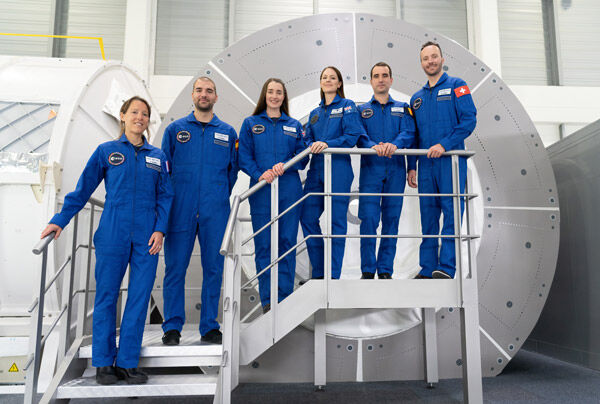
After six knockout rounds, five trips to Europe and some stiff competition from a field that included doctors, test pilots and volcanologists, Bennell-Pegg achieved the incredible and made it to the top 25 applicants. Then came the bad news: she hadn't been selected.
"I was disappointed for a few days, but I love my day job, so there was nothing lost. But then I found out that the reason I wasn't selected was due to my limited connection to Europe."
That wasn't the end of the matter, though. The European Space Agency made an offer to Australia to train Bennell-Pegg as part of the astronaut class after all, the proviso being that she would represent and receive support from Australia throughout
the training.
"That wasn't just because of my performance, it was also because of all the great potential that the European Space Agency saw in Australia entering this world."
Astronaut training begins
From there, Bennell-Pegg's astronaut training began.
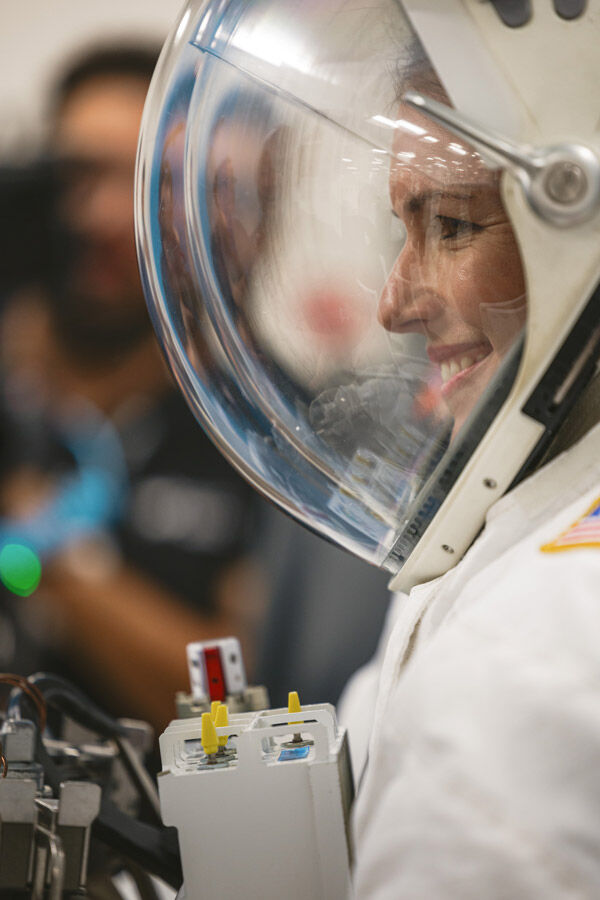
Unsurprisingly, it wasn't a walk in the park. In fact, one part of the training involved scuba diving in a deep pool over a full-scale mockup of the International Space Station to learn how to walk in space.
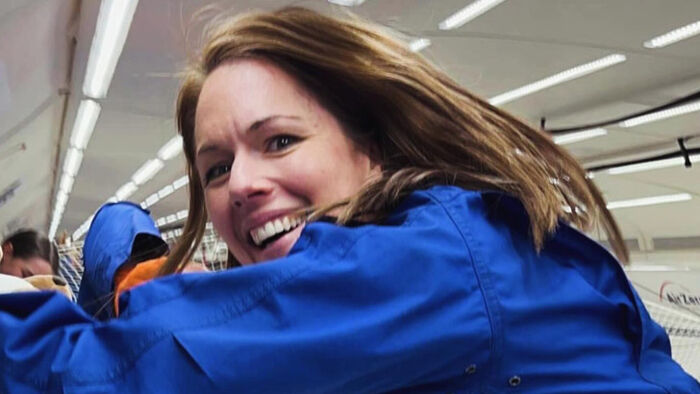
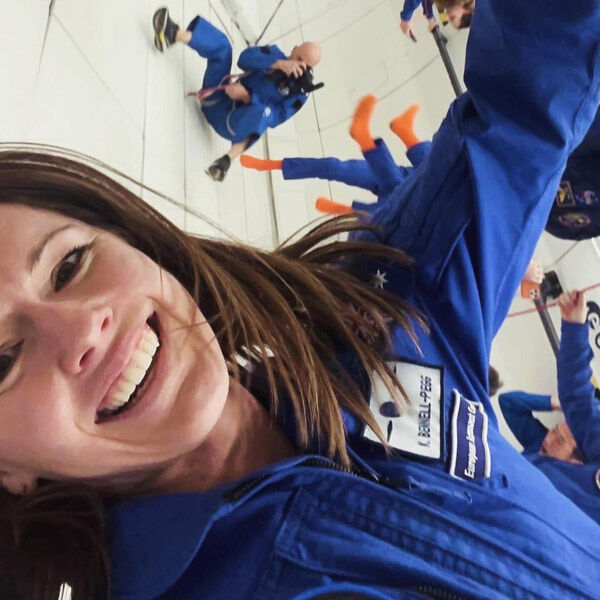
There was also ocean survival, firefighting, medical training and what she describes as 'vomit comet' flights to learn how
to move around in zero gravity.
Australia's first female astronaut
In April this year, Bennell-Pegg graduated, officially becoming Australia's first female astronaut and the first person to train as
an astronaut under the Australian flag. (The Australian-born astronauts Andy Thomas and Paul Scully-Power went into space as US citizens).
When she'll get the opportunity to go into space herself is a question for the future.
"When, or if, I fly is a decision for Australia to make when the time becomes right. So, we'll see what the future holds. Some astronauts wait a very long time to fly. But I'm excited for the future nonetheless - there's plenty to do on the ground for now."
Our space ambassador
Bennell-Pegg's not wrong about there being plenty to do. In addition to being an astronaut and the director of space technology at the Australian Space Agency, which is based in Adelaide, she's become an ambassador for Australian space since returning home from training.
"I'm so grateful to have this opportunity. Speaking to people, especially young people, is incredibly humbling.
"There is such excitement and passion when they see that this door has been unlocked for their future. Some kids get quite emotional when they meet me, and I remember being just like them when I was a kid sitting in the audience at talks by Andy Thomas and Paul Scully-Power."
A clearer path to follow
Things have changed in the decades since Bennell-Pegg sat listening to her own space idols.
With the founding of the Australian Space Agency, and thanks to her own remarkable achievements, young Australians who share the dreams that she had growing up have an even clearer path to follow.
"I'm really proud that today, to have a career in space, you don't have to leave Australia," says Bennell-Pegg, who lives in Adelaide with her husband and two children.
"You don't have to leave your State. You don't even have to leave most regional areas. There's a lot happening across the country and it's an incredibly exciting time."
Get stories like this in our newsletters.