Career change at 40: Why a NICU nurse became a carpenter




She swapped a hospital ward for a construction site, took a near-50% pay cut and started again at 40.
After 15 years as a nurse and midwife, Sarah Starbuck was burnt out.
Today, she's an award-winning carpenter, proving it's never too late to reinvent your career.
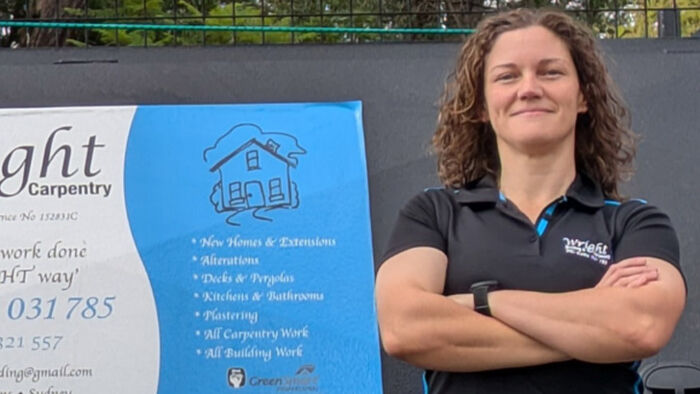
Sarah Starbuck, 40, did a big midlife career switcheroo.
A highly qualified nurse and midwife, she spent many years working at hospitals all over Australia, including the Newborn Intensive Care Unit at Sydney's Westmead Children's Hospital.
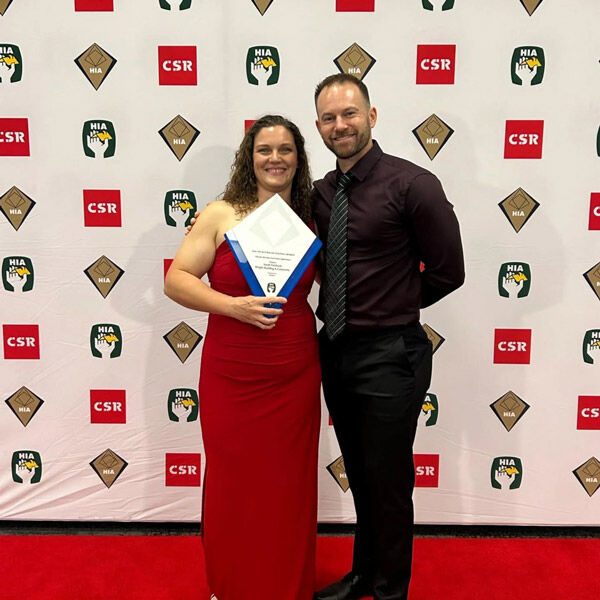
A chance encounter at a Latin dancing class led to a major career pivot in the form of a carpentry apprenticeship and in 2026 she won the HIA Construction Apprentice of the Year.
She now holds a Certificate IV and is employed by her former dance teacher as a carpenter at Wright Building & Carpentry.
That's quite a career shift. Why did you decide to leave nursing to start a building and construction apprenticeship?
I had been a nurse for 15 years at that point.
I'd been working throughout the pandemic, and as restrictions eased, conditions didn't really get any better for us.
We'd been working with minimal staff and resources for so long that many of us were burnt out, and with no sign of things improving in the near future, I was looking for a change.
I had met my current boss, Peter, through Latin dancing, as he is a Latin dance instructor.
We became friends and I started doing some casual labouring on his sites, and quickly realised I looked forward to going to work on a construction site far more than going to the hospital, so I made the decision to do a trade apprenticeship.
Peter asked me if I wanted to be his carpentry apprentice, and I said yes.
How did you manage the change in career in practical terms?
It was a clean break.
I still did casual shifts every few weekends (and teach advanced life support as well to supplement my income), but the more I got into carpentry, the less I wanted to work in hospitals.
What role did income or earning ability play in your decision to switch careers?
Doing an apprenticeship as an adult with no financial support was really tough.
I was in a good position to make it work though, as I had recently sold a house so I had some savings put aside to live off.
The base wage as a carpenter is less than I was earning as a nurse with a Master's degree, but the potential for growth in the building industry is so much greater than in nursing.
If I keep learning and progressing my skills, then my pay can go up based on merit, and I'm not limited to an industry-set wage.
Did you first work out if it was financially viable or did you decide to do it regardless?
I decided regardless of the money that I would make it work.
I went from $49 an hour to $24 an hour at the time of my apprenticeship.
I completely appreciate why a lot of adults just can't do it. It's not a livable wage.
I also understand that a first- and second-year apprentice doesn't really earn the company any money while they're learning for those first few years, so it's also difficult to ask builders to pay them more.
How did you change your lifestyle and finances to accommodate that change?
I had to limit social activities, be careful what I bought for groceries, and work weekends whenever I could to supplement my income.
I made a decision early on that the savings I had would be expendable to cover the cost of my apprenticeship.
I sacrificed the ability to buy my own house with those savings to get through my apprenticeship, with the aim to rebuild that wealth over the next few years as a qualified carpenter.
What was it like to go back to studying after 15 years in a different profession?
I have been studying all my life.
I did my nursing degree, then shortly afterwards did a postgraduate certificate, then diploma, then Master's degree.
Then a postgrad diploma in Midwifery and a bunch of certificates in various activities and fields.
Nursing also taught me to always keep up-to-date with the latest guidelines and research in my specialty, so I've never really stopped studying.
To go back to a Cert III was pretty easy, although a lot of work, and I had a lot of support from my boss to get everything completed quickly, as I was working one-on-one with him for a significant part of my apprenticeship.
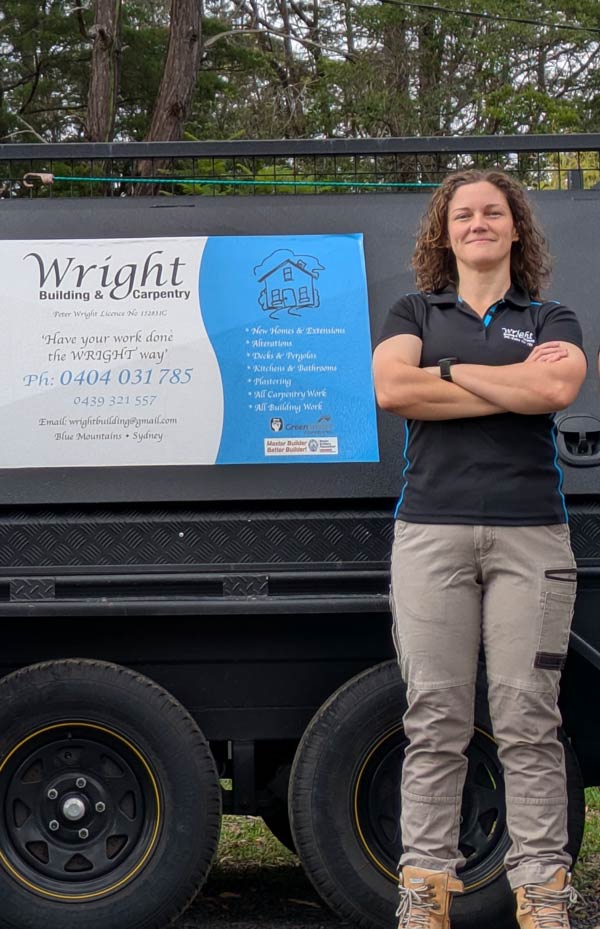
How have you found being a mature woman working in a traditional male environment?
I've been lucky to be working with my best friend.
He has always had confidence in my ability to do everything that any man in the industry can do.
Just because I'm smaller and a woman doesn't make me less capable.
I may have some minor strength differences simply as a matter of physiology, but regular work in the gym and being smart about how I tackle heavy work doesn't slow anything down.
Tell us about your upbringing. What shaped your attitude towards money?
I grew up in housing commission in a small country town in Victoria, so I'm no stranger to being tight with finances.
I had a job from when I was 14 and did shifts after school and on the weekends to help pay for food and clothes.
I've always had a strong work ethic, and understanding of what hard work can accomplish.
I put myself through university in Melbourne by living in share housing and working whenever I could, until I graduated and started working at the Royal Melbourne Hospital.
What is the best money advice you've ever received?
Stop using a credit card!
I stopped using a credit card during my apprenticeship, because it's easy to spend money on it, then realise you don't have enough in your savings account to pay it off at the end of the month.
I use a credit card now but I always pay it off in full at the end of the month so I don't pay interest.
Finish this sentence. Money is good for...
Surviving.
While I was an apprentice, I had to change the way I thought about money, and limit my spending to things I needed to survive: rent, food, fuel and bills.
I had to find other ways to spend my time that were free.
Luckily in the Blue Mountains, where I live in NSW, that wasn't too hard to do.
I made sure that every now and then I put aside a bit of money to do the things I really enjoyed, like Latin dancing or Brazilian jiu-jitsu, or just going out for a coffee and breakfast, but otherwise the focus had to be getting through my apprenticeship without losing all of my savings.
Get stories like this in our newsletters.