Simon Sheikh grew up in public housing, now he runs a $13.9b super fund




Simon Sheikh grew up in public housing, caring for parents who were struggling with illness while the family survived on welfare payments. Today, the founder of Future Super helps oversee $13.9 billion in retirement savings and plans to leave most of his wealth to charity, a decision shaped by the lessons he learned growing up.
Simon Sheikh had a difficult childhood where money was short.
He grew up in public housing and was the primary caregiver for his parents.
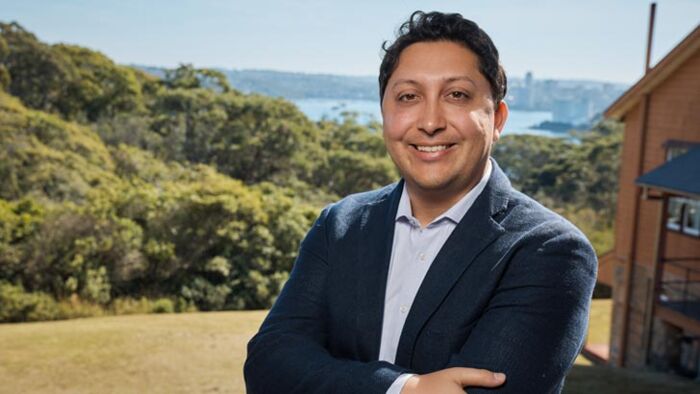
This first-hand experience of disadvantage has fuelled his commitment to improve the world and his careers, first as a social activist and, more recently, as the founder of ethical super fund Future Super.
"We're here to do a very simple thing, and that is to try to build a planet that's worth retiring into," says 40-year-old Simon Sheikh.
With 415,000 members and $13.9 billion in funds under management, Future Super doesn't invest in fossil fuels and aims instead to drive social impact with its investments, which Sheikh says can also deliver strong risk-adjusted returns.
Sheikh grew up in Sydney as the primary carer for his mother, who had a mental illness, and for his father, who had had a heart attack.
Both parents were still grieving the loss of a daughter before he was born.
Money was tight.
He grew up in public housing and was the beneficiary of "the amazing social safety net in this country" that allowed him to attend primary school, albeit a socio-economically disadvantaged school.
"Even though I grew up in a situation where we were living day-to-day off government welfare cheques, my parents were quite thrifty and didn't gamble or drink alcohol or smoke cigarettes," he says.
"I had a minimum level of comfort. That meant that I was already ahead. We had a little bit of money left over at the end of each week for private tuition."
His parents placed a high value on education.
His father had done his homework under the only working street light in his neighbourhood in Pakistan and ultimately won a scholarship to come to Australia. The private tuition, which his father paid for by taking on extra work, led to a spot at the Fort Street selective high school in Sydney.
For the first time, Sheikh came across students from middle-class backgrounds, who always had full school uniforms, and saw how disparate outcomes were for different people.
"I started to learn some early lessons about money through actually experiencing and witnessing what income inequality was doing for people and to people," he says.
From public housing to Future Super
He was offered several university scholarships, and not having anyone in his social circle who could advise on the best choice, selected the degree with the largest scholarship, a Bachelor of Commerce at UNSW.
He joined NSW Treasury as an analyst at the end of his first year and combined work and study.
Paul Keating was Prime Minister, and Sheikh started to notice how his observations about life connected with Keating's broader political narrative.
Volunteering to help set up the Australian Youth Climate Coalition resulted in Sheikh becoming the national director of left-wing activist group GetUp! at the age of 22.
He was propelled into the national consciousness when he passed out on ABC current affairs show Q&A live on air.
Explaining what happened, Sheikh says he had been battling the flu and had had a sleepless night while he wrestled with the decision to leave GetUp!.
"Not a week goes by where I'm not stopped on the street by someone who remembers that, unfortunately," he says.
"Not a week goes by where I'm not stopped on the street by someone who remembers that, unfortunately."
Simon Sheikh on fainting live on ABC current affairs show Q&A.
How Simon Sheikh founded Future Super
During a failed but surprisingly close attempt to win a Senate seat for the Greens in the ACT in the 2013 election where Tony Abbott won power, Sheikh learned about the power of money and the scale of Australia's super system, which prompted him to found the Future Group, in particular Future Super.
"I realised that if our Federal government was going to be less involved in driving climate action, we needed to make sure that people's everyday investments could fill the gap," he says.
"And so we started our business to be able to align people's money with their values. Future Super is a for-purpose company owned by employees, impact investors and some private equity investors, and focuses on ethical and impact investing.
"Because we've got a disproportionate focus on ethical and impact investing, we can find the opportunities to show people that they can make strong financial returns from these investments and that we can manage risk."
How ethical investing can drive returns and impact
Along with seeking good returns for members, the fund looks for investments where it can make an impact, and where other investors can later come and scale up its work.
One strategy is to invest in sectors supported by government initiatives to bring investment into those sectors.
"We were very early in investing in solar farms in Australia, when there was strong government support, [which provided] downside protection for those solar farms. Those same dynamics now are playing out in social housing, which is a space we're leaning into," he says.
Most of Future Super's investment in these sectors is in credit, so that it sits higher up in the list of creditors should something go wrong.
"We like the risk-adjusted returns and the downside protection that gives our members in different market environments," he says.
A more recent investment is in microfinance bonds, which are used to provide loans to women in developing countries to start their own businesses.
Future Super worked with World Vision to aggregate microfinance bonds, lowering the cost of borrowing for the women and providing a "really good" return for members relative to the risk they were taking.
Like other super funds, Future Super offers a range of options, varying in the amount of asset protection and growth they aim to provide.
Its Renewables Plus Growth option provided an annual return of 5.81% from inception in May 2018 to May 2025. Its Balanced Index option has grown 6.56%pa over a similar period, and its Balanced Growth Pension option has grown 7.41%pa.
Why Future Super avoids fossil fuel investments
Beyond the direct impact Future Super's investments are making, Sheikh says there is also a longer-term effect.
When capital markets deploy money into investments that are good for the planet and people, it means they are moving money out of sectors such as fossil fuel.
This shift in the demand and supply of capital increases the cost of borrowing for companies such as coal miners, making it more difficult for them to fund new coal mines.
Future Super also screens out fossil fuel companies from all of its funds.
Unlike some other funds, which exclude fossil fuel companies from their investments but will invest in companies that have a small amount of fossil fuel, its investments have no direct exposure to any fossil fuels.
How the Future Super founder invests his own money
Sheikh's approach to his own money could best be described as thoughtful and deliberate.
He and his wife are very intentional about how they spend their money, always trying to live within their means and spend money in a way that aligns with their values.
A rare extravagance was to break with the family's habit of holidaying in Australia or Asia and heading to Finland to see the Northern Lights.
"We also try to live a life where philanthropy is not something we plan for tomorrow. It's something we do today," he says.
The family has started a sub-fund at the Australian Communities Foundation, which provides a tax-effective way of setting up a small charitable foundation while keeping administration costs low.
Each year they allocate some of the budget to social and environmental charities, involving their 10-year-old son in the decisions.
The latest project is to help fund a micro forest in their local community.
The Sheikh family's biggest investment by far is their stake in the Future Group business. When he started the business they put everything they had into it, house-sitting because they didn't have enough money to pay the rent.
Now they also have a few high-risk investments in start-ups, and like most successful start-up investors, most have failed but those that have succeeded, including Amber Energy, have more than made up for the failures.
All this means they need downside protection, so the family went to an insurance broker to ensure they had life insurance beyond that which comes with superannuation.
The surprising decision to leave most of his wealth to charity
Finally, they plan for the long term, having already made a will.
Most of their money will be left to charity, with only a modest amount to go to their son when he turns 35, should they die early.
"We think that's really important, because we all know that when people leave money to their children it can often be wasted," he says.
How much money Sheikh will leave is an open question and he declines to comment on whether his stake in the Future Group has the potential to make him significantly wealthy. Certainly, the fund has grown strongly.
Sheikh says that when Future Super launched, there was no super investment option that didn't have at least some exposure to fossil fuels.
The offering resonated with younger investors in particular, with the fund attracting 500 members in its first month and becoming cashflow positive after 11 months. Revenue has grown an average of 58%pa for the past four years.
"At the end of the day, there's a long-term tailwind behind ethical investing," he says.
"There may be moments where it goes out of fashion in the media, but even during those moments, people are continuing to switch their super and add contributions."
Get stories like this in our newsletters.


 Reply
Reply