How to invest in Australia's data centre boom




Every day we tap into masses of digital information. But what does it take to power the hardware that facilitates the storage and processing of this data load?
In an age where so much of life plays out online, it's easy to forget that there's a physical nervous centre behind almost every digital interaction you have.
Every email you send. Every tap of your debit card. Every photo you upload. All that information will either be stored in or processed through a data centre.
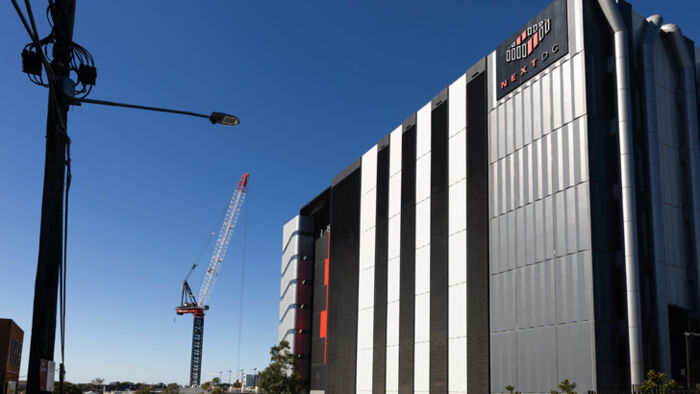
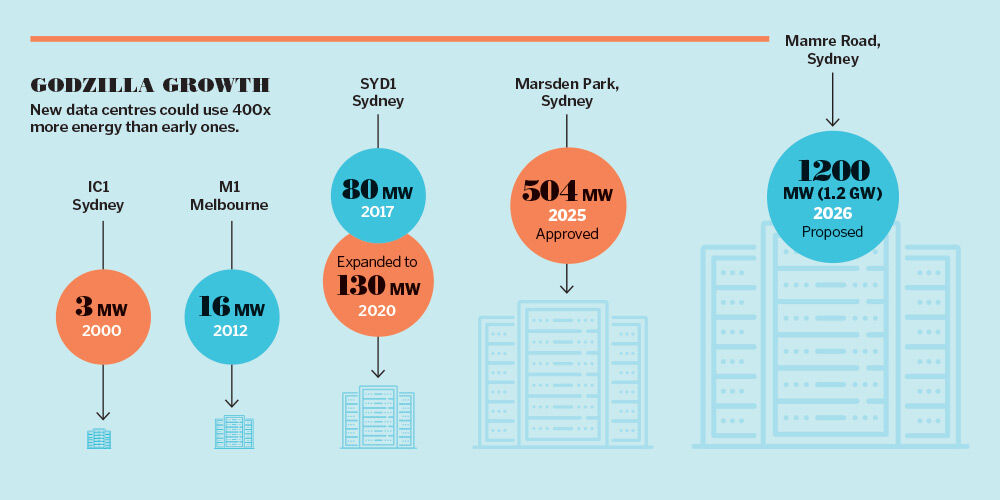
While their prominence may have grown, data centres aren't new. What is considered to be one of Australia's first data centres was opened by Macquarie Telecom (now Macquarie Technology Group) in Sydney back in 2000.
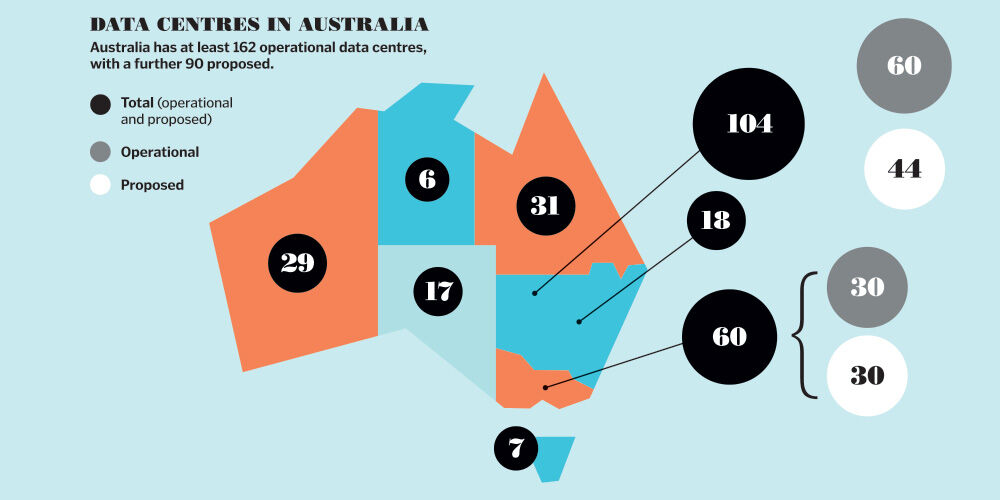
There are now 162 data centres operating across the country, according to a report released by Data Centres Australia in April. The same report indicates that a further 90 are in the pipeline, with the vast majority set to be built in NSW (44) and Victoria (30).
Australia is also emerging as one of the most attractive destinations for data centre investment, with Knight Frank research ranking it second only to the US in 2024, attracting about US$6.7 billion ($9.55 billion) in investment.
"There is huge uptake globally, but Australia is very appealing for data centres," says Associate Professor Joel Gilmore, an energy expert at Griffith University.
"We have a strong and stable regulatory environment; we have land available with proximity to fibre cables; we have a strong grid; and we have the ability to develop new renewables at scale.
"We are also strategically well positioned for Asia-Pacific connections, so strong links to the Asian market, which is helpful for data centres trying to minimise lag and maximise transmission."
What do data centres do?
At their simplest level, data centres are factories of computing power, explains Dr Amr Omar, a research associate at the School of Mechanical Engineering at UNSW.
They house the hardware that facilitates the storage and processing of all that digital information that forms a part of everyday life.
"When you use Netflix or stream online, these videos are stored in data centres. You're pulling that data from these factories onto your phone or your TV when you go to watch them. And that process happens very quickly, in a fraction of a second," says Omar.
Inside these facilities, that computing power and speed is made possible with racks and racks of servers, CPUs (central processing units) and, increasingly, GPUs (graphics processing units).
"You have some servers that are only for data storage, so banking systems, government data storage, or files in the cloud," says Omar.
"Then you have CPUs that are dedicated to simple computational needs, like sending emails, and GPUs that are mostly used for AI."
Scaling up: The cloud, AI and data centres
As our digital appetites have increased over the years, so too has the scale and sophistication of the data centres being built to serve those needs.
The advent of cloud computing triggered the first shift. As organisations and individuals moved onto the cloud, warehouses packed with servers began to replace individual server rooms in offices.
AI has changed the game again in recent years, requiring data centres, often purpose-built AI factories now, that can support the prodigious amounts of energy needed to power AI-related processing.
"If you think about a CPU, it can do simple calculations very quickly, while a GPU can do multiple calculations at the same time. This is very important for AI," Omar explains.
"With AI, there's two things happening: every time you send a prompt using ChatGPT, Claude or Gemini, the prompt is used to train the model while also providing an answer to the user.
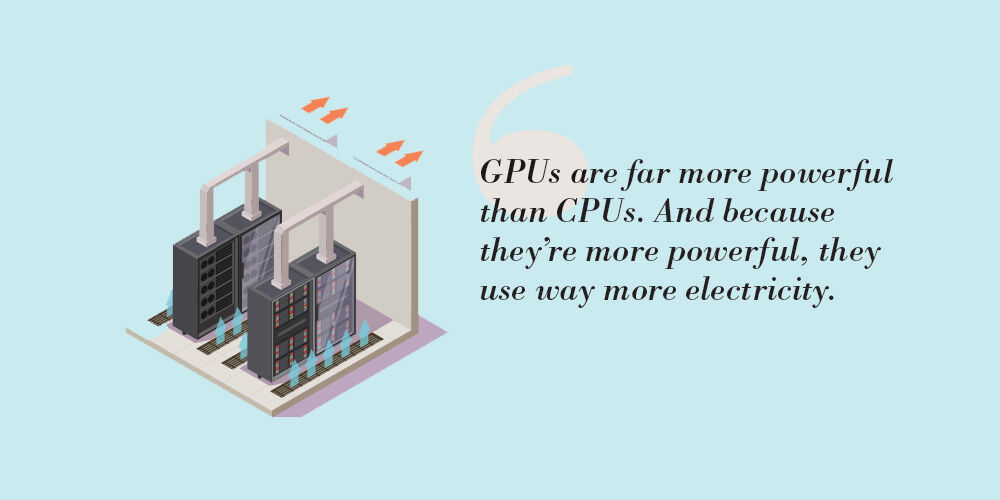
"These GPUs are far more powerful than CPUs. And because they're more powerful, they use way more electricity. For context, a GPU rack could use at least 10 times more electricity."
With all that electricity comes a great deal of heat that needs to be dealt with.
"As we transition to more powerful GPUs, we use liquid-to-chip cooling where we supply a very cold refrigerant all the way to the server level," Omar says.
"That's important, because as these GPUs warm up, they become less efficient, so you need to make sure that they operate in a very cold environment."
In practice, this all means that data centres are becoming far more than run-of-the-mill warehouses full of servers.
"These modern data centres have all the cooling technology, very powerful power distribution units, power quality sensors, electricity generators, fire suppression systems, all sorts of infrastructure," says Omar.
How much energy do data centres use?
As AI and the data centres that are powering it scale up, their broader energy demands are becoming harder to ignore.
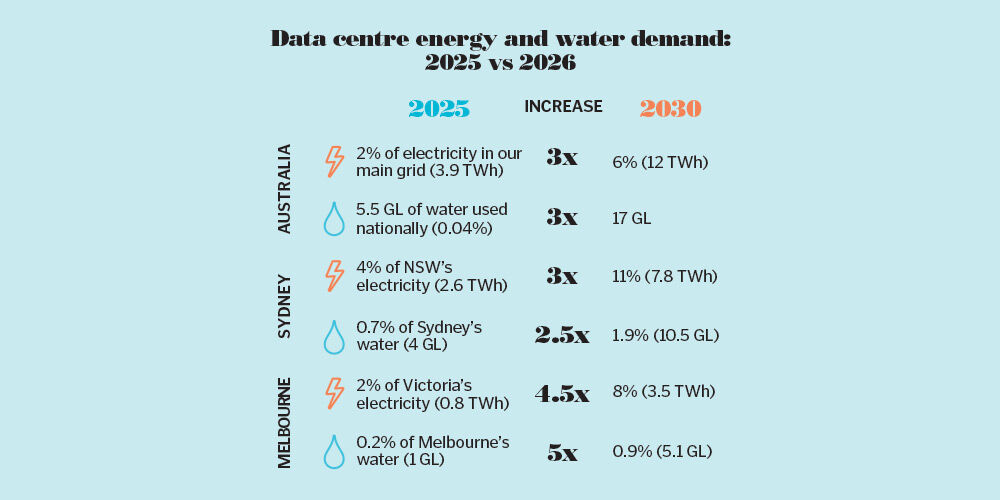
In the 2024-25 financial year, data centres are estimated to have used about 2% of the electricity in the National Electricity Market, a report published by the Climate Council suggests.
That's equivalent to the electricity use of about 700,000 homes.
The same report indicates that the share of electricity used by data centres from the main grid is forecast to rise to 6% by 2030 and 12% by 2050.
"There are data centres that will have more load than our smelters. Aluminium smelters are one of our largest single users of electricity in Australia, and one of these proposed data centres will have 25% more load," says Gilmore.
One of the outstanding questions is how this energy need will be met. As Gilmore explains, if it doesn't come from new supply, that extra demand is only likely to push prices higher for everyone.
"Independent modelling suggests that, based on current projections, if we don't build new capacity, new renewables and firming alongside those data centres, wholesale prices could rise by up to 26%.
"So, if it's not done in a sustainable, controlled way, we will see everyday Australians paying higher electricity bills because of those data centres."
Beyond their appetite for electricity, data centres can also consume significant amounts of water as part of cooling processes. In the worst-case scenarios, Gilmore says the usage can be huge.
"If you use the least energy efficient approach, single data centres can use 16 Olympic-sized swimming pools worth of water every day to cool them.
"But there are much more energy-efficient, water-efficient designs. The best case is closed-loop cooling, like the radiator of your car.
"This is where you fill it up once with one or two swimming pools' worth of water and then you don't need to keep topping up because it uses air-conditioners and circulating water to manage that."
Firmus: Australia's next big IPO?
While investors have had slim pickings when it comes to Australian-listed, pure-play data centre stocks, that could be about to change.
Rumours are swirling that Firmus Technologies, an Australian-registered company headquartered in Singapore, is seeking to list on the ASX later this year.
While nothing has been confirmed by the company itself, the initial public offering (IPO) had allegedly been mooted for July, but recent reporting suggests the timeline has been pushed back to September.
According to Samy Sriram, market analyst at Stake, the listing could be significant.
"If it does happen, it's also going to be a fairly large listing. It's rumoured to be targeting a valuation between $8 billion and $12 billion. That's not unrealistic, considering that the last time it raised capital, its valuation was above $7 billion."
Founded in 2019 by Tim Rosenfield, Jonathan Levee and Oliver Curtis, Firmus operates across two key areas: building and operating AI factories, and providing cloud access.
The company positions itself as a developer and operator powering the "green AI revolution", with a focus on designing AI infrastructure that is more energy- and water-efficient than conventional data centres.
Firmus already operates two AI factories in Singapore and is developing additional AI factories and supporting infrastructure across multiple Australian sites.
Sriram says one of the company's most compelling features for investors is its relationship with Nvidia.
"Nvidia has this habit of investing directly in suppliers and companies that it's working with, so that's a vote of confidence in the company."
"For investors and the market itself, an Nvidia endorsement in the form of a capital injection is really a catalyst to invest in that stock themselves. We've seen that with other names in the AI space where Nvidia has committed about $2 billion in strategic partnerships."
Why investors are paying attention
For all the concerns around energy and water use, the reality is that demand for data centres is exploding in Australia and abroad, and markets are taking note.
In large part, that's because data centres and AI have become inextricably linked, and if there's one theme that has driven investor enthusiasm in recent years, it's AI.
"AI and data centres are really reshaping how the world works. By virtue of that, they're reshaping how most stock indexes look today," says Samy Sriram, market analyst at Stake.
The best example of this impact can be seen in the S&P 500 index. As Sriram points out, tech giants and major players in the AI space, such as Alphabet, Amazon, Apple, Broadcom and Nvidia, have been responsible for much of the recent growth in the index.
"Excluding those big tech names that are really driving AI, the S&P 500 would be up just 16% in the past two years. But when you add them back in, it's up 42% over that same period."
Predictably, investors are jumping on board, with Sriram noting that there's been a marked uptick in allocations towards the AI thematic among investors on the Stake platform.
"There's definitely a lot of investment and interest from a retail investor point of view in companies at the forefront of AI and data centres. Whereas some of those names in consumer staples, in consumer discretionary and in healthcare aren't seeing quite the same amount of love."
Ultimately, Sriram suggests that the US-listed tech giants involved with AI, including in Australia, may be among the better options for investors wanting to get exposure to data centres and AI more generally.
"For Australian investors, that could look like investing in mega-cap stocks like Nvidia, Microsoft, Amazon and Google, which are really driving this narrative, committing to AI spend and directly funding Australian capacity.
"These companies have trillions of dollars in market cap, they have a large portion of cash on their balance sheet, and while their capital expenditure is high, the risk of investing in them is perceived by many investors to be a lot lower, because you're getting a much bigger stock."
How can investors get exposure to Australian data centres?
There are investment opportunities beyond the mega caps, including at home. While the options aren't extensive, it's possible for investors to gain exposure to the local data centre industry by way of Australian-listed companies and funds.
NEXTDC (ASX: NXT)
Along with the likes of AirTrunk and Canberra Data Centres, NEXTDC is one of the largest players in the Australian data centre space, with the firm currently operating 17 data centres. It also has five more in the pipeline.
The difference is that NEXTDC is listed on the Australian Securities Exchange (ASX), which makes it one of the better options for investors looking for direct exposure.
"If you're looking at a single stock in Australia, it would probably be NEXTDC. It's the country's largest pure play data centre operator," says Sriram.
"It offers hyperscale-grade capacity, and it has headline partnerships with higher potential upside, but also higher capex risk that comes with that."
Macquarie Technology Group (ASX: MAQ)
While ASX-listed Macquarie Technology Group isn't solely focused on the space, data centres are one of the four core parts of the business along with cloud services, government and telecom.
"Macquarie Technology Group is another name that comes to mind. It's a government-certified operator that serves about 42% of Federal agencies," says Sriram.
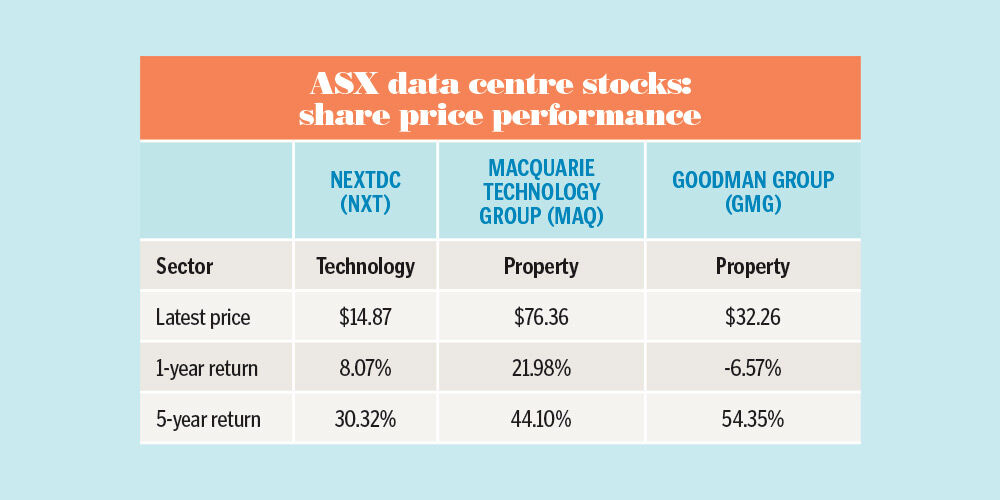
"It has a new 47-megawatt Sydney facility on track for September, and its stock price has done fairly well, up about 18% in six months to June."
Goodman Group (ASX: GMG)
Given that a lot of the data centres operating in Australia are foreign owned, Sriram says that a more roundabout way to get exposure to the local sector is through real estate.
"The companies involved in building these data centres out, and responsible for the real estate behind that, are actually seeing a lot of investor interest at the moment.
"Goodman Group is one name that comes to mind. It's a large, listed property group, and about 68% of its $12.4 billion development pipeline was data centres, as of last September.
"It is a little bit more volatile, but that tends to happen with certain stocks like Goodman and real estate investments in general."
Global X AI Infrastructure ETF (ASX: AINF)
Beyond individual stocks, investors can also tap into the data centre boom through thematic exchange traded funds (ETFs), which can provide exposure to companies involved in the broader ecosystem.
One example is the AI Infrastructure ETF from Global X. Launched in April 2025, the fund is up more than 82% as of mid-June.
"The Global X Artificial Intelligence Infrastructure ETF gives investors exposure to companies supporting the data centre build out," Sriram explains.
"These aren't companies running data centres themselves. Instead, they're the copper and uranium producers, the utilities companies and the engineering and material firms that are contributing to the wider build out."
Get stories like this in our newsletters.