AI real estate photos: what's legal - and how to spot fakes




Online property listings are no longer just photographs - they're increasingly AI-enhanced marketing tools. And while many real estate agents use artificial intelligence to make homes more appealing, the line between polishing a listing and misleading buyers is becoming alarmingly thin.
AI can now lighten rooms, remove clutter, replace furniture and insert features that don't exist. When these edits are used without clear disclosure, buyers may be forming expectations about a home that no inspection can meet.
As regulators play catch-up, the responsibility for accuracy still sits squarely with agents.
In October 2025 alone, more than 13 million Australians visited listing platform realestate.com.au. As a highly visual medium, online platforms have helped fuel demand for compelling photos.
But in this digital age, photographs may not always be completely accurate.
One Reddit user reports seeing a home advertised for sale, with images showing a big deck, thriving veggie patch and a straw-roofed hut described as a 'meditation room'.
An inspection revealed the deck was taped off due to rotting and unsafe timbers, the veggie patch was a weed-filled dust bowl, and the meditation hut had been split in half by a fallen tree. Apparently, the listing photos dated back to when the home was first built - 30 years ago.
How professional staging pushes up property prices
An increasingly popular trend is professional 'home staging'.
That's where the owner's much-loved though less photogenic furniture is replaced with rented designer furnishings.
It's legitimate, and it can be financially rewarding.
Stewart Bunn, communications and corporate affairs manager at First National Real Estate, says home staging can add around 5-10% to a final sale price.
The catch is that professional staging doesn't come cheap.
According to Hi-Pages, home staging can cost from $1500 to $8000-plus. This doesn't include the cost of offloading your old furniture, or paying for storage while it's hidden from public view.
The rise of artificial intelligence (AI) has seen a far cheaper solution emerge.
The rise of virtual staging
'Virtual' staging refers to the practice of editing photographs to fill empty spaces with new furniture, removing clutter from furnished homes, or making a property appear lighter and brighter.
For the seller, virtual staging can be quick and affordable. It can cost as little as $45 for one room if the process is outsourced to a third party.
Even that modest fee is being driven down by AI. Some services charge as little as 23 cents per image for virtual staging.
This raises two issues:
Is virtual styling any good?
That's debatable.
Home buyers tend to be a canny bunch. They are, after all, making one of the biggest purchases of their life. So it's natural to take a close look at what's on offer.
And alas, virtual staging can be heavy-handed.
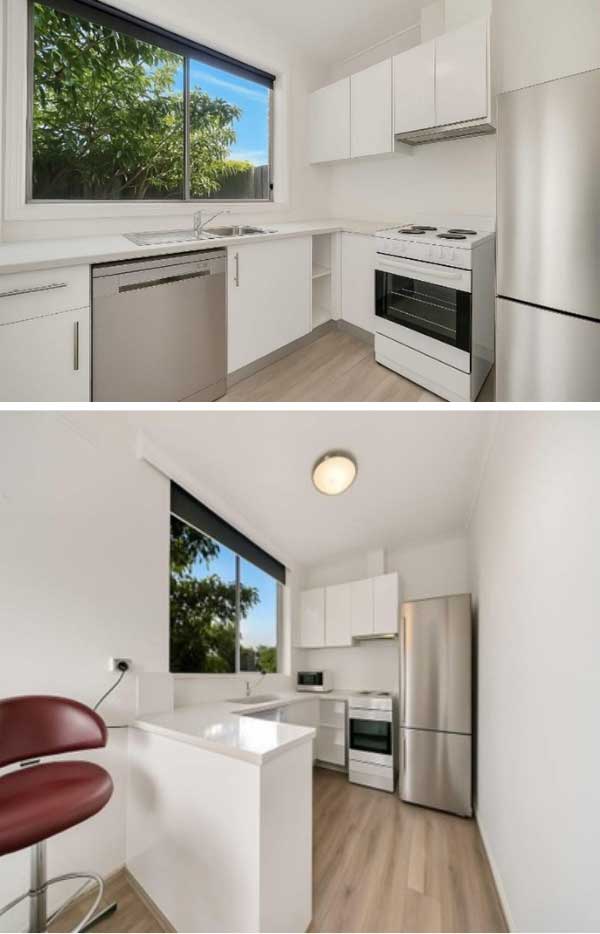
A Melbourne villa advertised for sale in late 2025 featured a kitchen that differed markedly between shots - something likely to raise buyers' eyebrows.
Is virtual styling even legal?
Under Australian Consumer Law, which is administered by the Australian Competition and Consumer Commission (ACCC), selling agents must provide truthful and complete information about a property including its features.
However, the ACCC doesn't handle laws specific to property sales and rentals. These come under state and territory control though the basics still apply.
Real estate agents in NSW, for example, must ensure photos used to advertise homes are accurate, clearly labelled, and not misleading.
Similar rules apply in Queensland. Digital 'enhancements' that artificially lighten the colour of walls, or alter rooms or outdoor areas to look bigger than they really are, are regarded as misleading.
Even so, as Stewart Bunn points out, "Low-quality AI virtual staging absolutely pushes into risky territory.
"If AI alters layouts, finishes, fixtures or sightlines in a way that a reasonable buyer could rely on, the risk is real, even if a disclaimer is included."
How agents are editing images to add non-existent features
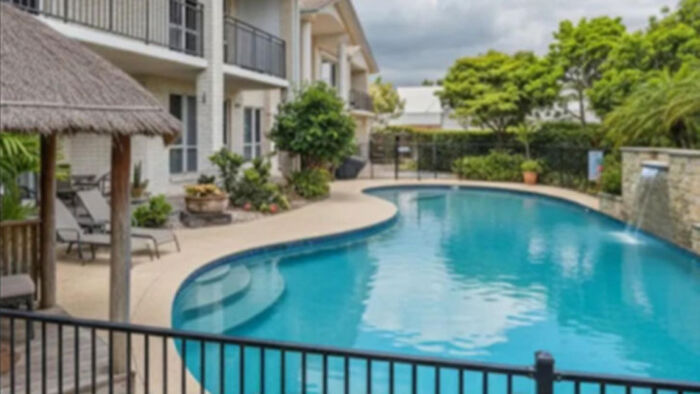
At the thin edge of the wedge, one Reddit poster came across an ad for a Queensland property featuring a swimming pool with an attractive water fountain.
The issue? Neither the pool nor water feature are real.
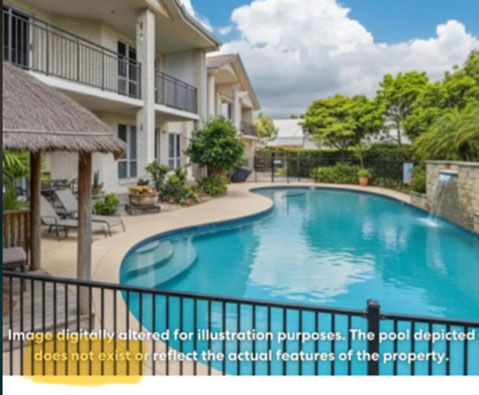
While the ad noted the image was digitally altered "for illustration purposes", Bunn cautions, "That is drawing a very long bow."
He adds, "Even where an image is labelled or disclosed, the initial visual impression carries weight.
"Buyers scan listings quickly. Many will see the image before reading the fine print.
"If the headline image depicts a feature that does not exist, such as a pool, the advertising is skating dangerously close to being misleading."
Bunn continues, "From a professional standards perspective, this is behaviour the industry is actively discouraging."
Reddit users were also critical of the practice.
"Even ignoring the ethical issue here, this is so stupid," commented Reddit user Lucky-day00.
"If I want a house with a pool, I'll go to check the place out, see it has no pool, and move on. And probably actively avoid listings from that agent because they waste my time.
"Or, if I actively don't want a pool (which is the case for me), I'll see the pool in the ad and move on.
"It repels both markets."
Another user, Extension_Branch_371, said: "This needs to be made illegal if it isn't already. And realestate.com and domain etc need to stop accepting these photos."
While parksofficeninenine added, "Wtf is even the point. If every house for sale has a photoshopped pool there would be no point in looking at houses. It just becomes pictures on the internet... Get this shit off real estate listings."
New NSW laws aim to stop misleading rental listings
In mid-2025, the NSW state government introduced legislation that doesn't just safeguard the personal details of renters, it also requires disclosure when images in rental ads have been altered to conceal faults.
It's a step in the right direction, especially as Sydney's vacancy rate is a wafer thin 1.8%.
More broadly, for the one in three Aussies who rent their home, time wasted checking out dud properties can mean missing out on a decent rental.
How California is cracking down on AI in property images
On the other side of the world, the US state of California has introduced new laws, effective January 1, 2026, which require real estate professionals to disclose the use of digitally altered or AI-generated images in property advertising.
Anything from minor edits (like lighting) to substantial changes such as adding or removing grass must be declared to give buyers a clearer, more accurate visual understanding of a home before they visit.
It's a fair bet that right now plenty of Aussies aren't sure about taking a leaf from any US playbook.
But legal requirements to show a property for what it really is can save valuable time as 2026 shapes up to be a competitive market for buyers.
Get stories like this in our newsletters.