The career threat facing every generation right now




AI is reshaping careers, hybrid work is under pressure and ageism remains a reality for older workers. Here's what Australians of every generation are up against, and how experts say they can stay ahead.
It's a brave new world out there in the workforce. In the space of a generation, workplaces have changed radically, and it's creating opportunities for some, while others may be struggling to keep pace.
We still refer to the nine-to-five grind, but rigid working hours are fast becoming a relic of the past. Australian Bureau of Statistics (ABS) data shows that 30% of employees work flexible hours - and one in three of us works from home.

Despite these advances, it can be easy to yearn for simpler times when we clocked off work at 5 pm, had the rest of the day to ourselves and enjoyed reasonable income security.
Today, one in five employees - about 2.4 million people - works on a casual basis. A similar number of employees doesn't have guaranteed minimum hours, making it hard to plan ahead.
There are many stressors in the modern workplace.
Pressure to meet deadlines, schedules and key performance indicators mean we are under intense pressure to be always 'on'. It's made the eight-hour working day a pipe dream for many.
Unions NSW says Australians typically work nine hours of unpaid overtime each week - and it's costing us about $21,563 annually.
The situation reached a tipping point in 2024 when right-to-disconnect laws were introduced, allowing employees to refuse to monitor, read or respond to the boss's emails outside of working hours. We're also more likely to be white collar workers - more Australians (about 34%) hold university degrees than ever before.
This has fuelled the rise of jobs that are less physically demanding than blue collar jobs. The downside is that more than 5.5 million people are entering the workforce with a five-figure HECS debt.
The biggest workplace challenges reshaping every generation
Deloitte Access Economics partner David Rumbens, points to "structural changes in the labour market", notably the rise of artificial intelligence (AI).
According to Rumbens, demand for roles involving routine tasks is weakening, while demand for trades, physical roles and human-centred services continues to expand. So, who will win, who risks falling behind, and what steps can we each take to shore up our value in the workforce?
Here's how different generations of Australians are dealing with the challenges of today's workplace including real people who have made the workplace work for them. We show what each generation wants and tap into expert advice to get there.
Gen Z: Building a career in the age of AI
While all generations of workers are concerned about losing their jobs to AI, a recent Finder survey found this fear is highest among Gen Z professionals, with two in five worried they'll be replaced by AI.
Those fears are not without foundation.
Anglicare Australia's annual jobs availability snapshot confirms entry-level roles are among the most vulnerable to automation and AI because they often involve routine or standardised tasks.
Reflecting this, entry-level jobs now make up only 11% of all job vacancies - the lowest share in a decade.
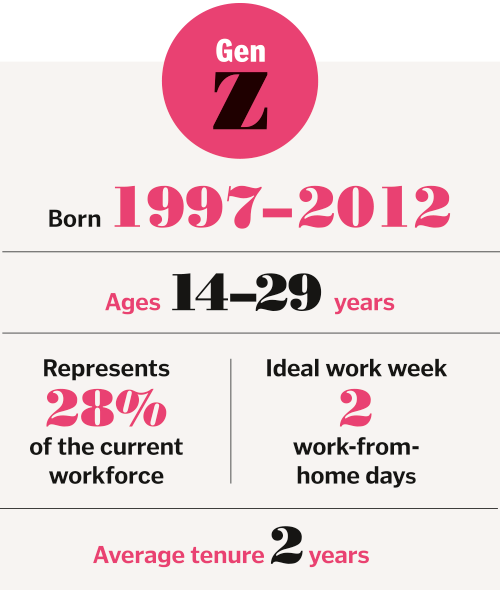
Will AI replace entry-level jobs?
Graham Cooke, consumer insights analyst at Aussie Insights, says, "The risk isn't just about robots taking over jobs, it's about roles quietly shrinking, hours being cut and fewer opportunities coming through the door."
Despite the concerns, global recruitment agency Robert Half's director Tom Ward says AI is broadly being embraced by workers, with 83% believing "generative AI skills are now necessary for career success".
"There is some pushback," he adds.
"But it is mostly a trust issue, not a technology issue.
Employees will embrace AI when it helps them do better work, but they push back when it feels like a surveillance tool or a shortcut that ignores quality."
It seems plenty of Gen Zs are embracing AI at work even if it is with cautious optimism.
Sarah Carney, Microsoft ANZ's national technology officer, says 78% of Gen Z workers have introduced a new AI tool, shortcut or hack that was later adopted more broadly.
Three in five (61%) have built or customised an AI agent, proactively looking for ways to automate part of their job.
That said, Carney points to an emerging digital divide that risks creating a two-speed workforce where some young employees race ahead with AI, while others are left behind.
Carney says, "AI should be a launchpad for every worker, not a privilege for a few. Especially for young professionals whose entire careers will be shaped by how they harness AI.
"Even in heavily regulated sectors, the answer isn't to stand still; it's to adopt AI safely and responsibly, because there is also the risk of doing nothing."
How Gen Z workers are building multiple income streams
Bernadette Schwerdt, author of Secrets of the New Online Entrepreneurs, says "Gen Z don't clock off; they just switch income channels. The idea of a single job as a safety net is an outdated concept.
Where security for Gen Xers used to be a salary, for Gen Z, it's a portfolio.
One income stream is risky, so for them, multiple streams is the go-to strategy."
According to Schwerdt, freelancing, content creation, micro businesses and digital products run in parallel, with each adding a layer of protection to ward off a restructure, redeployment or realignment.
"They no longer rely on one employer, but build a system that can move, adapt and deliver a pay cheque, no matter what happens to them, the economy or the world."
That change demands a different kind of mindset. As Schwerdt notes, "Creativity is no longer a hobby; it's a revenue model. Gen Z are looking at their skills, interests and experiences through a commercial lens, asking: how can this be monetised?"
Managing all of this requires discipline. "For Gen Z, the 9-5 funds the 5-9," says Schwerdt.
"Their primary job provides stability, but the real opportunity resides in the side hustle. Gen Z aren't job stacking; they're risk spreading.
"They are building income streams that scale independently of their time, using platforms and audiences that offer optionality."
Careers are no longer a series of steps on a ladder to the top. For Gen Zs, every skill is an asset and every asset can be monetised. Constant reinvention is the name of the game and knowing their next job probably doesn't exist yet, means everything that happens today is an opportunity for tomorrow.
Why one future lawyer doesn't expect one career for life
A job for life is a thing of the past. But so is a career for life.
Research suggests the average Australian will have at least three careers during their working life. Gen Z could have as many as seven.
Nicholas Terrell, 20, is studying to be a commercial lawyer, but he doesn't see this dominating his career path.
"I think careers are a lot less linear today," he says.
"There's more movement between roles and industries. "I don't see myself doing just one thing for my entire career. I want to start in law and build a strong foundation, but I'd be open to moving into other areas."
Workplace mobility - how frequently we change jobs - is highest among younger Australians. Like many of his generation, Terrell has no expectations of staying in the same job long term.
"I'd say two to four years in a role provides enough time to properly develop skills and actually contribute." While salary is Terrell's top priority when choosing an employer, remote working and flexible work also matter.
"Life comes before work and a workplace that recognises this is doing a far better job than the alternative," he says.
And he's "not overly concerned" about the possible impact of AI on his career.
"I think it'll change the nature of work more than replace it," he says.
"More repetitive tasks are already being automated. That means there's more of a focus on judgement, strategy and client-facing work."
Gen Y: Caught between housing costs and career change
The resilience of Gen Y (Millennials) has to be admired.
They copped the global financial crisis early in their careers and have seen property values skyrocket 43% nationally in the past five years, while wage growth has limped along at a little more than 3% annually.
But Millennials have a few aces up their sleeve.
They are the first generation to have employer-paid super throughout their entire working lives and have benefitted from first-home buyer incentives from the First Home Owner Grant, launched in 2000, to, more recently, the Federal government's 5% deposit scheme.
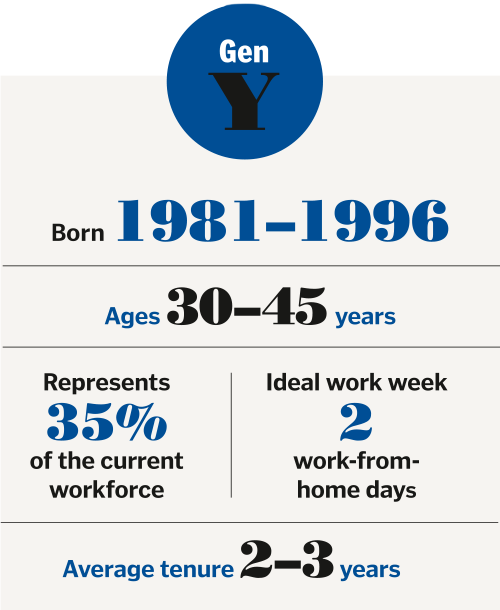
Why Millennials won't give up hybrid work
For many Gen Ys, the COVID pandemic shifted the dial on workplace expectations and many are lukewarm about returning full-time to formal workplaces.
On the plus side, Robert Half's Tom Ward, says, "Employers are still willing to offer hybrid work.
"In fact, the 2026 Robert Half Salary Guide found that 43% of Australian employers say working from home and hybrid work options have the highest usage among their staff."
Still, the market has shifted.
"Hybrid is still very much alive because employers know it helps attract and retain talent," says Ward.
"But businesses are under pressure to maintain productivity, collaboration and team culture. As a result, many employers are now setting clearer expectations around office attendance, rather than offering full flexibility by default."
Notions of loyalty to an employer have changed too. "Loyalty today is less about tenure for tenure's sake and more about whether the employer delivers an experience people believe in," says Ward.
"Culture and flexibility matter much more than they used to, but they are not silver bullets.
"Employees are less willing to stay somewhere that no longer fits with how they want to work or what they want from an employer."
Should you pay off HECS or buy a home?
Like Gen Z, Millennials are likely to have a hefty HECS-HELP debt.
But Vince Scully, financial adviser and founder of Life Sherpa, says, "HECS-HELP remains the lowest cost debt available," he says.
"It also dies with you. And the government is developing a habit of writing off chunks of it." However, it's different if you're in the housing market. Scully says,
"A single person earning the average weekly earnings for a full-time adult, of $2051, with no other debts could borrow $470,000.
"With a typical HELP debt of $29,000, this would fall to $414,000. So, using $29,000 of savings to repay a HELP debt could leave them with more to spend on a home."
Scully adds that engagement with super is "critical" for Gen Ys, but says, "the fund that's right for you now may not always be".
"When your balance is low, fixed fees matter. A $1.50-a-week fixed admin fee is 0.78% of a $10,000 balance. This is usually more than the investment fee. Look for a fund that has only asset-based fees. As your balance grows, returns and asset allocation become more important," he adds.
"At $50,000, that $1.50 weekly fee is a much more respectable 0.16%." Interestingly, Scully cautions against making additional contributions at a young age.
"The trade-off for the tax benefit is that you don't get to spend the money until you turn 60. Don't forget about super, but focus on aspects outside super until you are more settled - like having the home loan under control, eliminating consumer debt and holding investments outside of super."
The redundancy that changed everything
Plenty of Gen Ys are discovering that career experience is no protection from the tap on the shoulder that spells redundancy.
Human resources specialist, Lyra Jai, 32, found herself on the receiving end of redundancy in mid-2025.
"I wasn't completely shocked," says Jai.
"I was managing the (company's) redundancy processes at the time, so I knew where things were heading.
"The overall morale in the company had dipped quite a bit, so moving on didn't feel like a loss so much as a natural next step." Fortunately, Jai received a job offer before her redundancy payment ran out. Even so, the experience cemented what really matters to her in a job.
"Perks such as remote or hybrid working are a big one for me, probably because I've been working in a hybrid setup since COVID," she explains.
"It's hard to unlearn the joys of not having to sit in traffic each workday or give up the freedom to throw on a load of laundry between meetings."
Jai says she would now find it hard to join a company without a strong hybrid policy.
"To me, flexible working reflects a level of trust. It means you have leadership believing that their people are capable and responsible, and don't need to be watched to do good work."
Jai and her husband recently became first homeowners though this meant added pressure to hold onto a good job.
"It's really exciting to finally have a place we can call our own," says Jai.
At the same time, it comes with a sense of responsibility. I feel more motivated to stay financially stable and contribute as much as I can to our household."
Gen X: Squeezed by ageism, AI and retirement
Gen X has faced unique generational challenges. They were the first to pay for a tertiary degree.
They had to navigate the global financial crisis at the outset of their careers and later adapt to the COVID pandemic.
Today, many Gen X hold leadership roles, although they can still face workplace threats.
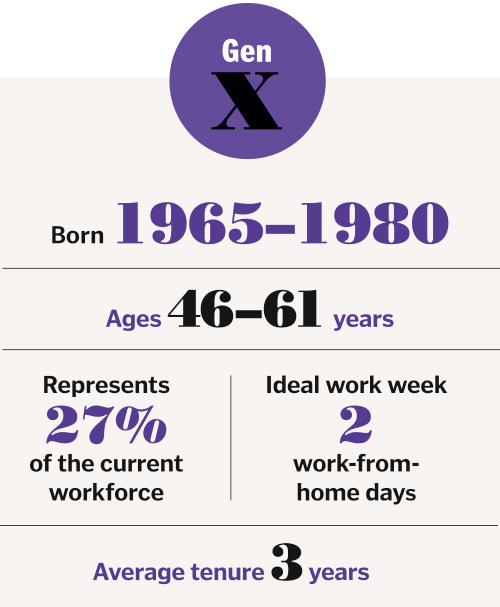
Too old at 50? The growing ageism problem
A survey by the Australian Human Resources Institute found one in four (23%) employers now classifies over-50s as 'older' workers, more than double the proportion (10%) in 2023.
This suggests Australians may be considered 'old' long before they plan to retire and well in advance of the average intended retirement age (65).
And if Gen X doesn't feel threatened by younger, cheaper and more digitally savvy jobseekers, they may fear the looming spectre of AI.
According to Boston Consulting, over the next two to three years, almost half of jobs in the US will be reshaped by AI.
This doesn't necessarily translate to job losses, but it can see workers face radically new expectations for how they work. Career expert Robyn Greaves, says, "Artificial intelligence is accelerating change, but it is highlighting also the value of deeply human capabilities."
She explains, "Experience is not just knowledge. It is judgement, pattern recognition, perspective and the ability to navigate complexity. These are strengths that tend to deepen over time. The key is to make that visible."
Greaves says this means demonstrating curiosity and engagement with new tools, including AI, showing how experience translates into better decisions and outcomes.
In a plus for Gen X, Greaves is confident that as work becomes more complex, their ability to interpret, guide and connect becomes more valuable, not less.
The super and mortgage dilemma
For Gen X, outdated skills are less about ability and more about pace and pressure.
Rapid change is the primary driver, compounded by practical constraints, such as limited time to upskill (29%) and uncertainty around which skills are now required (21%).
Gen X are often at the peak of their earning power. The flipside is that they may be facing peak expenses - a home loan and school fees, coupled with the need to grow super savings.
Financial adviser Shaun Ganguly believes Gen X can crisis-proof their finances by building a cash buffer equal to "three to six months' worth of expenses, held either in cash or available in an offset account, if anything goes wrong."
He recommends reviewing personal insurances too, adding, "When something goes wrong, you want options, not panic."
As for super, Ganguly says most people focus on their balance - usually with the $1 million threshold of savings in mind.
"That was a marketing gimmick from an industry fund and it's the wrong starting point," he says. "You need to start with the lifestyle you want." He says the key is to convert a super balance into income.
"That's where most people get lost. A number on a statement doesn't tell you what you can safely spend."
As Ganguly notes, salary sacrifice is a useful way to grow super savings, especially if you have a stable salary. Personal deductible contributions are typically better for people with variable incomes such as business owners.
"You can wait until year end, see your income position, then contribute to super and claim the deduction. The real opportunity is carry-forward contributions. These are available if your super balance is under $500,000. But timing matters because older unused caps expire."
One of the challenges Gen X faces is paying down their home loan ahead of retirement.
More than one in four (27%) Gen X expects to have a mortgage when they retire.
Is it better to focus on paying down a mortgage sooner or tuck extra cash into super?
Ganguly says, "Higher income earners tend to benefit more from putting money into super. You're turning income taxed at up to 45% into contributions taxed at 15%, with the benefit of concessionally taxed investment earnings.
"For lower income earners, paying down the mortgage can be more effective. It's a guaranteed, tax-free return and your home is exempt from the age pension assets test."
Why more Gen X workers are becoming their own boss
Running your own show is often seen as one of the great Australian dreams and, when thrown out of the workforce, Gen X is turning that dream into reality and becoming their own boss.
The Committee for Economic Development of Australia (CEDA) says that more than one in 10 (13%) adults aspires to business ownership as part of their career journey.
But starting an enterprise from scratch isn't easy. CEDA chief executive Melinda Cilento, says, "New and small firms often have fewer resources to navigate regulation, secure finance or compete against established incumbents."
The solution can be to buy an existing business with a proven track record.
Simon Winter, principal of Raine & Horne business sales, says, "Higher interest rates can boost demand for business acquisitions. But it boils down to risk versus return.
"Nobody would buy a small business unless the return is there. There are very few small businesses that have a really low risk.
"I'm talking about post offices, childcare centres and maybe a few others that derive much of their revenue from government sources."
Winter adds that about 80% of businesses he sees listed for sale are coming onto the market because the owners wish to retire - and the sellers are typically motivated and flexible when it comes to price negotiations.
Even so, buying a business calls for plenty of homework.
"Due diligence is not necessarily that complicated," says Winter.
"The three issues to address are income, gross profit and expenses. Income can be confirmed by looking at a tax return - nobody's going to overstate their income in a tax return.
"Or look at a BAS (business activity statement) that declares sales results.
"When you're looking at expenses in a business, if you look at wages and rent alone, you'll find they generally represent 60%-70% of expenses, with inventory costs making up the balance.
"Probably the most important aspect of due diligence is meeting the owner," says Winter.
"That's a chance for the buyer to ask whatever questions they want and gauge their sense of trust in the owner."
Business operations specialist and founder of Auvie Consultants, Lyn Nguyen, says 'boring' businesses could easily be overlooked but they can offer lucrative opportunities.
"Boring businesses are the unsexy ones," says Nguyen.
"Those that don't typically attract attention or headlines. Think waste management, solar panel cleaning or pest control.
"These businesses tend to be consistently profitable, in steady demand and, in many cases, more resilient during periods of economic uncertainty. They're also less exposed to disruption from technology, including AI, because they rely on essential, hands-on services."
How divorce sparked a second career
Gen X couples are especially vulnerable to separation and divorce. If it happens, it can radically overhaul the work patterns of one or both partners.
That was the case for Fiona Knodler, founder and managing director of NSW-based Leave it to me Cleaning.
Knodler, 56, had previously worked as a truckie. By the time she and her former husband separated eight years ago, she had been a homemaker for 15 years.
When the dust settled on her divorce, Knodler walked away with both the family home - and the mortgage.
With two primary school-age children, she needed to return to work but faced a wall of hurdles.
"I could only work school hours," says Knodler.
"And when I applied for jobs, my age, lack of tech skills and the fact I'd been out of the workforce for 15 years worked against me."
But when the going got tough, Knodler found a solution.
She launched her own professional cleaning service.
It ticked the boxes for flexible work hours, low capital requirements, and plenty of demand.
One in three Australians outsources household jobs to the tune of $6 billion annually. Hard work, attention to detail and sheer determination has seen Knodler's business bloom.
Today, she leads a team of employees, with cleaning contracts that span residential properties to the defence industry. Her workplace journey, while not easy, has been rewarding.
"I'm getting to the point where I am finding out who I am," says Knodler.
"I am proud of what I have achieved personally and professionally.
"The next step is to work on the business, rather than in the business - if that happens I could keep going for another 10 years."
Baby Boomers: Why retirement isn't what it used to be
One of the most significant changes to the workforce occurred 34 years ago, yet its impact is only being felt today.
Compulsory employer-paid super, introduced in 1992, has seen about 18 million Australians - close to four in five of us - build retirement savings, one of the highest coverage rates in the world.
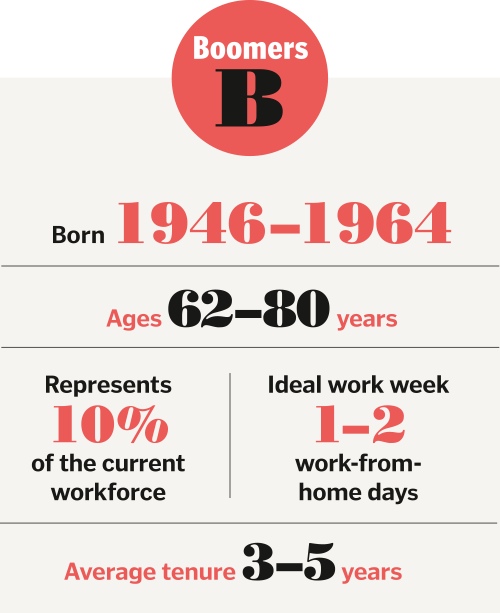
Retirement is being rewritten
While this has helped the Baby Boomer generation retire with more of a nest egg, they also face the prospect of greater longevity. One in two (48%) Australians aged 50 to 66 is worried they will run out of money in retirement.
At the same time, Boomers are realising that employment offers more than a regular income.
Staying in the workplace for longer doesn't just stretch out super savings, it also provides non-financial benefits - a sense of purpose, social connection and mental stimulation.
The catch is that holding onto an existing role or scoring a new job isn't always easy as we age. Boomers can come up against the brick wall of ageism in the workforce.
Robyn Greaves, career change expert and author of Your Third Chapter says, "Many of the assumptions we hold about ageing and retirement come from an outdated model of life and work.
"For decades, careers followed a predictable path: build, peak, then step back," she says.
"That model no longer reflects reality. We are living and working longer, and many people still have the energy and desire to contribute in meaningful ways well beyond traditional retirement age."
One option for Boomers keen to stay in the workforce is to move beyond the advertised job market into portfolio, advisory and project-based work. Greaves says this is "often where the most meaningful and flexible work sits".
Many later-career opportunities can emerge through conversations and referrals.
"Organisations are increasingly looking for people who can solve specific problems, bring perspective and lead through complexity, often without a full-time hire," says Greaves.
"To access this, people need to shift how they position themselves. That means moving away from listing past roles and towards clearly articulating who they are now, how they work and how they add value today.
"When you focus on contribution rather than chronology, age becomes far less relevant."
How to make your super last through retirement
From age 60, it's possible to access super through a transition-to-retirement pension (TRP).
But Shaun Ganguly, founder of Prime Years financial planning, urges caution about using a TRP.
"Investment earnings are taxed at 15% within a TRP," he says. You are forced to draw down funds and, if markets drop, this could mean crystallising losses by selling depressed assets."
Ganguly adds, "The tax savings aren't always there for higher income earners, especially under 60. Plus the income drawn out is generally subject to income tax (with an offset).
"But you really need to know what the taxable components (of super) are. I've seen DIYers with unexpected tax bills."
The upshot, he says, is to get advice before drawing on super ahead of full retirement.
From age 65, the tables can turn.
It's possible to access super whether you're working or not and, at this point, Ganguly says, "The biggest risk for most people isn't running out of money, it's being so scared that they never actually spend it properly.
"I see this constantly. People go into retirement with a decent (super) balance, then spend like they're about to go broke, it's like they live their best years in fear.
"Longevity risk shows up as underspending, not overspending for most," says Ganguly.
According to Ganguly, one of the most effective ways to manage money in retirement is by "income layering".
He explains this isn't about "having one big account-based pension and hoping it lasts", but instead blending an account-based pension with:
- A guaranteed income, through the likes of a lifetime annuity, to cover essential costs
- Investments, such as shares, property, managed funds and investment bonds, for discretionary spending, and
- Accessing the age pension where possible.
"This helps with the psychology of fresh money coming in, so people actually enjoy spending their money after a lifetime of hard work, while leaving something for the kids/grandkids," says Ganguly.
Made redundant in her late 50s
For Janelle Turek, 63, a change to her work prospects came hard and fast.
In her late 50s, Turek found herself staring down the barrel of redundancy, despite 40 years of experience managing quality control across some of Australia's largest television networks.
"I was so angry," says Turek.
"It was pure ageism. My employer could hire younger, less experienced workers who cost less.
"To rub salt into the wound, it didn't matter that my replacements had less experience because so many systems and processes were becoming digitalised."
With rent to pay and ageing parents to care for, Turek needed an income stream fast.
"I soon realised that when no money is coming in, your savings start to run down very quickly," says Turek.
"I needed a job that at least let me pay the bills."
However, as she approached 60, Turek found her options narrowing.
She took on jobs in meat-processing factories, where long hours standing at production lines in near-zero temperatures took a toll on her physical health.
A fresh career 'break' came about a year ago when Turek landed a role as retail assistant at a local pharmacy.
"I really enjoy the job," says Turek. "The hours are flexible, I have lots of contact with local community members and I have built close relationships with my customers."
While Turek is confident her super savings will help her enjoy a comfortable retirement, she has no immediate plans to stop working.
"I'm physically healthy, I enjoy the social contact of the pharmacy and, frankly, none of us likes to believe we are getting older - retirement to me still seems a long way off," she explains.
Get stories like this in our newsletters.