Diary of an ETF Beginner: I took stock tips from an influencer




When an influencer convinced me gold was worth a look, I decided to invest $10,000. What followed was a crash course in emotions and investing.
Now that I've got a decent chunk of money invested into a select few exchange traded funds (ETFs), I've realised I'm just getting into the hardest part of this journey.
You see, I thought after I'd done the mental gymnastics of choosing my investments, it would all be smooth sailing and I could just sit back and watch my (virtual) money (hopefully) grow.

But I've now realised this process is a little more emotional than I expected.
The morning after: am I checking my portfolio too often?
I found myself checking my portfolio every few days, mostly out of curiosity rather than anxiety, which I reasoned was probably what most sane people would be doing.
But I'd be lying if I said I felt completely indifferent.
I'll admit, seeing more red than green in my portfolio raised my heart rate a smidge... Imagine how I'd feel about the daily fluctuations if this were my own hard-earned cash!
It's funny how quickly your brain starts playing games with you.
When my portfolio was in the green, I found myself feeling surprisingly smug, but the moment one of my assets dropped into the red?
My brain immediately scrambled to find a logical justification - anything to avoid admitting I might've picked a dud.
What surprised me most about investing
Another thing to combat is the head noise. The investment world is loud, and almost everyone has an opinion on what you should or shouldn't invest in.
You're hit with endless information online, conflicting expert opinions, unsolicited advice from mates, and drama-filled headlines designed to incite panic.
I'm an over-thinker at the best of times, so there's no way I could watch the 6pm news each night without feeling the need to tinker with my assets, buy new ones or make a rash decision to sell something that's dropping in value.
Reminding myself how little daily fluctuations matter in the long term is something I'm still working on.
Why investing can feel uncomfortable
To understand why those fluctuations make my heart race a little faster some days, I reached out to psychologist and behavioural economist Phil Slade.
He told me it's totally normal to second-guess decisions, like wondering if you chose the right ETF, so long as you avoid taking things personally.
"When we own something, even notionally, our brain just treats it as ours and we want to avoid the pain that's attached to loss. We over-index pain over gain," explained Slade.
Much of the discomfort felt from a loss is due to emotional attachment, so treating your investments as a separate entity - or someone else's money - is a tactic Slade says will help reduce irrational reactions to negative market changes.
"You need to consciously not think that they're your shares. They're just shares that you currently own.
"You can try to reduce the ownership over it and depersonalise it as much as you can."
This relates directly to loss aversion.
As humans, we're wired to avoid pain, which is why losing money stings far more than making an equivalent amount feels rewarding.
"Often in order to have the equal amount of feeling good at a gain, you need twice as much good. So $100 will feel as equally good as what losing $50 would feel (at a loss)."
Five signs you're becoming emotionally attached to your investments
If any of these sound familiar, you're not alone.
- Checking your portfolio multiple times a day
- Feeling proud when investments rise and annoyed when they fall
- Looking for information that confirms your investment choice
- Considering selling after reading a negative headline
- Taking market movements personally
The fix: Focus on your long-term plan rather than daily price movements.
The beginner mistakes I nearly made
There are a few classic pitfalls that first-time ETF investors fall for, and one of the biggest involves people treating it like a quick trade, according to eToro's lead analyst Josh Gilbert.
And while this isn't such an issue for me, getting guidance from the wrong people might be.
After revealing my latest investment - a cool $10,000 in State Street's SPDR Gold ETF (GLD.RTH) - was inspired by a social media influencer, Gilbert offered some sobering advice.
"Social media has become a huge tool for investors to get market news and information, but it shouldn't be your only source of guidance," he said.
"There's no problem with using social media for inspiration, but it shouldn't be seen as advice. Do your own research, understand what you're buying and look for trusted sources."
I wish I could blame it on the virtual money mentality but truth be told, gold really did seem like a good idea!
Of course, right after I bought it, gold dipped slightly but looking at the fund's long-term performance, I'm not worried.
Where my portfolio stands today
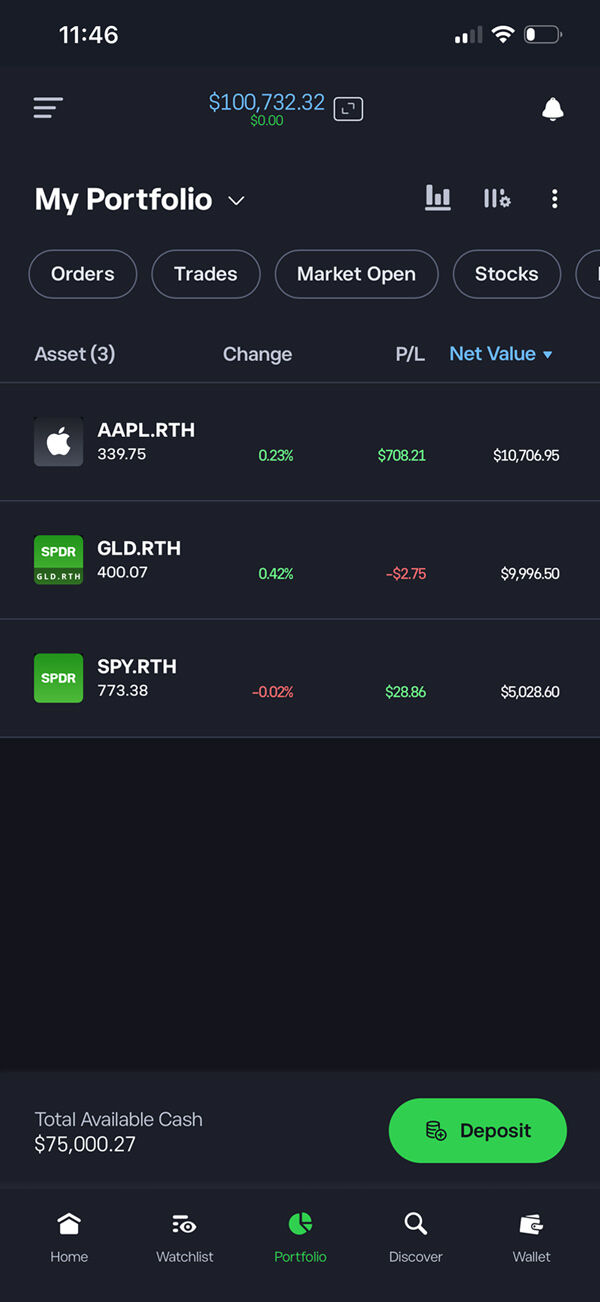
I'm glad to report that since my initial $15,000 investment into the SPDR S&P 500 (SPY) and Apple (AAPL), plus the addition of a gold ETF ($10,000), I'm in the green!
Where I stand right now
💰 Started with: $100,000
📈 Invested so far: $25,126
🏦 Current portfolio value: $100,732.32
🎉 Gain to date: +$732.32
💵 Cash still waiting to be invested: About $75,000
Of my investments, Apple has been the standout performer, and the current result is an extra $730 in my account.
It's nice to see a solid increase but realistically, if this were my own money, I wouldn't have thrown $25,000 at the market right off the bat, so the return wouldn't look quite as dramatic.
What happens next?
Now that I've survived - maybe even thrived during - my first few weeks of "owning" ETFs and watching my portfolio move, it's time to get tactical.
In part three, I'll be taking a deep dive into how to compare ETFs, striking the right balance between Australian and international exposure and what fees to be aware of when you start trading.
Oh and I think it's time to spend - er, I mean invest - some more money. After all, I've got $75,000 still sitting there, so I might as well put it to work.
Now to figure out where...
Next in Diary of an ETF Beginner: In part three, I'll compare ETFs and decode the fees. Plus, I still have $75,000 left to invest. Let me know in the comments what I should invest in next.
Get stories like this in our newsletters.