Why ex-cop Peter Baines ran 1400km across Thailand




Peter Baines has quite the resume. During more than 22 years with the NSW Police, Peter led teams responding to terrorism and natural disasters, later advising Interpol, the UN and the Saudi Arabian government.
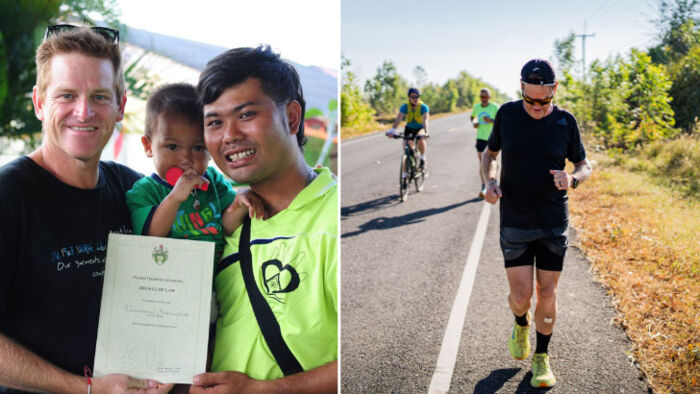
In the wake of the Boxing Day tsunami, Peter founded Hands Across the Water, a charity that has raised more than $40 million and transformed the lives of thousands of orphaned Thai children. In 2024, Peter completed a 1400km run across Thailand to mark 20 years since the tsunami.
His book, Together We Can, explores this mission through the heat of Southeast Asia, proving that what may look like an individual achievement is always powered by community.
Tell us about your career in law enforcement. What insights did this give you into society?
I saw the worst of humanity when I was doing forensic work at crime scenes.
Greed, drugs, domestic violence - the horrific toll that loneliness and the drain on mental health has on society.
So many times, I would investigate a scene where an elderly person had been dead in their apartment for weeks at a time. I often wonder, how could someone lie dead on the floor for that long without anyone noticing? Without anyone missing them? That stuck with me.
From there, you worked in major crises internationally, including the Bali bombings and the 2004 tsunami. How did that shape you?
They were both defining moments. The Bali Bombings was the first major terrorist event Australia had experienced on that scale. I was part of the forensic team deployed to identify the 202 victims, 88 of whom were Australian.
I was then positioned as one of the senior forensic leaders in Australia.
Without Bali, my profile might not have been known on the national stage. When the Boxing Day Tsunami occurred, Australia responded. I was called upon to deploy into Thailand to lead both the Australian and the international forensic teams. It's there in Thailand where I had my greatest impact.
Has money ever been a consideration in your career or personal life choices?
When I was with the police, I was on a fixed salary and no overtime. You got paid what you got paid regardless of what time you spent. So, money was never the driver.
But beyond the individual accumulation of financial wealth, I look at the impact of what I did and how that translated into a financial return. It was significant, but not for me personally.
I went on to work for Interpol and counter-terrorism, and during that time I was paid to share my stories across the corporate circuit. It was these speaker fees that I used to build the first home for the kids in Thailand, and this is where the charity started.
You started Hands Across the Water in 2005. What services does it provide?
Originally, the goal was to build and open that one home for the kids who lost their parents. But going over there, I realised we had just started.
Now the charity's purpose has moved from just being related to the tsunami to reflecting the needs in Thailand. We provide shelter, food and employ local staff. We look after their medical needs.
One of the homes that we took on in 2010 was a home that dealt with a lot of kids who had HIV.
They had a high mortality rate because they didn't have enough money to access medicine. When we learned about that, we took responsibility. We ensured then that they all had access to money, and we stopped the kids dying. So that's a direct result of the financial benefit Hands Across the Water provides.
What financial hurdles did you face in setting up and funding the charity?
When we started, I had to consider how we would finance us. Who funds the staff? How will we meet our operational costs? Rather than asking our donors for money, we asked ourselves: how can we be self-sufficient?
We're now running several sustainable agriculture projects, and I believe that within five years, they will fully cover our operational costs and make us self-sustainable.
How is your charity model different from traditional approaches?
I've taken a different view on how we should operate as a charity. With 60,000 charities in Australia, staying relevant can't just be about Thai kids - that's not on most Australians' radar.
So, we must do things differently. Our model shifts charity support from a cost centre to a profit centre. In tough economic times, donations are often the first to go.
But that's when people need more support. If supply drops while demand rises, it's not a good model. But if people see that the benefits of being involved outweigh the costs, they'll stay engaged. That's how we build partnerships.
One example is our corporate bike rides in Thailand. Teams spend five days cycling together, building strong relationships.
Many join thinking they're helping others, but leave recognising the personal and professional benefits. Our first core partnership began in 2013 and continues today. We don't want to exist because people feel sad or guilty, but because we create value for everyone involved.
You ran 33 marathons in 26 days across Thailand last December. What was the aim?
The first goal was to raise awareness in Thailand. We are the largest Australasian charity contributing to Thailand, but most of our funding comes from Australia or New Zealand. We need Thais to support Thai kids. The second aim was to raise $1 million and the third was to commemorate 20 years since the Boxing Day Tsunami.
How did you sustain your motivation during all those hours of running?
First, I'm no marathon runner. I had only run one marathon before I started training.
But I went in with a rock-solid commitment to get it done.
I knew if I didn't finish, it would haunt me for the rest of my life. The darkest time I experienced was on day 14 when I got shin splints, which turned into a stress fracture. Each day started at 4.30am with my wife sticking needles in my feet to drain my blisters. There were some difficult points.
Some days it was nearly 40 degrees and the humidity was incredible, so I was drinking 15-20 litres of fluid a day and still losing up to three kilos. But I never struggled for motivation. Two words stuck in mind: privilege and commitment. Without question, it was the hardest thing I've ever done, but also the best. I'm so grateful.
What does financial freedom mean to you?
The first thing that comes to mind is choice.
That's how we measure success in Thailand - not by money raised or the number of homes built, but by the choices available to the kids when they leave school.
For me personally, financial freedom means having the choice in how I spend my time. I work on the farm, travel to Thailand monthly, meet my commitments, and live comfortably. But the real reflection of success is the choice we're creating for the kids and their communities.
What's one piece of money advice you'd give your 20-year-old self?
To work hard and enjoy the fruits of your labour.
Please finish this sentence: Money is good for...
... creating a positive impact for those who don't have health or wealth.
Get stories like this in our newsletters.