How to make sense of your energy bills and save




There was a time when receiving a letter was something to look forward to - the days of penfriends and birthday cards. Now it's mostly bills with your eyes drawn straight to two dreaded words: amount due.
Among those bills, the power bill often stands out as the most confusing. Tariffs, usage rates and fees blur together. You skim it, slap it under a fridge magnet and vow to deal with it later.
Buried among all the dullness, however, are vital clues to how you could cut costs.

With the average two-person household paying $322 per quarter for their power usage and 40% of Australians struggling to afford it, understanding your bill could lead to real savings.
Somewhere near the dreaded amount due, you might notice additional information prompting you to consider: could you save money on another plan?
"It's supposed to be your energy provider's cheapest offer for you," says Liz Stephens, public affairs and strategy general manager at Energy Consumers Australia.
"It's based on how much energy your household or business used over the past year."
Where the electricity savings are hiding
If you live within the National Electricity Market (NEM) - comprising Queensland, NSW, ACT, South Australia and Tasmania - energy companies must include best-offer information on your electricity bills every 100 days or, in Victoria, every three months.
Even without the prompt to look into a cheaper plan, Stephens says it's worth asking. "Call your provider and ask if you're on the best offer... they must tell you."
The savings can be significant.
According to the Australian Competition & Consumer Commission (ACCC), customers on plans that are more than a year old pay $238 more per year than those who have taken up new offers. And more than 80% of NEM households could pay less for their power by switching to a new and cheaper provider.
So, why would four out of five Australians stay on more expensive plans? A recent CHOICE investigation discovered that even when providers included the 'best-offer' message, the plans often had the same name as the one the customer was already on despite being cheaper.
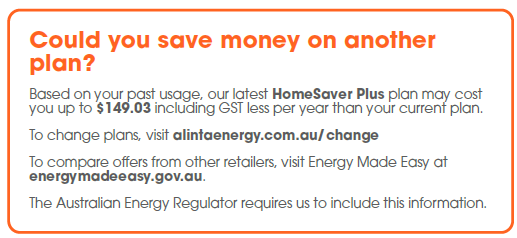
For example, in the best-off message (see graphic A, above), the customer was already on the HomeSaver Plus plan, just not the latest.
The upshot is that the best-offer message lacks transparency; its meaning isn't immediately obvious. It states: 'our latest HomeSaver Plus plan may cost you up to $149.03 including GST less per year than your current plan'.
For clarity, it should say instead: 'our latest HomeSaver Plus plan may save you up to $149.03 including GST per year than your current plan'.
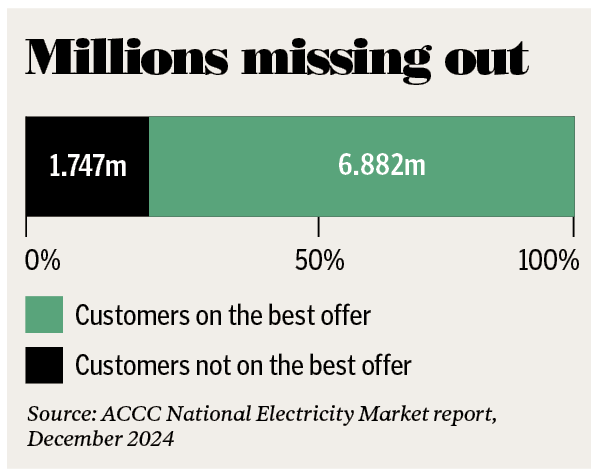
Out of 382 bills reviewed, 64 included an indirect best-offer message, potentially leading to customers missing out on an average $171 a year, simply because they didn't switch to the newer version of the same plan (see table below).
"If you haven't changed electricity plans in the past 12 months, chances are you are paying more for your electricity than you need to," says ACCC commissioner Anna Brakey.
Actual vs estimated readings on energy bills
Is your bill based on an actual or estimated reading? If you don't know the answer, it could be costing you.
Estimated readings, which may occur if a meter reader couldn't access your property or if you pay monthly, are calculated based on past usage or average area consumption. This should be clearly labelled on your bill.
"Estimated bills can result in bill shock," warns Stephens. If you were over- or under-charged, your next bill will adjust to match the actual usage. That can mean unexpected costs or refunds.
Smart meters remove the guesswork by sending usage data directly to your provider. A meter reader doesn't need to visit your property and you're billed only for what you use.
"If you don't yet have a smart meter and want to ensure an actual reading, you are also able to provide your retailer with your own meter reading before the due date on your bill," says Stephens.
"Once you provide your own reading, your retailer must promptly provide you with an adjusted bill based on the reading you give them."
Get to know retail tariffs
Fewer than 20% of Australians know what a retail tariff is or what type they are on, according to Energy Consumers Australia.
For those who do not know, a retail tariff is simply the price you pay for the electricity you use from your retailer. However, there are multiple types of retail tariffs. Here's a quick guide:
Flat rate (single rate) Same rate for electricity, no matter the time of use. Ideal for those who use power consistently throughout the day.
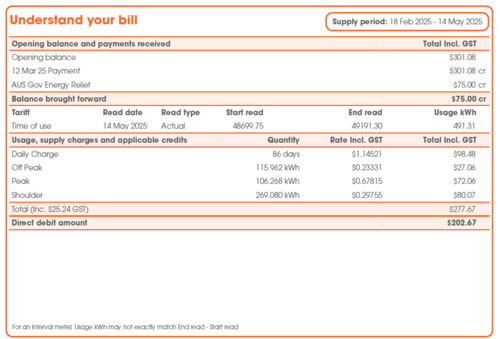
Time of use Different rates for peak and off-peak times. Sometimes you will be charged for a 'shoulder' period, with a rate between the peak and off-peak rate. Useful if you can shift usage to cheaper times.
Controlled load Lower rates for specific appliances (such as hot water systems) connected to a separate circuit, restricted to off-peak hours.
Demand charge A charge based on your highest energy use during peak periods. Managing usage spikes can help you save (see graphic B, above).
Information overload
Australia's electricity market is notoriously hard to navigate. "There's no other service as unnecessarily complicated as energy.
Our research shows only one in five people knows the plan they're on and understands how they're being billed," says Stephens.
"The problem isn't a lack of information: consumers tell us they switch off because they are overwhelmed by the amount of information out there."
According to Energy Consumers Australia's Consumer Energy Report Card, 54% of people just want reliable supply, good customer service and a fair price. But 46% want to be more hands-on: monitoring usage, switching plans or generating their own power.
Stephens believes stronger consumer protections are needed. She supports a "duty of care" to ensure retailers treat customers fairly and promote better outcomes.
"We also want to see 'one-stop shops' that will help consumers find trusted, reliable and well-publicised information on energy," she says.
Ask for help - it's your right
If you think your bill is wrong or you simply can't afford to pay it, Stephens says the first step is to call your energy provider.
"They're obligated to help you, and the sooner you ask, the sooner you can get a solution. Remember, it's your right to ask for help."
According to Energy Consumers Australia, your retailer may offer:
• Flexible payment plans or billing cycles
• A review of your energy plan and usage patterns
• Payment matching or hardship assistance
• Suggestions on reducing usage
• Access to concessions or rebates you might qualify for.
"If you aren't satisfied with how your retailer has dealt with your concerns, you can contact the Ombudsman for your State or Territory," says Stephens.
How to take control of your power bill
• Check for sneaky fees. You might be charged for paper bills, late payments or credit card use.
• Read the fine print on deals. Discount and sign-up perks may only last a short time. Know
what you're paying for after the honeymoon period ends.
• Know your rights. Energy companies must give at least five days' notice before making changes that will affect your bill.
Source: Energy Consumers Australia
Get stories like this in our newsletters.