The $13,800 card hiding in a childhood collection




A Pokémon card recently sold for $23 million, but experts say valuable treasures could be hiding much closer to home. Jonathan Marin, one of Australia's leading trading card valuers, has seen everything from childhood collections containing cards worth $13,800 to a $1.7 million collection stored in a garden shed.
Pikachu. Even those not well-acquainted with Pokémon will recognise the yellow, mouse-like creature with the lightning-bolt tail. What might come as a surprise is that a card bearing Pikachu's image recently became the most expensive trading card ever sold.
In February, a mint condition 'Pikachu Illustrator' Pokémon card was purchased at auction for a cool US$16.49 million, about $23 million. That may seem an astronomical sum for a relic from a children's game, but Pokémon cards, along with other trading cards, have become a serious collectable category in their own right.
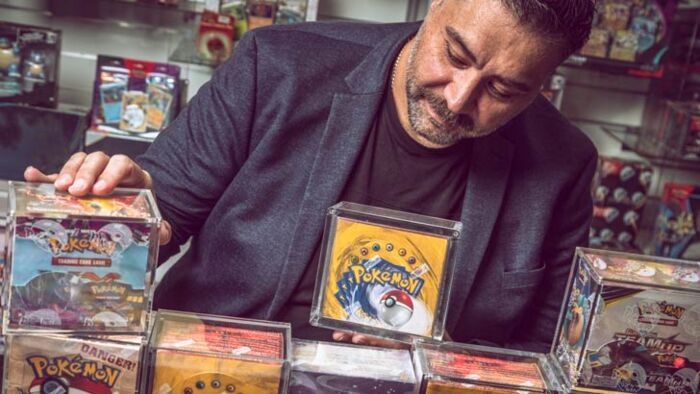
This is a world Sydney-based Jonathan Marin, 45, lives and breathes, not only as a collector, but as a certified valuer and one of the country's leading experts on trading cards and collectables.
The managing director of TCG Valuations is a collector, certified valuer and one of Australia's leading authorities on trading cards and collectables. He first discovered Pokémon cards in his late teens and opened his own trading card store, TAG Collectibles, in 2019.
"I've got this core memory of opening a box under the Christmas tree when I was eight. It was my very first Nintendo. From there I began building my own collections, starting with retro video games."
Jonathan was in his late teens when he was first introduced by his younger cousins to what would become another major passion: Pokémon cards.
But it wasn't until 2015, when he started building a proper collection, that he realised the real value in the cards.
How Pokémon cards became a serious investment
At that point Jonathan was still a collector. That all changed in 2019 when he took the plunge and opened his own store, TAG Collectibles. That was followed by the acquisition of grading business TCG Grading in 2023, and the founding of TCG Valuations in late 2024.
Jonathan's timing proved impeccable. Much like it did with sourdough starters and online cocktail-making classes, the COVID pandemic unleashed a new wave of interest in collectables.
"We started to see two big things emerge. The first was people dipping into the retro video game scene. Then there was Pokémon and people rushing out to pick up cards. I think it was a case of nostalgia converging with boredom."
Interest in trading card games (TCGs), sports cards and other collectables hasn't died down, but nostalgia is by no means the only driving force.
For some, these have become investments. One recent customer brought in a childhood Pokémon collection with no idea what it was worth. One card alone was valued at $13,800.
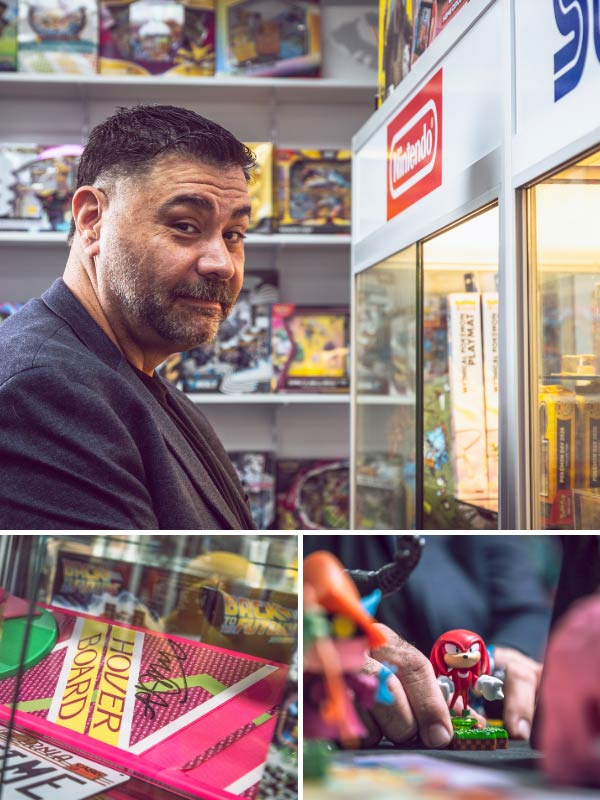
How to tell if your Pokémon cards are valuable
For every Pikachu Illustrator, there are millions, likely billions, of Pokémon cards in circulation worth only a fraction of the value. The question is: why?
Like a fine wine or vintage car, there are numerous factors that go into determining the value of trading cards, including rarity, age and popularity among collectors. As Jonathan explains, the most significant factor is condition.
"When it comes to determining the worth of a card, what we've seen in the past two or three decades has been an anchoring to the grade of the card, to its condition."
Grading works on a scale of 1-10, where a 10 indicates a flawless card, across the various lines of trading card games and sports cards, based on four main factors.
"The first is the centering, the overall positioning of the artwork on the card. The second is the surface and whether there are any marks, scratches or creases. The third is the corners and whether they are dented, blunted or show signs of whitening or dog earing. The fourth is the edges and whether they show signs of whitening, serration or tampering.
"The closer a card is to that mint or pristine condition, the more money it's worth. But that's not to say that all cards graded 10 are worth squillions of dollars."
As Jonathan has experienced himself, even cards that come fresh out of an unsealed packet are not guaranteed to be rated pristine.
"I actually opened a pack recently with an ultra-rare Mega Charizard. I was so happy, but I took it to one of our graders and they said, 'Look, sorry, this is an eight'.
"Even though it had come straight out of the pack, there was a dent in the back. This isn't uncommon. You'll see pack-fresh cards with print lines, with whitening, with the centering being completely off."
Four things that determine a Pokémon card's value
✓ Condition
✓ Rarity
✓ Age
✓ Collector demand
How Pokémon card valuations and grading work
To an outsider, the process of having a trading card professionally assessed might seem as simple as giving it a once-over for wear and tear and looking up a few comparable listings.
As Jonathan lays out, however, it's more like a forensic examination.
"First of all, we do a consultation trying to understand the percentage mix of the collection and the customers' goals. We're seeing a lot of people with multi-collectable lines, whether it's sports cards, Pokémon cards or Lego, contained within their collections."
Next is the condition assessment, authentication and valuation, based on standards set by the Auctioneers and Valuers Association of Australia. Then comes the process of determining the market value of an item.
"Once we understand the condition and that it's authentic, we get into the market value. At a minimum, we look at three to four price points across sources. eBay is one of those sources, but we also look at PriceCharting, Card Ladder, Troll and Toad, 130 Point and SportsCardsPro."
Finally, customers are walked through the findings and provided with recommendations.
All up, Jonathan says a formal assessment starts at $195, while a simple market opinion can cost as little as $80-$100.
"It really is a combination of hard and soft skills that makes you a really good valuer. You have to be excellent at researching, your data and analytical skills need to be on point, and your precision and ability to use loupes, magnification systems and UV lights needs to be there."
These skills, Jonathan says, can make all the difference when it comes to spotting a well-executed counterfeit from the real deal.
"A lot of the time, you will be presented with some really good fakes and even items that other valuers may have passed as authentic when they are absolutely not."
Found old Pokémon cards? Here's what to do next
That was exactly what played out recently when a customer of Jonathan's came in with a binder full of Pokémon cards from his childhood.
"He had no idea what the cards were worth. Unfortunately, we went through the process and explained to him that some of them were not authentic.
"What he did have was an authentic Gold Star Rayquaza."
The Pokémon card worth $13,800
"We did the pre-grade assessment, and it came in at $13,800. He nearly fell off his chair. It was one of those Antique Roadshow moments where he looked at us like, 'Really?' That was pretty cool."
With the renewed popularity and value of Pokémon cards, Jonathan has heard plenty of stories of people digging through cupboards and attics in pursuit of cards from their youth.
For those lucky enough to uncover an old collection of their own, or inherit a set of sports cards or trading cards from a family member or friend, Jonathan says it pays to do some homework before rushing out to get a professional assessment.
"Research the cards in your collection. You'll want to try and figure out what's worth something, what isn't and whether something is authentic or not. That will save you time and money before approaching a grading company like ours.
"Getting your bearings around where the market sits will also help people avoid underselling their cards if they choose to sell them without going through a formal grading or valuation."
How to protect a valuable Pokémon card collection
The irony, says Jonathan, is that even collectors who do have a sense of what their collections are worth don't always take the steps to safeguard their valuables.
"Last month we did an assessment for a client whose collection ended up being valued at about $1.7 million.
But he was storing it in cardboard boxes in a storage shed.
"Once someone has decided to collect as an investment, I always recommend taking the collection out of storage.
"Invest in some good security, a fireproof safe and make sure that it's insured.
"Something as simple as a penny sleeve and a top loader is your best friend, if it's kept in a box that's in a cool, dark, dry place, ideally in a safe."
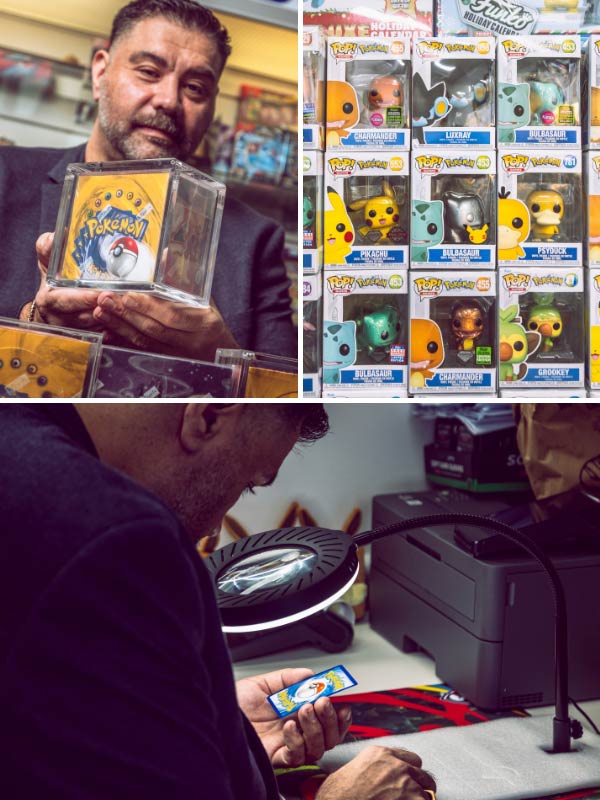
Are Pokémon cards a good investment?
With prized cards regularly trading for thousands and tens of thousands of dollars, and for the rarest of the rare, even more, it's easy to see why people have been drawn to trading cards as investments.
Jonathan stresses that, like any investment, there's an element of risk.
"Trading cards are operating in a highly speculative environment that isn't underpinned by regulatory frameworks like shares and other investment classes."
Having said that, he adds there are particular lines of cards that may be worth considering when building a collection from scratch.
"If anyone is looking to start their investment journey in trading cards, Pokémon is one of those core staples that has now been around for 30 years.
"One Piece is another that is really accelerating at the moment. Because of the quality and rarity of the cards, people are really loving it. Then there are dark horses like Yu-Gi-Oh! and Riftbound."
Jonathan also advises newcomers to focus on a niche rather than chasing big cards or influencer hype.
"Take the time to understand the rarity, the difference between eras and series and sets, the difference between types of pre-runs and chases and hits and commons and uncommons. And try to stick within one particular set, series or TCG line that you can master."
The biggest mistake new collectors make
Ultimately, Jonathan says people looking to turn a quick profit are unlikely to find much success.
Rather, it's collectors who genuinely enjoy immersing themselves in their hobby who are more likely to succeed over the long run.
"The biggest mistake people make is thinking that they can sell their shares or other investments to pour into Pokémon and within six months they'll be millionaires," he says.
"You have to have the passion and the patience to really get behind it and understand it."
Get stories like this in our newsletters.