Inside the life of AMP economist Diana Mousina




Diana Mousina is one of Australia's best-known economists and the deputy chief economist at AMP, helping shape forecasts on interest rates, inflation, house prices and investment markets. But before becoming a leading voice on the economy, she arrived in Australia as a child after the collapse of the Soviet Union. Here, Diana explains how she became an economist, what economists actually do, her outlook on investing and why she wants to make economics easier for everyday Australians to understand.
Have you ever watched the movie The Terminal with Tom Hanks? It's where he's stuck in a US airport because his country collapses and he can't go home.
Diana has never been stranded in an airport. At least, if she has, it doesn't come up in conversation. The connection with the Tom Hanks' film is that Diana spent her earliest years living in a country that no longer exists.
"I grew up in the Soviet Union. I was born in Uzbekistan, but I'm not Uzbek at all. My family is Russian Tatar and we were living in Uzbekistan because, at the time, you had different people living and moving across all parts of Russia and the ex-Soviet states."
It was a momentous time to be living there. In late 1991, the Soviet Union officially dissolved and, like many others, Diana's family sought a new life abroad.
"After the collapse of the Soviet Union, my parents thought it'd be better for us to move overseas. It was basically just for work and better opportunities - the typical migrant story.
"We had a great aunt who lived in Australia, so we migrated here when I was about five and ended up in the eastern suburbs, and I've never really left."
Diana's parents had both worked as scientists before the move to Australia, but it was not a path that she would follow.
How Diana Mousina became an economist
"I started doing business studies in high school and then economics in years 11 and 12 and I just loved it. I fell in love with economics. To be honest, it helped that I was naturally good at it. For some reason I just understood how things worked.
"I didn't really know what economists did at that point, but I knew that I definitely wanted to do it at university, so I ended up doing a degree in accounting, finance and economics."
After finishing her degree Diana fired off applications for any graduate job related to economics that she came across but found that her love of economics didn't line up with some of the firms she applied to.
"I ended up having a few very interesting interviews for investment banking jobs. I remember crying after a Goldman Sachs interview. They made me feel so dumb for loving economics but having no real interest in equities. Looking back, I probably wouldn't have been appropriate for that role."
Those experiences obviously didn't stop her. Diana landed a graduate job at Commonwealth Bank, then ended up joining the bank's economics team. Five years later she made the move to AMP where, a decade on, she holds the position of deputy chief economist.
But Diana hasn't stuck to the usual script. Lately, she and her fellow AMP economists have taken their insights to social media to break down economics for a new and rapidly growing audience.
What does an economist do at AMP?
There's a perception that economists spend their days crunching numbers and creating charts. As it turns out, that's true, in part. But being an economist requires wearing many different hats.
"Every day can be a little bit different, but it inevitably involves looking at a lot of different charts. I usually start the morning by looking at overnight data from the US, Europe or Japan and updating charts that we send out every week.
"Then, usually, it's either writing a note about data that's come out that day or about something more thematic. Yesterday, for example, I wrote a note about inflation figures.
"I might also have to do a presentation for clients, or talk to journalists about data, or a forecast, or an event that's coming up."
One of the most interesting parts of the job is the need to be across so many different areas - and not just the topics you might expect of an economist working at AMP, like inflation or equity markets. Diana says she's increasingly found herself talking about geopolitical issues in recent years.
"I'm hardly an expert on Venezuelan oil supply, but after what happened at the start of the year I had to quickly start reading about it in detail because I had journalists asking me for quotes.
"I do find that that's one of the most challenging parts of the role. You can't be an expert on everything, but I think people expect economists to know a little bit about everything."
While the economic team's remit is broad, a fundamental part of the work that Diana and her colleagues do is to assist with the superannuation and investment side of the business.
"We serve the whole business, but the main channel is that we sit within the investment team, which is quite unusual for an economics team.
"So we have fortnightly meetings with our portfolio management team. But we talk about markets and our outlooks all the time - on a daily basis, basically. Because our view, around the world, informs the longer-term investment process that AMP is taking to manage $80 billion worth of superannuation.
"We also talk to, for example, a different number of boards that govern the investment process and present them with our outlook. And we do forecasts for different asset classes that are used in mid-term return projections that super funds are guided by in terms of their performance goals.
Life beyond forecasts
Between the demands of work and family life with two young children, free time is not something Diana has in abundance. So in the spare time she does have, she becomes a bit of a "grandma".
"I love crocheting and knitting - mainly crocheting now, which I find really relaxing. And I love cooking and baking. I love trying to make new recipes and I have like a million different kitchen gadgets.
"I'm very into low-tox cooking and living, and making healthy foods for the kids. I just get a lot of joy out of making new foods and feeding people."
However, switching off completely is not always an option. Not when you're frequently being peppered with questions and good-natured feedback by your family, friends and other acquaintances.
"I get stuff all the time. 'You got the RBA wrong'. That'll be one I get at barbecues or at children's birthday parties. I get a lot of slack for that sometimes, but never when I get it right.
"So lots of RBA views, but also people wanting to know whether they should fix or float their mortgage or what stocks should they invest in.
"The biggest one is housing. People asking for home price forecasts or whether they should buy or sell. People are just obsessed with housing in Australia."
How Diana Mousina invests and manages her super
Being on the receiving end of so much unsolicited curiosity about the financial world does raise another question though: has her role as an economist shaped the way she approaches her own finances?
"Absolutely it has. Like, a million times more than I ever expected. But I think it's because I'm in an investment team where it's much easier for us to relate our economic views to what's actually happening in markets.
"Maybe it's also older age and wanting to preserve my wealth. But I monitor markets so closely now that I've set up my kids with their own share portfolio. I manage my own super and I have money with AMP super too. So I'm much more involved."
As Diana alludes to, her attitude to investing is vastly different from her parents who approached it with a healthy - and understandable - amount of scepticism.
"My parents are dubious of sharemarkets because of the cycle that they went through in the Soviet Union when inflation was so high, and their money just disintegrated sitting in a bank.
"So I never grew up in a family that invested or had any sort of literacy around financial markets at all. I wish I did have that at a younger age, but I've come into it at a later age, which is fine."
Why economics matters to everyday Australians
For a discipline that touches almost every part of life, Diana wishes that economics was more accessible to people outside of the industry.
"Day-to-day life involves economics in so many different ways that you may not even realise. Like how you spend your money, why the price of things is going up or why the government does certain things that influence you.
"Economics is everywhere you look and it's not just for the financial elite or people that understand the jargon that comes with it.
"So I wish that more people were involved with it, but I understand why they aren't. I think that the commentary is confusing and I don't think economists help themselves by using jargon. Too often I read economists' work and I don't even know what they're saying."
This is part of the motivation behind the AMP Econosights Instagram page - an account featuring Diana and her fellow economists Shane Oliver and My Bui.
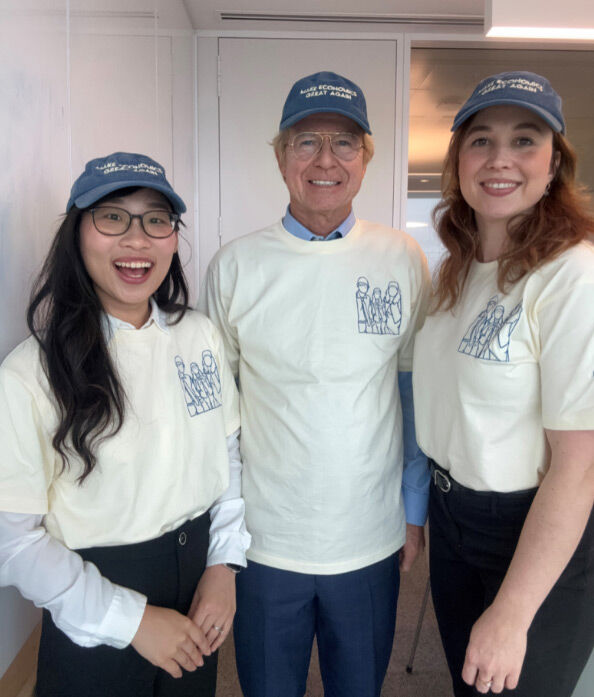
Designed to showcase economics in a more engaging, accessible and often humorous light, the account has amassed a bit of a cult following with 16,000 followers and counting.
"I think it was initially a bit of a shock to people. Some people said to me 'I didn't know you guys had such good personalities'.
"It's so natural for us, though, because we all love what we do. It's more work, but at the same time, it's something so enjoyable to be a part of because it's new, it's different, it's creative.
"And I think it's important in terms of the financial literacy aspect. A lot of people who follow us already have an interest in finance and economics, so the aim is to broaden that.
"We want to try and make sure that even if you don't have that inherent interest, you can still find something that's relevant for you in there. That's definitely my goal."
Get stories like this in our newsletters.