Smashed avo lie: Economist exposes the wealth gap




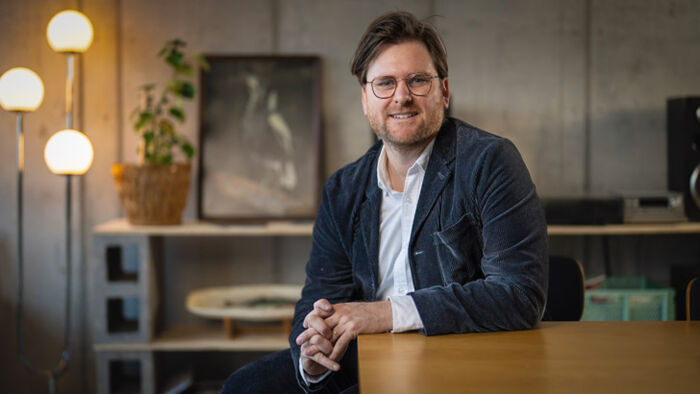
Economic inequality is a subject that Thomas Walker lives and breathes.
As the chief executive and lead economist at Think Forward - a Melbourne-based not-for-profit dedicated to advancing policy related to intergenerational fairness - it's at the core of his work.
Growing up near New Norfolk, a town 30 minutes west of Hobart, there was no indication that tax and economic policy were going to play such a major role in his life.
Early life and education
Walker, 36, readily admits there was no single event or 'aha' moment in his youth that sparked his future interest.
Instead, he describes his early years as being very normal. "My childhood was a happy, middle class kind of life.
Growing up in Tasmania was brilliant because there's lots of bush walking, camping, sailing, kayaking and all those kinds of outdoor activities that are much harder to do now I live in Melbourne."
After finishing school, he enrolled at the University of Tasmania to study economics and geography - a choice that, he recalls, was inspired by his first trip abroad.
"I'd never been overseas as a kid, so when I went to Indonesia on a surfing holiday with my mates when we were 18, I was just so shocked at the scale of the world and different cultures. So I guess I wanted to study economics and geography to better understand how the world works."
Towards the end of his degree, Walker picked up an internship at planning and economics firm SGS Economics and Planning, which turned into a full-time job and prompted a move to Melbourne.
"I did that for seven years, became a partner and ended up doing a lot of work on regional economic development.
"Growing up in Tasmania I was really interested in regions and their transition from economies based on farming, forestry and manufacturing to tourism and services."
How Thomas Walker became interested in inequality
It was during this period in his mid-20s that Walker's thoughts around inequality began to crystallise.
"I think Millennials grew up being told this story that if you get good marks, you go to university, you get a job, then you'll be able to afford a home and start a family. But that wasn't what I was seeing.
"There was also that whole smashed avo trope that seemed to be everywhere between 2015 and 2020. If you're not making it, it's because you're not working hard enough or you're wasting too much money on avocado toast.
"Getting annoyed at that narrative was one of the early instigators of starting to think about economic equality and things like wealth, which sort of led me to Think Forward."
Walker joined the organisation - started in 2018 by Sonia Arakkal and Megan Shellie while at university - in 2020 where he worked one day a week as the lead economist while still working his old job.
"The original genesis of Think Forward was around governance and decision making and how our political leaders seemed incapable of making the correct long-term policy decisions. The critique was that through their inaction they are denying younger generations the kind of futures they want.
"When I joined and started to unpack the structural economic stuff, we realised that a lot of economic and tax policies, alongside decision making, were also having harmful impacts on younger people.
"So our focus has become the tax and transfer system. When we talk about housing, jobs, education or climate, behind all those things is a tax transfer system that rewards the wrong things. We don't support entrepreneurs. Instead, we give massive tax breaks to property investors."
A quirk of fate that changed everything
In 2022, Walker's views on inequality and the transformative power of wealth were influenced again after he lost his mum to cancer.
"She passed away at 58, which is just... it was a shit experience.
"She never got to spend her superannuation, so it was split three ways between me and my siblings. It wasn't a huge amount, but it was enough for a 20% deposit on a two-bedroom apartment.
"What I found is that instead of having to pay 30% of my income on rent and then trying to save another 20% on top of that for a house deposit... to have that taken off my shoulders was so liberating.
"That money allowed me to quit my job and take the risk of investing all my time in Think Forward. It allowed [my partner and I] to buy an apartment, then, six months ago, we had our first child."
Walker says that it was a reminder of just how essential wealth is to people's economic security and how, in his eyes, the current system is denying opportunities to people who aren't wealthy.
"If we just gave everyone the foundational economic security they need by making education, housing or starting a business or a family affordable - and by not loading up young people with debts - I think that would unleash a wave of innovation and prosperity across the country.
"At the moment, our economic development strategy seems to be based on speculation and wealth hoarding, and many Millennials and Gen Z are on the wrong side of that.
"I found the big difference that economic security has had on my life and I just wish everyone had that. This horrible quirk of fate is what allowed me to buy a house, not hard work. And I think that's wrong."
A shift in focus for Think Forward
Originally, Walker says, Think Forward operated like a think tank. They would put out research papers, write op-eds, make media appearances and even meet with politicians to advocate for their policies.
"Young people talking about tax was this kind of niche that we found ourselves in, which opened doors. But over the years we grew frustrated that in a lot of policy areas there's heaps of evidence about what the problems are, but there's a disconnect between that and our political leaders taking action."
Many politicians were receptive to issues around generational inequity, but nothing changed. That's when Think Forward began to change tack.
"We've pivoted quite a bit over the past 18 months towards a more educational approach where we've tried to mainstream the need for economic reform by explaining to younger people how the tax system works and how it's impacting their lives.
"There's this veil of complexity and jargon around tax and economics, which denies people of all ages an opportunity to participate in the debate about how our society is structured. But conversations about the tax system are often left to older experts and vested interests, so we wanted to challenge that."
The idea took life as an education series on TikTok, but over the past six months Think Forward has been developing an online tool called Tax Match that presents people with different tax policies and then (just like online dating apps) users can swipe right or left to reject or accept them.
"Through that process, you build up your own idea of what you'd like the tax system to look like. And then at the end, it shows how much government revenue was gained or lost. It just gets people to understand the trade-offs within the tax transfer system in an engaged way," says Walker.
Holding onto hope for tax reform
Beyond fixing issues in the economic system, Walker believes there are consequences to inaction.
"Many young people don't trust the government and they're disengaged with political systems. But we think there's an opportunity for reform. To show we can change these systems and prioritise people's economic security.
"To me that's an obvious way for governments to rebuild trust with younger generations. So it's frustrating to see short-termism and band-aid solutions that don't address the structural issues."
Walker does see glimmers of hope, however. One being that the narrative seems to have progressed beyond the avocado toast era. "To hear the Treasurer say at the end of the economic reform round table that intergenerational equity in our tax system is a big issue this parliament needs to address - that's a big win.
"From the avocado toast years to having that problem identified and to see agreement across the political spectrum that there's intergenerational inequity in our tax system, that's encouraging.
But problem identification, as Walker calls it, is the easy bit. As he's come to learn in recent years, reform and action from politicians is the hard - and most important - bit. But it's what Walker, Think Forward and many others are continuing to push for.
"The evidence is all there. It's how we go about getting the government to move from problem identification to action. There's a real opportunity here, though, if we can take it."
Get stories like this in our newsletters.