Why Gina Rinehart is betting $1 billion on the space economy




Gina Rinehart's billion-dollar backing of Elon Musk's SpaceX has put the spotlight on a rapidly growing space economy. From satellite internet and defence technology to data infrastructure, here's why investors are paying attention.
The space economy is expanding quickly beyond rockets into defence, energy infrastructure and data services which are underpinning commercial enterprises.
The popularity of the SpaceX initial public offering (IPO) illustrates the attraction for investors, including Australia's richest person, Gina Rinehart, who has backed Elon Musk's IPO with more than US$1 billion.
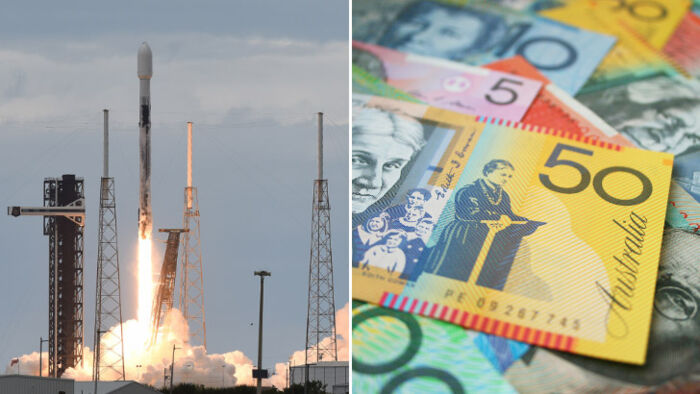
The big news in markets this month wasn't just the SpaceX IPO, but the phenomenal demand for it, including from Gina Rinehart, who hit the headlines in The Wall Street Journal when the paper revealed Australia's richest person had invested over US$1 billion in the SpaceX IPO.
That news was the most read story in The Wall Street Journal the day it was published.
Such is the desire to know how the rich are investing.
Space economy by the numbers
- US$137.4 billion in government space spending in 2025
- More than 12,000 active satellites in orbit
- Commercial launches now account for 70% of orbital activity
- Global space economy forecast to exceed US$1 trillion by 2034
- Satellite broadband market projected to reach US$100 billion by 2035
Rinehart is betting on founder Elon Musk's vision to transform the space economy into a profitable commercial enterprise.
Her stake in SpaceX is the single largest investment outside of iron ore made by her private company, Hancock Prospecting.
Like many others, Rinehart is betting that investing in space isn't just about launching rockets, but an expected growth in the space economy.
The forces driving the space economy boom
Space companies are benefitting from a combination of several factors including rising commercial demand for communications services and increased government spending, including rising defence investment in early warning, counterspace systems and secure satellite communications.
Global government space spending, for example, reached US$137.4 billion in 2025, and for the first time, defence-driven space spending accounted for 54% (US$73.5 billion) of that total, officially outpacing civilian space budgets, such as NASA's.
The modern space age today is also being defined by commercial demand and economic infrastructure.
Commercial activity now accounts for roughly 70% of global orbital launches, up from 25% a decade ago, as satellite launch costs fall.
Over the past 60 years, the cost of reaching Low Earth Orbit has fallen approximately 200 times, to roughly US$1000 per kilogram today from US$400,000 per kilogram.
This collapse in launch economics is the single biggest structural change in the industry encouraging commercial enterprise.
Internet connectivity, for example, is burgeoning as a business enterprise.
Active satellites in orbit, for example, have grown from around 1000 in 2010 to over 12,000 in 2025, with estimates approaching 100,000 by 2030 as broadband constellations such as Starlink and Amazon Leo deploy satellites to keep us connected.
From Starlink and satellite internet to defence: Where the money is being made
Increasingly, satellites are where the space economy generates revenue, with over half of today's space market tied to satellites providing infrastructure and connectivity.
Falling launch costs and reusable rocket technology have enabled the rapid deployment of satellites that deliver broadband, navigation, Earth observation, and secure communications at scale.
This is helping push the growth of the global space economy, which is projected to surpass US$1 trillion by 2034.
Apart from satellite broadband, defence modernisation and emerging applications such as orbital computing are underpinning commercial opportunities.
The satellite broadband market alone is forecast to grow from US$22 billion in 2025 to US$100 billion by 2035, driven by household connectivity, enterprise backhaul, mobility, and military applications.
Government spending too is rising.
The US Space Force budget request for FY27, for example, is approximately US$71 billion, more than double the FY25 budget, with proposed programs such as Golden Dome adding a long duration government spending which provides a durable demand floor for the sector.
How the space economy makes money
- Satellite internet services such as Starlink
- GPS and navigation technology
- Earth observation and climate monitoring
- Defence and secure communications
- Rocket launches and space transport
- Data and infrastructure services
How everyday investors can access the space economy
With SpaceX raising the profile of the space economy, it's not just Gina Rinehart that is keen.
Investors are increasingly seeking access to companies leading reusable launch technology, satellite networks, mission-critical components, including space exploration.
Australian investors can invest in these ground-breaking companies directly, such as many did in the SpaceX IPO, or diversify their investments though a space technology ETF listed on the ASX such as the Global X Space Tech ETF (MOON).
For investors who missed the SpaceX IPO or were priced out by high minimums and limited share availability, an ETF offers a more practical entry point, spreading exposure across the broader space economy rather than concentrating a bet on a single name.
The ETF tracks the performance of companies driving growth and commercialisation of the global space economy.
MOON holds a diversified mix of companies across the space value chain, including satellite operators, launch technology providers, defence-linked space contractors, and the manufacturers of mission-critical components that make it all work.
Since its ASX listing on June 11, 2026, MOON attracted over A$5 million in flows within its first five trading days, reflecting strong early investor appetite for dedicated space economy exposure.
Much like railroads in the 19th century, the internet in the 1990s, and AI in the 2020s, space infrastructure could define the 2030s as a foundation for the next phase of the global economy and investors who get in earlier could see the greatest rewards.
As with all investments, this fund has risks - see the PDS for more information.
This fund may expose investors to currency risk, sector risk, concentration risk, and/or market risk.
Get stories like this in our newsletters.