Why the Aussie tech sector is set for lift off




The broader Australian equity market has suffered two consecutive financial years of negative earnings growth. In fact, from the end of FY23 to FY25 earnings at the ASX 200 level fell 13%. This is in stark contrast to the remarkable growth experienced in the US led by mega cap technology companies.
However, this underwhelming headline for the ASX 200 masks strong pockets of growth under the surface of the Australian equity market.
For instance, the Australian Information Technology (IT) sector has achieved a higher rate of earnings growth than its S&P 500 counterpart over this two-year period. In FY25 the Australian IT sector grew earnings by a commendable 26.4%, trailing only the complementary Communication Services sector.

Ultimately the poor earnings growth of the ASX 200 has come down to the market's makeup. Namely the concentration in more mature, lower growth blue chip companies and, over recent years, the suffering materials sector.
While our IT sector has recorded strong earnings growth, and returns, it only represents 3% of the weight of the ASX 200, in comparison to 20% for Materials and 35% for Financials.
So, is there a strong case for Australian investors increasing their allocation to local technology names?
Seeking out strong earnings growth in the Australia market
From an earnings perspective, being the main driver of long-term equity performance, Australian technology appears well placed to continue its run of strong growth.
Earnings growth has been broad across the sector with 75% of companies reporting positive earnings growth for FY25 and over 30% of companies reporting growth of 50% or more. By comparison, more than half of the companies in the ASX 200 that are not in the IT sector reported negative earnings growth over the same year.
Over the next two years the companies in the S&P/ASX All Technology Index are expected to grow earnings above 25%, not only outpacing the ASX 200 by three times, but also at a higher rate than the US IT sector.
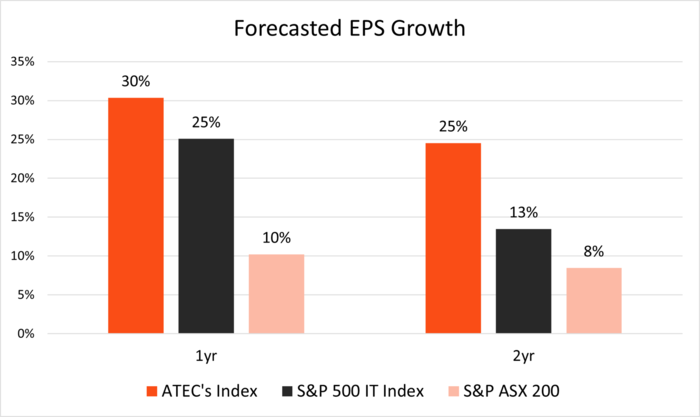
Australia's monetary policy setting is expected to be another key driver of this growth. The Reserve Bank's shift toward a rate-cutting cycle has created conditions that are typically supportive for Australia's mid and small cap technology companies.
Relative to large caps, these businesses are generally earlier in their lifecycle and are still expanding their product ranges and customer bases, leaving them more reliant on external capital to fund growth and more sensitive to borrowing costs. Consequently, easing cycles have historically favoured mid and small cap performance, relative to their large cap counterparts.
Tomorrow's global technology leaders
The ASX technology sector already contains household names in Xero, a global leader in accounting software, CarSales, the leading car marketplace in Australia with international expansion well underway, and Life360, the location-based servicing app operating in 170 countries with 71 million monthly users.
But equally, it has a growing list of companies that could be tomorrow's technology giants.
WiseTech is already growing to become a leader in international logistics software, servicing over 17,000 logistic companies including 46 of the top 50 global third-party logistics providers.
WiseTech's software offers logistics companies the opportunity to replace outdated, legacy software with a highly efficient, automated, and integrated solution that is fast becoming industry standard. Among the top 25 Global freight forwarders (companies that act as middlemen for transporting shipments) those using WiseTech's software have experienced 82% growth in container volumes since 2011 compared to 12% for those who are not.
Founded in 1983, Pro Medicus has grown from a small Australian medical imaging software provider into a global leader in radiology IT solutions, servicing major US academic hospitals, healthcare networks, and imaging practices worldwide with its flagship Visage 7 platform.
Pro Medicus' Visage software enables radiologists to view and interpret medical images at unprecedented speed, approximately 60-70% faster than legacy systems, significantly improving diagnostic efficiency and patient outcomes.
This cloud-native platform replaces fragmented legacy systems with a single integrated solution, allowing healthcare organisations to handle massive imaging datasets across hospital networks and geographies.
The company now holds 10% of the total addressable market in the US and has achieved a 100% customer retention rate since 2009, with customer volumes growing four to seven times faster than the industry average. The company is leveraged toward a global aging population and the likelihood of increased healthcare needs in years to come.
These are just a few examples of the innovative companies growing to global relevance in Australia's technology sector.
How to get exposure to Australia's tech sector
Most Australian investors likely have a low exposure to Australia's technology sector given it has just a 3% weight in the ASX 200.
For investors seeking to capture the growth potential of our local technology sector, the Betashares S&P/ASX Australian Technology ETF (ASX: ATEC) invests in a diversified portfolio of companies across a range of tech-related market segments such as information technology, consumer electronics, online retail and medical technology.
Investors should consider an allocation to ATEC, as a satellite complement to their core Australian equities portfolio, as a way to participate in the sector's long-term potential.
Get stories like this in our newsletters.