Ask Paul: Can we afford to caravan around Australia?




Chris and Jonna are travelling Australia in a van after health issues shortened their working lives. Are their savings and super enough?
Reader question
Hi Paul, we're 63 and 58 years old. We have a small mortgage on our investment property in Queensland.
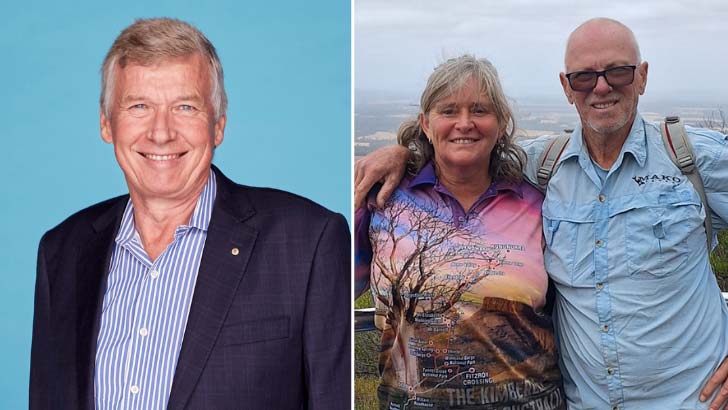
We're retired (we hope). We have $400,000 in super between us and $500,000 to invest from the sale of our primary home.
Should we put much more in our super accounts (half the $500,000) leading up to pension age and make smart spending and investment choices with the remaining $250,000?
Health has impacted our working life so we're currently seeing Australia in our van.
We are pretty much minimalists and are planning to live in the investment property down the track. Can you see a financial path for us? Hope we haven't confused you. - Chris and Jonna
Paul's response
One thing is for sure, Chris and Jonna, I can certainly see a terrific life adventure for you. I'm still having a chuckle at you saying, "We're retired. We hope".
I know what you mean. It is one thing coming up with a life plan and another thing making your money fit your plan. You are off to a cracking start, though.
I get to enjoy some very funny conversations about money and life plans.
Once on a flight, an executive asked me how much he would need to retire. He had no idea what his annual spending amount in retirement would be. We chatted about holidays, paying for his family home, cars, insurance, healthcare, entertainment and all the stuff that costs money, which added up to a large number. He wanted to retire at 65, so had to multiply his annual required spending amount by 17. At this point he went pale.
Sadly, too few of us have got a realistic plan about how we want to live in the years to come and how to pay for it. But your plan sounds realistic to me. In the example above, assets did not meet the dream. In your case, I think they will.
You have given me the broad information I need. First up, you have had some health issues and are vanning around Australia. My concern is, of course, what backs up this dream lifestyle if one or both get ill and need to be near care? But you will have your investment property that can become your home. This also gives you an asset that you could use to fund aged care if required in the future.
You have a logical start with the van and a logical end, if required, with your investment becoming your home. The spending gap between beginning and end is, of course, filled by your current assets. Let's take a look at these.
First up, I think I am safe in assuming that with a small mortgage your investment is producing surplus cashflow after expenses, but to be safe I'll call that neutral.
Forgetting where it is invested for a moment, you have an additional $900,000 in your super and proceeds of the sale of your home. History suggests that on a diversified amount of money, you could spend some 5% of the capital sum each year and your capital would keep pace with inflation over time, that is, you would die with $900,000 plus inflation.
Here is the first question. Does 5% of $900,000 or $45,000 cover your annual van lifestyle? Out of curiosity, let's look at $70,000 a year, which I suspect is more than you are spending. That amount would require a return of about 8% on your $900,000. If we look at historical guidance from assets such as shares, we find that since 1900, the average return, including dividends has been a bit more than 10%pa, but 100% in shares is a pretty risky strategy for retirees. Let's look at the returns for balanced type superannuation funds.
Compulsory super started about 34 years ago, the typical large, low-fee, balanced fund being around 8% over these decades. This means that $70,000 a year from your $900,000 is not crazy.
Second question is: if you do need $70,000 a year to enjoy your van life, are you happy to run down the real value of your $900,000? I should say in your shoes, I would be. At life expectancy of 81 for men and 84 for women, you would still have real buying power with your $900,000. You'd also have an investment property worth a lot more.
The magic sauce to your magic pudding is your ability to get an age pension at 67. Talk to Services Australia, an independent adviser or your accountant, but I think it makes sense after the sale of your home to turn your investment property into your home.
You must seek your own advice but general information suggests this may require you to live there for six months. Once it is established as your home, you could move out and rent it for up to six years at a time. This is important because your home is an exempt asset under the assets test for an age pension.
You and all Australians are entitled to own a home that is exempt as an asset for pensions, land tax and capital gains tax on the sale. Sure, you would not get a lot of pension at first, but as you cut into your $900,000 and inflation indexing increased the assets test level, you would get more. This is well worth understanding as even a small amount of age pension could help to protect your investment assets.
We have not covered 'how to invest', because once again you need professional advice based on the complete knowledge of your personal circumstances. In general terms, it is hard getting money into super, but once you reach retirement age, very easy to get it out.
In your position, I would be looking at putting the $300,000 that is allowable from the sale of your home into super. Your fund is one source of advice on the merits of this or, of course, an adviser.
Anyway, you have asked me can I see a financial path for you. Obviously, when it comes to health, nothing can be guaranteed, but your plans and your financial resources seem to match up.
Go for it. And please send a photo or two to us here at Money as the years go by.
What to read next
- Why thousands of retirees are better off with less super
- The grey nomads' guide to money
- How to get free advice from your super fund
- How much super you need for a comfortable retirement now
- Why one-off financial advice is so hard to get
Get stories like this in our newsletters.

 Reply
Reply