CBA's shock drop could be a turning point




CBA tumbled over 10% in a day. With investor loans at 43%, budget tax changes could hit bank growth harder than expected.
Commonwealth Bank just suffered the biggest one-day share price fall in its history this week, plunging more than 10% in a single session.
Most of the headlines blamed the latest trading update and the federal budget, but that explanation only scratches the surface. Something much bigger may now be unfolding.
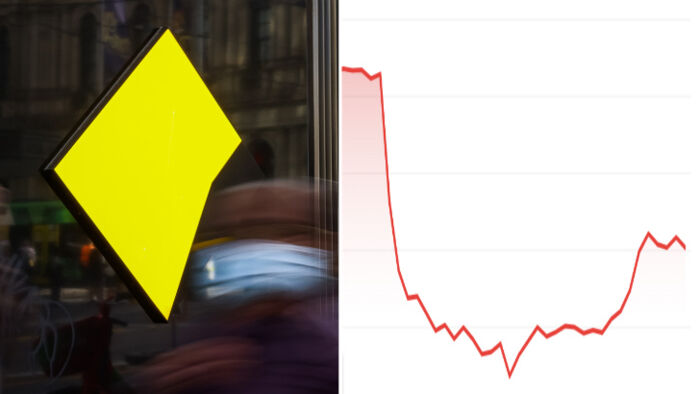
For decades, CBA traded exactly how you would expect Australia's biggest blue-chip bank to trade. The stock climbed steadily over time, delivered reliable dividends, and moved in controlled long-term cycles, but then COVID changed everything.
Since 2020, CBA has traded less like a traditional bank and more like a momentum stock, surging aggressively higher and becoming increasingly disconnected from the way banks historically behave.
At some point, the market stops paying for safety and starts paying for fantasy. That's the danger when investors begin treating a bank like a tech stock.
History also paints a worrying picture. Before CBA's previous major collapses, including the 60% fall during the GFC and the 44% decline between 2015 and the COVID low, the stock experienced the same kind of aggressive acceleration phase we saw over the past few years, and that's what makes this week so important.
This may not be a dip buyers celebrate in six months. It may be the first crack in a much larger unwind.
If history repeats, a move back toward the $95 region cannot be ruled out. That would imply another potential 50% decline from its highs.
CBA is Australia's largest mortgage lender, and investor lending has become a major engine of growth, with investor loans making up around 43% of new mortgage business at CBA.
Now the government has fired a direct shot at that investor market through the proposed changes to capital gains tax and negative gearing.
Those tax incentives are some of the biggest reasons Australians borrow to invest in property and shares in the first place. The banks built a growth machine around leveraged investors, but now Canberra is actively pulling parts out of the engine.
Higher interest rates were supposed to help banks by boosting lending margins.
Instead, banks may now face weaker investor demand, slowing credit growth, stretched households, and a government making investing less attractive.
And here's the uncomfortable truth many investors ignored for years, and that is that CBA became one of the most expensive banks in the world in 2025.
When a bank becomes priced for perfection in an imperfect economy, gravity eventually returns. This week may have been the market finally waking up to that reality.
The real question now is whether CBA was the warning shot for the banking sector, or simply the first domino to fall.
What are the best and worst-performing sectors this week?
The best-performing sectors include Materials, up more than 4%, followed by Utilities, up more than 2% and Real Estate, up more than 1%.
The worst-performing sectors include Healthcare, down more than 8%, followed by Information Technology and Financials, both down more than 5%.
The best-performing stocks in the ASX top 100 include Dyno Nobel, up more than 10%, followed by Aristocrat Leisure and Sandfire Resources, both up more than 9%.
The worst-performing stocks include CSL Limited, down more than 18%, followed by WiseTech Global, down more than 13% and Xero Limited, down more than 11%.
What's next for the Australian stock market?
The All Ordinaries Index slipped lower again this week, posting a 1.07% decline by Thursday's close.
On paper, that's not a major move, but it's the way the recent price action has unfolded that's starting to raise a few eyebrows. Let me explain.
Earlier this year, the market sold off aggressively into the March 2026 low, falling more than 10% and breaking below the previous 8600 support level before eventually finding a low around 8400.
Since then, we've seen a strong recovery attempt over recent months, but there has been one major issue.
The market failed to reclaim the previous highs and instead found resistance around the 9200 level, which I highlighted in earlier reports as a very difficult level for our market to break through.
Since that rejection, price has started to drift lower in an orderly fashion.
It hasn't been a panic-driven collapse like we've seen during previous sell-offs, but rather a slow grind lower, with each of the past five weeks trading slightly weaker than the last.
Sometimes that kind of price action can be more concerning because it suggests a lack of conviction from buyers rather than outright fear from sellers.
What makes the picture a little more contradicting is that the Materials sector continues to perform strongly.
Normally, when Materials are leading, the broader market tends to hold up better. However, heavy weakness in Commonwealth Bank and other banks has put significant pressure on the index and dragged the broader market lower.
Still, regardless of the reasons behind it, we can't ignore the structure currently developing on the chart.
The key level now becomes 8800.
If buyers can't defend that area, then a retest of 8600 becomes increasingly likely, followed by 8400, the major low established earlier this year.
Those levels should provide support, but with volatility elevated, markets can move between them far quicker than many expect.
Of course, this could still simply be a healthy pullback after the sharp recovery we experienced off the lows.
Markets rarely move up in a straight line, and some consolidation after such a fast rise would be normal.
But if that's the case, then eventually we need to see the market reclaim and break above 9200 to confirm the bullish structure is back in play.
Right now, this feels like one of those critical turning points where the next week or two could tell the story.
Add in the fact that President Trump is currently in China discussing trade, and the market has another major variable to react to.
Depending on how those talks unfold, sentiment could shift very quickly in either direction. For now, it's a market that deserves respect from both sides. Stay nimble, stay disciplined, and buckle up.
Get stories like this in our newsletters.