ETFs are a gateway for investors, Money survey reveals




At a glance
- ETFs are now a common entry point for new investors, especially younger Australians.
- Many say ETFs boost their knowledge and confidence, but non-investors still lack understanding.
- People buy ETFs for diversification, low fees and easy access.
- Most invest through platforms and use mixed contribution habits.
- The ETF market keeps expanding, creating more choice and confusion.

Australians have long learned investing through advisers, magazines or tips from friends.
Increasingly, they're also turning to exchange-traded funds (ETFs) as a way to build knowledge and confidence.
Money's survey of 676 readers shows exchange-traded funds (ETFs) are fast becoming the entry point for new investors.
Four in ten ETF investors say ETFs improved their investing knowledge, while nearly a third gained confidence to branch out.
ETF adoption is strongest among younger investors: 81% of those under 34 in Money's survey say ETFs improved their understanding of investing. Separate research shows one in three young investors (average age 21) now own them.
In Australia, ETF ownership jumped from 1.3% of the population a decade ago to one in five now.
It says a lot for an industry that has rocketed from $0 globally in 1993 to $26 trillion today.
"ETFs are one of the greatest investment stories of our time," says Vanessa Walker, Money's managing editor. "They've become the gateway to investing for many readers."
How Australians are investing
Most ETF investors buy through platforms rather than advisers, with 93% choosing the direct route.
Their habits vary: some tip in lump sums or reinvest dividends, while others stick to regular contributions.
About a third invest monthly or more, and just over 40% add funds a few times a year.
Dollar-cost averaging is less common, with only 18% relying on it exclusively and another 13% mixing strategies.
"ETFs may be relatively new, but dollar-cost averaging is still one of the most reliable ways to build consistent habits," says Walker.
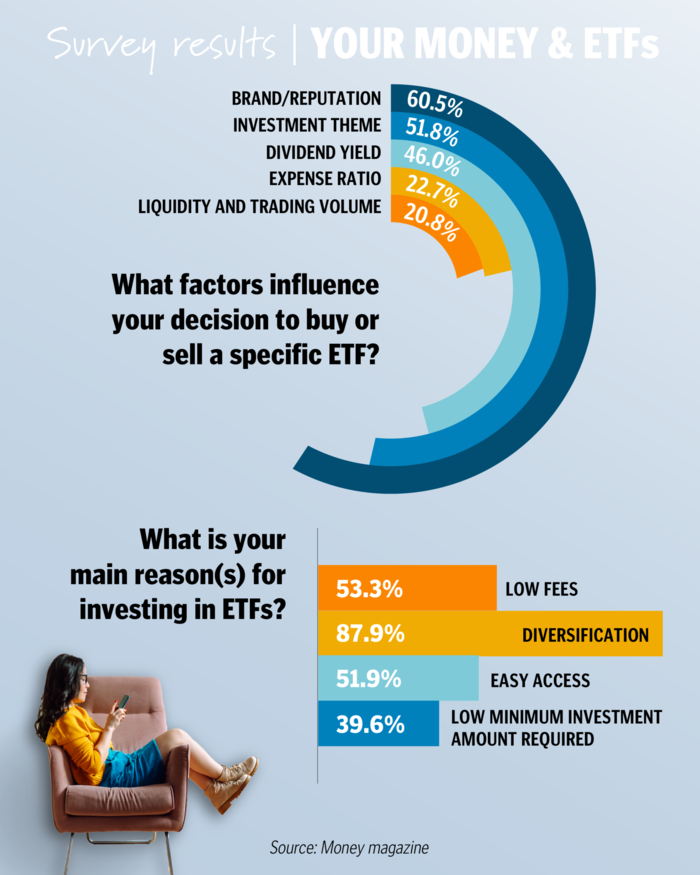
When it comes to choosing an ETF, reputation matters most. Six in ten respondents said the issuer's track record influenced their decision.
Half said the investment theme - whether that's technology, sustainability, bonds or something overseas - helped sway their choice. Yield came next.
Technical factors such as liquidity and expense ratios matter less for most investors in practice.
Walker says it all comes back down to trust.
"Investors are entrusting their money to institutions and want to be sure they are partnering with a trustworthy organisation."
Why Australians buy ETFs
Diversification remains the biggest drawcard for ETF investors, with nearly nine in ten respondents pointing to it as their main reason for buying.
Low fees (53%) and easy access (52%) followed.
"Consumers value being able to invest smaller amounts from their phones at any time, knowing they can access a range of underlying assets at a low price," Walker says.
There are trade-offs, of course. Investors don't get voting rights over the underlying shares, and small trades can come with proportionally high costs.
As Walker points out, a $2 brokerage fee on a $100 purchase means you're starting 2% in the red.
"Fees are a detail that's easy to overlook but can add up over time."
Why some Australians still don't invest in ETFs
Knowledge is the biggest barrier.
Two-thirds of non-ETF investors in Money's survey said they simply don't understand how ETFs work.
More than a third admitted they're unsure how to pick a strong performer - something unpacked in Money's feature on the Top 20 ETFs Australians are investing in now.
Only a small minority, fewer than 8%, said they prefer other investments.
Walker says that gap isn't surprising given how fast the market has grown.
There were 370 ETFs listed as at June 30, 2025, up from 212 five years earlier, according to Rainmaker Information, Money's parent company.
And the number keeps climbing with new cryptocurrency and thematic strategies entering the mix.
"Honestly, the choices can feel overwhelming," Walker says. "Helping people cut through that noise is going to be huge... and it's something Money is focused on as we gear up to announce our 2026 ETF Manager of the Year on December 1."
Get stories like this in our newsletters.