How to spot fake news about your super




On October 9, the federal government actually announced a bill requiring employers to pay super at the same time as wages from July 2026 - a genuine reform flagged by the ATO.
By the next day, the Internet was abuzz with claims that "super withdrawals are now tax-free if you're over 60" and that "the tax rate on early withdrawals just went up".
One of these is real policy (the first sentence, for the record). The other is pure fiction, and it's spreading fast.

It's just one example of Australia's new wave of fake superannuation news, convincing-looking 'articles' designed to trick readers into clicking for ad revenue or, worse, handing over MyGov details and tax file numbers to scammers.
According to the Australian Taxation Office (ATO), misleading claims about super access are surging online, blurring the line between credible financial news and dangerous misinformation.
"Getting your tax and superannuation obligations wrong can be serious. You need to be careful about acting on advice from a person, business or organisation that isn't a qualified expert," the ATO told Money.
The anatomy of fake news
Trusting the ATO over a site called The Pelicans Nest might seem obvious. But in practice, spotting misinformation isn't always easy.
When scrolling, most people click on the headline, not the publication. And while fact-checking is crucial, news often implicitly asks the public to trust what's on the page.
So, what should you look for? A privacy policy, an About Us page, terms and conditions, a physical address, and real contact details are all basic credibility markers.
At first glance, The Pelicans Nest ticks all the boxes, with tables, FAQs, and even social media icons across its homepage. It looks legitimate, and that's exactly the point: to build false trust.
You've probably never heard of The Pelicans Nest, but with thousands of news sites competing for clicks, who can keep track of them all?
And while it's no New York Times (or Money, for that matter), it looks the part - even though it's plastered with ads.
Looking closer, readers will discover there is no privacy policy, no terms, no real contact details. The façade falls apart fast.
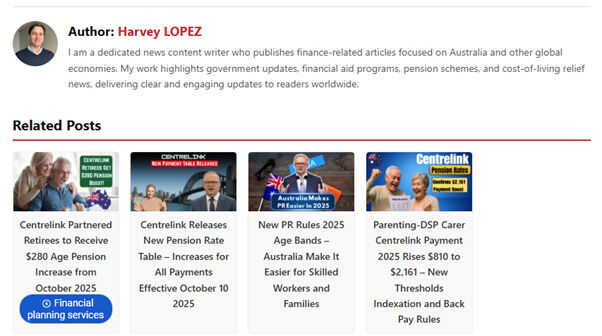
Every story is written by the same 'journalist', Collins Bodewa, all published on the same day.
And The Pelicans Nest isn't alone. Sites like Basic Steel Adelaide and Supercar Rides are running the same story.
Some go even further, posting disclaimers that absolve them of responsibility for "loss of data or profits related to the use of the website". Others list disconnected phone numbers or email addresses that never reply.
The bylines are equally implausible. One writer, "Harvey Lopez", claims to be a "dedicated news content writer" covering global finance.
A skeptical reader might wonder what Lopez is doing writing for a site that also calls itself "a one-stop destination for quality steel supplies in Adelaide."
The AI Overview problem
It's not the first time these scams have circulated. The ATO issued similar warnings back in May just before the July 1 super changes.
"This is classic fake news," ATO Deputy Commissioner Emma Rosenzweig said at the time.
"Always consider the source and think twice before acting on anything you hear from non-official websites or on social media."
Spotting fake news websites is a challenge itself. But today, you don't even need to visit them to be misinformed.
Google search results now often include AI Overviews, short summaries that pull in information from multiple sites to provide quick answers without a click.
The problem is these overviews draw from indexed sources, including fake news.
In one recent search, misinformation about "tax-free super withdrawals" appeared in the AI Overview, citing five supposed "sources". All of them were fake.
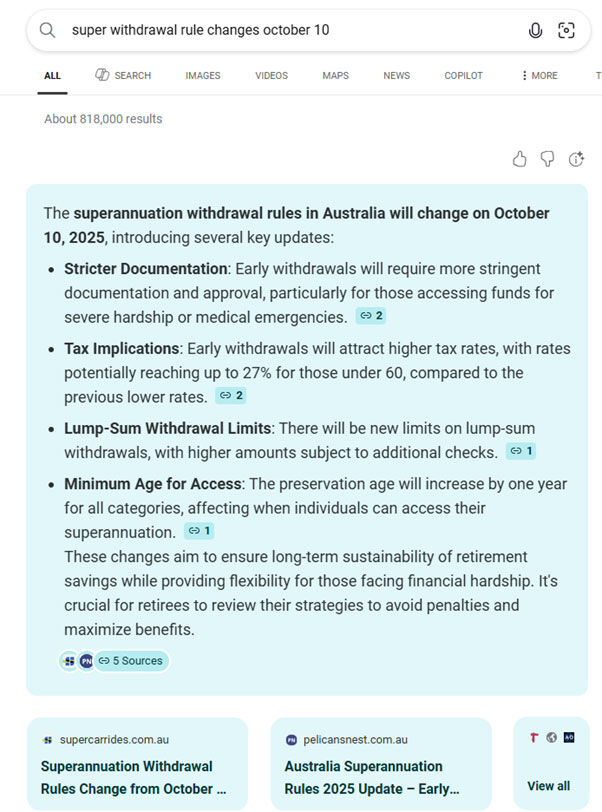
The ATO warns that AI summaries can easily include content that's "incorrect, incomplete, outdated or not applicable to your situation".
"Always check the source of information that the AI tool summarises," an ATO spokesperson told Money. "Click through to the source and confirm it comes from a trusted, official website."
Regulators respond
ASIC says it's aware of the misinformation sites and is investigating their intent. The regulator has previously warned that fake news and scam websites are often used to lure consumers into investment scams.
In August, ASIC's Moneysmart warned of a 25% rise in investment scam websites using fake celebrity endorsements.
Through its scam takedown service, ASIC removed more than 14,000 investment scam and phishing websites between July 2023 and June 2025, including:
- 8330 fake investment platform scams
- 2465 phishing scam links
- 3015 cryptocurrency investment scams
"Scammers can create fake digital ads, websites, news and reviews to make investments seem legitimate," an ASIC spokesperson said.
"Consumers should exercise caution when relying on testimonials, celebrity endorsements or a professional-looking website to make decisions."
Real super changes
Superannuation rules are complex, and that's exactly what scammers exploit.
They feed on confusion and fear, creating fake urgency to make Australians feel like they're falling behind.
But there are actual super rule changes to keep in mind, so here's what's really changing:
Payday Super: The government introduced a bill requiring employers to pay super at the same time as wages from July next year if passed. The change aims to curb unpaid super, currently costing workers $5.2 billion a year, and help savings grow faster through compounding.
High-balance tax reform: On October 13, Treasurer Jim Chalmers announced a revised plan to tax large super balances. From 1 July 2026, earnings on balances above $3 million will be taxed at 30%, and those above $10 million at 40%, with thresholds indexed and no tax on unrealised gains.
LISTO boost: The Low Income Super Tax Offset will rise from $500 to $810 from 2027, expanding eligibility to incomes up to $45,000.
These changes come from trusted government and financial sources, not AI summaries or anonymous ad-riddled blogs.
But it raises the question: should it really be this hard to find reliable information amid the noise?
How to report misinformation
Visit Moneysmart.gov.au for official financial guidance, including how to spot scams and what to do if you think you've been targeted.
If you believe you've found or fallen for a scam, report it to Scamwatch.gov.au.
You can confidentially report misinformation or disinformation by completing the tip-off form on the ATO website or in the ATO app, or call 1800 060 062.
Get stories like this in our newsletters.