Will the Venezuela crisis affect petrol prices in Australia?




The United States' military action in Venezuela has sparked dramatic headlines, but it's unlikely to trigger a spike in global oil prices.
For Australian motorists watching geopolitical headlines with growing unease, industry analysts say the message is clear: don't panic, and don't expect prices at the bowser to jump.
"Oil prices are driven by how much oil is produced and supplied each day and not how much oil sits underground," says NRMA spokesperson Peter Khoury.
That distinction explains why markets have so far barely reacted: Venezuela holds 17% of the world's proven oil reserves - yet only produces 1% of global supply.
"Because of this, I don't think anyone's forecasting this event to have any effect on oil prices," Khoury says. "We urge people to stay calm and not rush to the bowser."
Reserves don't move prices, production does
While Venezuela is rich in oil, its ability to influence global prices has eroded over the past two decades.
Once the world's largest oil producer - producing around 2.5 million barrels per day in 2015 - Venezuela's output has fallen sharply due to years of underinvestment, political instability, and sanctions.
One decade later, the figure has dropped to 800,000 barrels per day, with China, its only buyer, purchasing oil at discounted rates in exchange for national debt repayments.
To put it in perspective, OPEC data shows Venezuela currently sits on 303 billion barrels in its reserves - around seven times the US holds.
It's an attractive prospect for a US administration that says it's looking for energy dominance over the Western hemisphere, along with cutting off an oil artery of one if its main adversaries in China.
After initially framing the legally dubious military strike and arrest of the country's president as an anti-drug law enforcement action, US President Donald Trump appeared to expand the point of the intervention.
"We're going to rebuild the oil infrastructure, which will cost billions of dollars. It will be paid for by the oil companies directly. They will be reimbursed for what they're doing, but that's going to be paid," Trump said.
Could Venezuelan oil ever push prices down?
In theory, a stabilised Venezuela with rising oil production could eventually increase global supply, and Khoury says that would be good news for motorists.
"If Venezuelan production returns to the levels seen more than 20 years ago, that would increase supply in global markets, which could put downward pressure on prices," Khoury says.
But he cautions that such a turnaround would be slow, expensive and uncertain.
"It's an expensive process and it takes time. With global prices being quite low, that makes it even less attractive to pursue right now," he says. "Venezuela's oil industry has been far from its potential for a very long time - not dormant, but nowhere near what it could be."
Even if production ramps up, Khoury says it would not happen in isolation. Other global factors - from OPEC decisions to demand in China and the US - would shape prices long before Australian drivers felt any impact.
Why some crises move prices - and others don't
Khoury says not all geopolitical shocks are created equal when it comes to oil prices.
"What has caused upward pressure on prices in the past are major global events," he says, pointing to supply chain breakdowns after COVID and Russia's invasion of Ukraine, which pushed oil and petrol prices to record highs.
And while the Venezuelan crisis could be considered a major global event, the difference is it only affects the oil reserves of one country and not the production or supply chain of oil globally.
In comparison, last year's US-led airstrikes on Iran did cause a temporary spike at the bowser, after Iran threatened to shut down the Strait of Hormuz, a maritime trade channel where one-fifth of the world's oil flows through every day.
And while the conflict between Iran and its foes is by no means sorted, Khoury says there's no reason for concern.
"We always urge people to stay calm and not panic," Khoury says. "Shutting down the Strait would effectively shut down Iran's own economy, so it's highly unlikely."
Compared to those risks, he says, Venezuela's crisis is "far less significant... you can't even compare the two".
Stable petrol prices in Australia
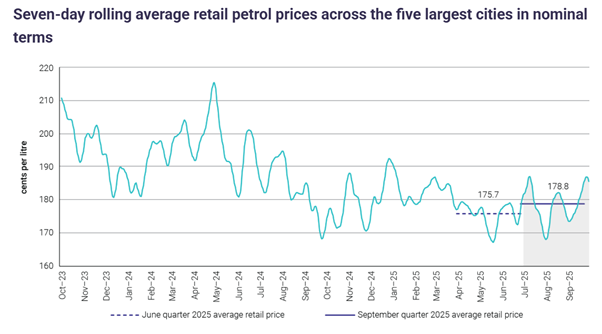
Against that backdrop, Australia has enjoyed one of its most stable fuel-price environments in years.
"2025 was the cheapest year for oil and petrol in Australia since COVID," Khoury says. "Wholesale prices never went above $1.70 and never went below $1.60 for most of the year."
That stability has continued into early 2026, with wholesale prices sitting below $1.60 a litre.
"There's nothing to suggest in the short term that prices are going to spike or jump significantly," he says, while cautioning that long-term forecasting is notoriously unreliable.
How motorists can save
While Australians have little control over global oil markets, Khoury says there are real, practical ways to cut fuel costs, thanks to real-time fuel price transparency.
Following years of campaigning, every Australian state and territory now requires service stations to share fuel prices publicly in real time.
"That's been a game-changer," Khoury says. "Sometimes we're talking gaps of 50 to 60 cents per litre, depending on where you go."
Using fuel price apps or government websites can make a bigger difference to household budgets than reacting to overseas headlines.
"Spend that 30 seconds and check the app," he says. "It takes the guessing game out of filling up."
Want to save more money at the petrol pump? Here are six ways to spend less on fuel.
Get stories like this in our newsletters.