How Tanya built 45 remote op shops across Australia




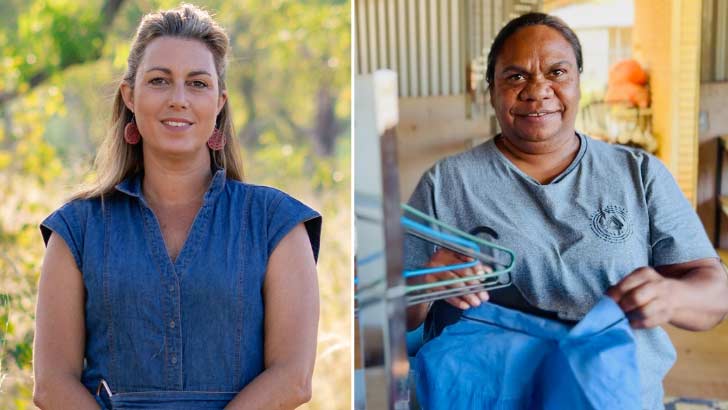
Tanya Egerton, the former marketing manager for Patagonia, lives in Katherine, Northern Territory, and is the founder and chief executive of Remote OpShop Project, a 45-plus network of remote independent op shops in the Northern Territory, Queensland, Western Australia and South Australia.
The op shops provide affordable clothing to communities while also helping to fund local Indigenous business initiatives.
We sort through how Tanya set it up, the lessons she learned along the way, and how it provides a blueprint for sustainable remote businesses.
What shaped your attitude towards community/sustainability?
I grew up in Yamba, NSW.
My early life was shaped by the natural environment, a small-town community and a fairly simple way of life.
I think when you grow up close to nature, you develop a sense of responsibility for it, even before you have the language for sustainability.
That understanding deepened through my work.
I had a career in marketing with global fashion brands, including Patagonia, which exposed me to business-for-good and the idea that companies could take responsibility for their environmental and social impact.
Later, when I found myself working in remote First Nations communities, including places like Cape York in Queensland and the Top End of the Northern Territory, my understanding of community shifted.
I began to see sustainability as something much bigger than the environment alone.
I don't believe profit, people, environment, culture and community are mutually exclusive.
At their best, they are interconnected, and good business models should be able to strengthen all of them at once.
How did you come to found the Remote OpShop Project?
The project started with a group of women in Jilkminggan in the Northern Territory in 2016.
These women were artists. They loved painting, weaving and sewing, but they were required to participate in work-for-the-dole activities where, really, they were just turning up with nothing meaningful to do.
They told me they wanted to start an art centre. So we sat down with a piece of butcher's paper and mapped out ways they could self-fund it.
An op shop emerged as an idea because clothing was so hard to access in the community.
We put a call out on Facebook asking for a couple of boxes of clothes, and the post went viral.
People from all over Australia wanted to donate, and we ended up with hundreds of boxes of clothing arriving in Katherine.
The women opened the op shop, sold about $10,000 worth of goods, bought art supplies and formally incorporated their art centre.
That was the moment I really saw what the model could be. It wasn't charity, it was self-determination in action.
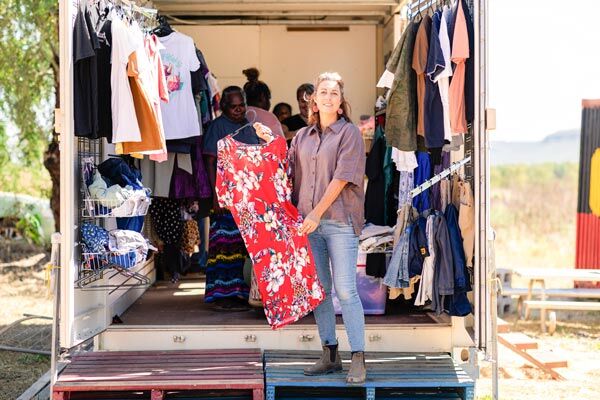
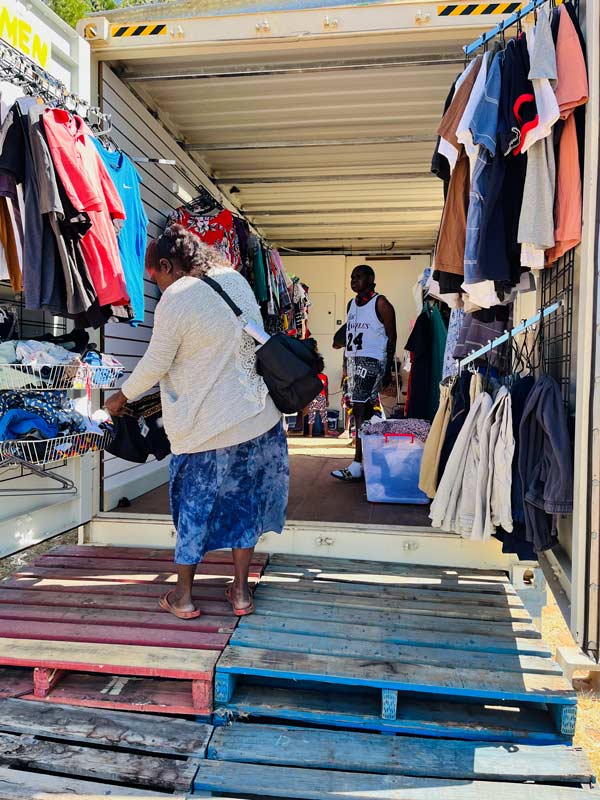
We now have more than 45 remote community partners, with op shops operating in different ways depending on local needs, from pop-ups and mobile op shops through to permanent community-led spaces.
Have you refined the business model since you first began?
I don't think of business models as static. They are living systems, and they need to keep changing as you learn, adapt and respond to what is happening on the ground.
In the early stages, we had a simple, low-cost model where donors sent goods directly to remote communities by post.
It worked because it was practical and direct.
But as demand grew from remote communities wanting to join the network, we needed to strengthen the system behind it.
That led to the opening of our first reuse hub in Darwin.
The hub has enabled us to engage fashion industry partners and work with them to redirect quality surplus goods into a central point, where items can be sorted and redistributed to communities that need them.
Designing business models for remote Australia is challenging.
There are elements that are non-negotiable, like no road access during the wet season, cultural obligations and protocols, long distances, dispersed communities, limited infrastructure and high freight costs.
You cannot design around those realities, you have to design with them.
In communities, the op shop model has evolved, but the core has stayed the same: community-led, low-risk and built around local ownership.
Where to next for the Project?
The next stage is about building the infrastructure to support scale without losing the community-led heart of the project.
Our Darwin Reuse Hub is a key part of that.
Over the longer term, the vision is to establish regional reuse hubs in places like Cairns, Broome and Alice Springs, connecting quality surplus goods with remote communities across the Northern Territory, Western Australia and Queensland.
We are also working towards securing impact investment to develop a broader precinct model, a logistics hub and community of purpose-led businesses focused on circular economy, Indigenous enterprise and regional employment.
The idea is to create the infrastructure that allows excess goods to move more efficiently, while also creating opportunities for collaboration, training, jobs and innovation.
What are the greatest challenges communities in remote areas face?
Access is one of the biggest challenges. Access to affordable food, clothing, household goods, transport, infrastructure and employment is extremely limited.
Distance changes everything, it adds cost, complexity and time.
A family might have to prioritise food over clothing, or go without basic household items because prices are too high or supply is limited.
But I think the deeper challenge is that in remote communities, First Nations people have had generations of programs and systems designed for them, rather than with them.
People have often been told what to do, rather than being backed to lead.
One elder once said to me, "We have been told to sit down for so long that now it can be hard to stand up."
That has stayed with me.
What gnarly issues have you had to fix that you didn't anticipate?
Logistics is by far the biggest challenge.
In the early stages, our direct donation model helped us avoid a lot of handling costs, while also creating a powerful direct connection between public donors and the women leading op shops in their communities.
But as the network has grown, so has the complexity.
Moving goods across remote Australia is expensive and difficult. There are long distances, limited freight options and communities where people may already be travelling a 100-kilometre round trip just to get to the post office.
We have been fortunate to have a strong partnership with Team Global Express, who have been incredibly generous in their support.
The next step is to build a more sustainable logistics model that creates employment opportunities for logistics coordinators in remote communities, while also increasing the volume and value of goods being sent so the model becomes more viable.
Finish this sentence: money is good for...
Money is good for turning values into action.
Get stories like this in our newsletters.

 Reply
Reply