Fans gave millions, then came the backlash




Fans raised millions for James Van Der Beek's family, but backlash and outrage quickly followed. So why are donations still streaming in?
It's become the go-to advice in times of crisis: "Why don't you set up a GoFundMe page?"
Whether it's illness, natural disaster or falling on hard times, even contributions to holiday and wedding funds in some cases, asking for donations has taken on a life of its own in the form of crowdfunding. And GoFundMe is making it all possible.
The popular American social fundraising platform has taken the shame out of asking for money.
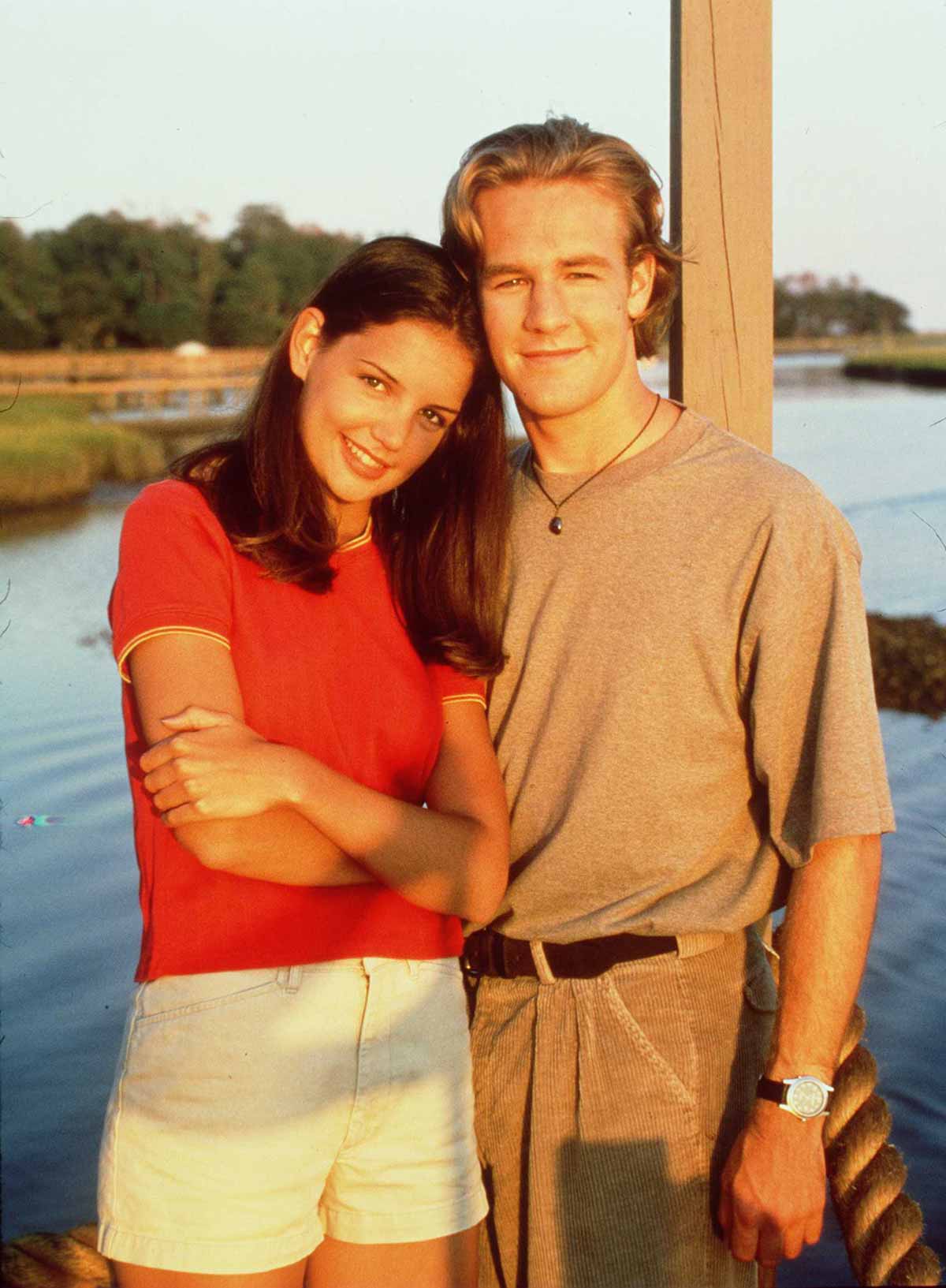
In fact, it has normalised it to the extent that even celebrities have jumped on the bandwagon, most recently American actor James Van Der Beek, who in the late '90s was one of Hollywood's most recognisable faces. At age 20, Van Der Beek shot to fame playing Dawson Leery on US series Dawson's Creek.
When celebrity grief turns into crowdfunding
In recent years, Van Der Beek had mostly eased out of Hollywood. There was a steady stream of work, voice acting, recurring sitcom roles, reality TV, but nothing like Dawson's Creek.
Then, in 2024, he made a public announcement, he'd been diagnosed with stage three colorectal cancer.
His battle with the illness was short and, in early February 2026, Van Der Beek's wife, Kimberly, announced his death in an Instagram post. The actor was only 48 years old and left behind six children.
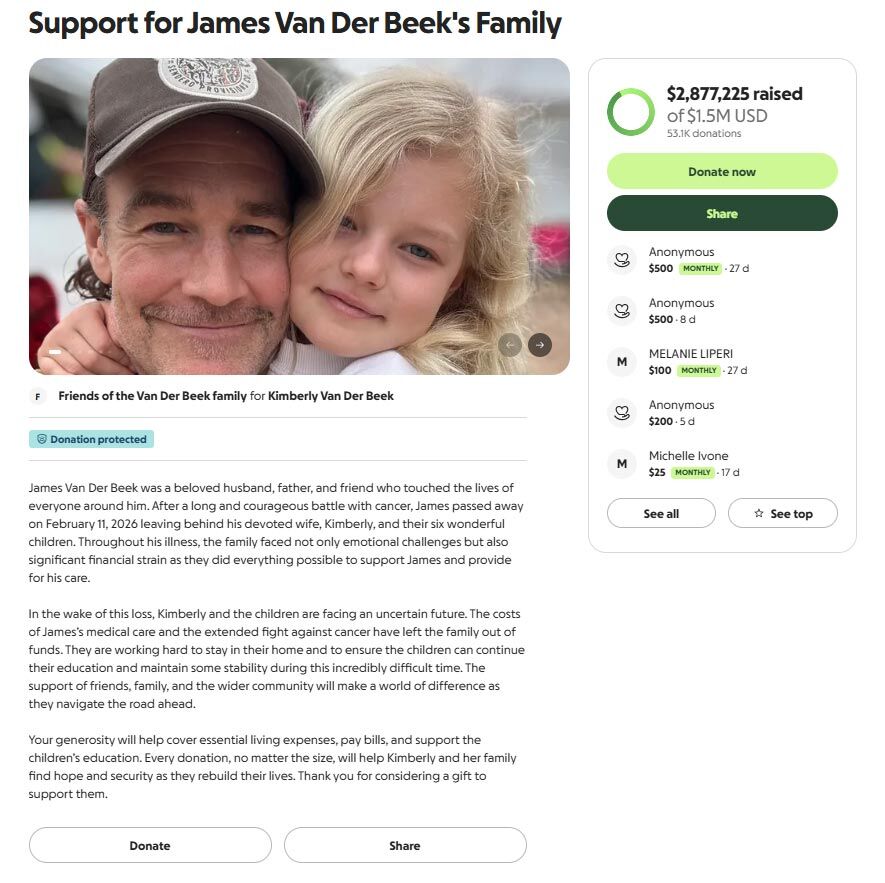
Within a few days, a GoFundMe page had been set up to support his family. The response was immediate, donations poured in.
"The costs of James's medical care and the extended fight against cancer have left the family out of funds," the page said.
"They are working hard to stay in their home and to ensure the children can continue their education and maintain some stability during this incredibly difficult time."
But what does 'out of funds' mean when you're the family of a Hollywood star?
There were no further details.
That didn't stop the donations. At time of writing, more than US$2.8 million has been raised for Van Der Beek's family on GoFundMe.
The fundraiser is still open, with donations as recent as June 10, but speculation about Van Der Beek's financial situation intensified.
It was eventually reported that, just a month before his passing, Van Der Beek and his wife bought the Texas ranch they'd been renting. The property settled for $4.76 million.
Van Der Beek's representatives later reported that the down payment for the property was secured "with the help of friends through a trust so they could shift from rent to mortgage".
'I feel totally duped'
Unsurprisingly, there was a public backlash.
"Does anyone know how I can get a refund on the go fund me?!? I donated hundreds of dollars and I feel totally duped," one person wrote on Kimberly Van Der Beek's Instagram page.
Discourse on Reddit forums was particularly unforgiving.
"The reality is all of us are living within our means, and yeah, we're going to side-eye the celebrity asking for donations to maintain a celebrity standard of living," wrote one person.
This was a sentiment repeated many times across the internet.

Another star, another GoFundMe
Just days after Van Der Beek's death, another Hollywood heartthrob passed away.
Eric Dane, best known for playing Dr Mark Sloan in Grey's Anatomy, died from the degenerative disease ALS.
A GoFundMe page was immediately set up.
"Any contribution, no matter the size, will help provide stability during this incredibly difficult time... for Eric's wonderful daughters," the fundraiser said.
More than 4400 people donated almost half a million dollars.
People who donate to GoFundMe campaigns can also leave public messages. One note, written by a woman calling herself "Cristina J", stood out.
Alongside a $5 donation, she wrote:
"I have Stage 4 cancer and am living on social security so I couldn't donate more, sorry. I have a young daughter myself so I know how awful it can be having a terminal illness and leaving behind a child."
Some estimates valued Dane's estate at about US$7 million at the time of his passing.
But an exact valuation isn't possible, which highlights a bigger question: should celebrities and their families disclose more financial information before asking the public for donations?
When asked about this issue, a GoFundMe spokesperson said every situation is different and "it's ultimately up to donors to decide which causes they wish to support".
For GoFundMe itself, however, every donation also generates revenue, with the platform charging a 2.2% fee plus $0.30 per transaction.

The psychology behind celebrity donations
It's true that people are allowed to donate their money however they please, and it seems unlikely that anyone who donated to the Van Der Beek family cause thought they were in danger of homelessness.
"My best informed guess would be that people in this instance are not giving because of perceived need but rather due to other motivations," says The University of Queensland's Dr Cassandra Chapman.
According to Chapman, who has a PhD in the psychology of charitable giving, there are many reasons someone might support a celebrity fundraiser.
Donating can act as a form of identity expression, allowing people to signal what they value or feel connected to. Nostalgia can also play a role, in particular if the celebrity was tied to meaningful moments in a donor's life.
Interestingly, people may even be using the donations as a way to confront their own mortality.
"There is a theory in psychology, terror management theory, that people's behaviour can be motivated by an unconscious fear of death," says Chapman.
Many people, myself included, grew up alongside James Van Der Beek. He was the prototypical teenager of our time. And now we're all middle aged, and he is dead.
"For some, this may stir up deep-seated fears around their own mortality. Giving could be a way to dissipate that uneasiness."
Is celebrity crowdfunding ethically fair?
Fundraising to memorialise the dead is not without precedent.
According to Simon Longstaff, executive director of The Ethics Centre, communities have long pooled money to honour those seen as having made meaningful civic contributions.
"This is not a new phenomenon, it's been going on for centuries where there have been public subscriptions to fund memorials to notable citizens," says Longstaff.
"It gave people of quite modest means the opportunity to participate in the commemorative process. In a sense, become a contributor to some broader process of recognition."
Perhaps this is a normal part of public grieving, one that has been accelerated by the internet and social media.
Whether that makes fundraisers ethically defensible depends on the intended purpose of the money and the financial situation of the people for whom the donations are being raised.
But the moral responsibility does not rest entirely with the people seeking the funds. Those donating should also examine whether the donation aligns with their own moral and ethical code.
"I think the moral obligations fall on both sides and everybody's responsible for the choices they make," says Longstaff.
The hidden risks of online fundraising
Of course, the internet has made collective giving easier to organise and scale. On GoFundMe alone, more than $1.1 billion has been donated in Australia since the platform's local launch in 2015.
"Last year 1.7 million donations were made to fundraisers, raising $141 million for local causes. In fact, nearly one in four Aussies has made a donation via GoFundMe for causes that matter to them," said a GoFundMe spokesperson.
But is every cause a worthy one? On GoFundMe there are people asking for donations towards their holidays, honeymoons and school excursions. It might be frivolous, but it's not illegal.
"At the end of the day, if somebody wants to do a fundraiser for something they feel is important, then they can do that, as long as it's not fraudulent," says Katherine Raskob, chief executive of the Fundraising Institute Australasia (FIA).
That means you can ask strangers on the internet to contribute to your kitchen renovation, five-star holiday, or dream of owning a Ferrari.
Whether they will want to help you is another matter. But what you can't do is say you're fundraising for one thing, and then spend that money elsewhere.
|
How to check if a fundraiser is legitimate
Before donating online, experts recommend taking a few precautions:
|
What to check before donating online
Just how that's enforced depends on the nature of the misconduct and the jurisdiction, laws on fundraising vary across States and Territories.
The Australian Competition and Consumer Commission may intervene if Australian Consumer Law has been breached.
There are also a number of State-based fundraising regulators who can get involved. Platforms such as GoFundMe will have their own rules as well.
If you think you've been scammed, it can be a complex regulatory system to navigate. Better to ensure your donations are going to the best possible cause in the first instance.
"It's buyer beware," says Raskob. "Make sure that you're aware of what it is that you're contributing to, and that you know who they are."
To check if a charity is legitimate, Raskob recommends starting with the Australian Charities and Not-for-profits Commission, where you can review its registration, purpose, reports and leadership.
If you want an extra layer of protection, charities that have aligned with the FIA have also agreed to ethical and transparent fundraising practices.
Ultimately, you can spend your money however you want.
There is nothing inherently wrong with giving money to a cause that feels meaningful, especially if it gives you some measure of peace or happiness. As the GoFundMe spokesperson points out, the decision rests with the donor.
But before donating in an emotional state, consider thinking about the potential impact of your money and whether it's going to the people and causes who need it the most.
Get stories like this in our newsletters.