A major solar change could be coming for renters




The federal government wants to bring portable solar for renters and apartment-dwellers to Australia, but says it could be a while before we see panels on balconies. Plus, foreign investors told to contribute to Australia's housing supply and farmers say migration cuts will raise food prices. Here are five money stories you may have missed this week.
1. Living in an apartment? You might soon be able to join the solar saving spree
Renters and apartment dwellers could soon be allowed to put portable solar panels and batteries on balconies and in gardens.
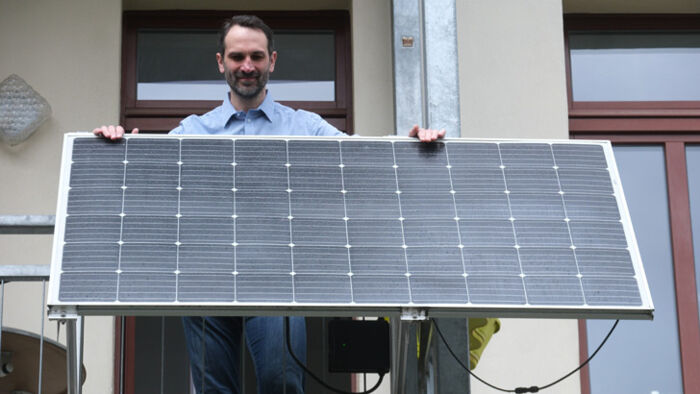
Federal climate change and energy minister Chris Bowen announced this week that state and territory governments had agreed to work with his department to make plug-in solar legal in Australia.
Large panels and batteries are already popular on detached and semi-detached homes.
They allow Aussies to produce and store their own electricity, reducing the amount they take from the grid and, therefore, their power bills.
"Now we're taking the next step, by looking at how even more Australians can take advantage of free, abundant sunshine - even if they don't have a roof," Bowen said, according to the ABC and Nine Newspapers.
Bowen said the panels and batteries would be small enough that residents could move them on their own from property to property.
Plug-in solar systems are already popular in several European countries, including Germany, where residents often put panels on their balconies to power appliances inside their home.
But Bowen warned the products wouldn't become available in Australia "overnight", adding there was "a lot of work to do" to make sure they were safe and met safety standards.
2. Foreign investors told to contribute to housing supply
Foreigners who buy residential land are being reminded to contribute to Australia's housing supply after one investor was fined for taking too long to start construction.
The tax office issued the warning to "land banking" investors after the individual was ordered to pay $370,000 by the federal court this week for not building a home on the lot within four years.
"This case should serve as a warning to foreign investors and their advisers," said ATO assistant commissioner Jennifer Moltisanti.
"[They] need to understand that buying residential land in Australia comes with clear and enforceable obligations".
"Where foreign investors do not comply, we will take firm action, including court proceedings, to uphold the law and protect Australia's national interests."
Foreign investors who purchase vacant residential land in Australia are generally required to build on it within four years under rules designed to ensure land is put to productive use and contributes to housing supply.
3. "Low blow" migration cuts could raise grocery prices: farmers
Farmers say the federal government's plan to make backpackers wait longer for work visas will push up grocery prices and could lead to shortages on supermarket shelves.
Responding to the government's plan to cut migration announced this week, the National Farmers' Federation (NFF) said new processing times for visas would lead to a labor shortage.
"Working holiday makers fill about one in seven farm jobs, making them central to getting food and fibre produced, harvested, packed and into supermarkets," said NFF President Hamish McIntyre.
"When farms cannot get workers at the right time, crops are left unpicked, livestock care becomes harder... and households ultimately pay the price at the checkout."
One of the migration changes the government announced on Thursday was to "stabilise" processing times for working holiday maker applications at three months.
The NFF says approvals previously took just days.
Federal immigration minister Tony Burke rejected farmers' claims in a comment to The Guardian.
He said the government's changes would allow quicker visa approvals in other vital industries and that growers could still bring in workers on Pacific labour schemes.
4. Major airlines earning billions despite fuel crisis
Australia's two biggest airlines are still raking in billions of dollars, despite having to pay much more for jet fuel, according to the national competition watchdog.
The Australian Competition and Consumer Commission (ACCC) said the earnings show how well the carriers have fared in a "highly concentrated" domestic aviation market.
The ACCC's latest report on the local airline industry reveals Qantas earnt $2.35 billion before interest and tax in the 2025-26 financial year, while Virgin Australia took in $753 million.
The watchdog noted the "strong results" came despite jet fuel costing nearly 50% more in August this year than in February.
In April, Qantas and Virgin announced they would charge customers more for tickets and reduce capacity on some services to deal with the higher fuel overheads.
The ACCC noted that, despite this squeeze, the carriers were still enjoying strong passenger demand.
But it said the dominance the companies enjoy domestically gave consumers few other options.
"These results highlight the financial resilience of the two largest operators in Australia's highly concentrated domestic aviation market."
5. Scamwatchers flag return of summer ticket cons
Aussies desperate to see their favourite acts or sporting teams this summer are being warned to watch out for scammers selling fake tickets.
Western Australia's government ScamNet service expects fake ticket scams to increase as we head into the warmer months and believes cases are already on the rise.
It said Western Australians had already lost more than $1000 to scams in the first few days of this month.
The group said WA could see a repeat of last summer, when more than 80% of scam losses occurred during warmer months as festivals, outdoor concerts and other events ramped up.
ScamNet says people looking for tickets for popular events should avoid online ads for secondhand passes or offers from sellers on social media whose profiles appear new.
It also recommends sticking to an event's official resale platform and, if buying from a private seller, using PayPal rather than bank transfer.
Get stories like this in our newsletters.