JB Hi-Fi refunds customers after 'fake discounts'




Fake discounts exposed, gift cards at risk, and a $50,000 homebuying win. Here are the money stories Australians can't ignore this week.
JB Hi-Fi refunds customers after 'fake discount' claims
Why the ACCC says shoppers were misled
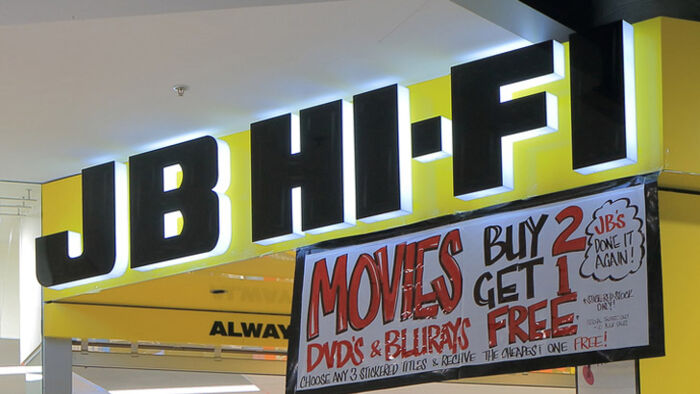
JB Hi-Fi is refunding more than $250,000 after shoppers were misled by "fake discounts".
It follows investigations by the Australian Competition and Consumer Commission (ACCC) that the electronics giant may have misled consumers with dodgy 'was/now' pricing claims for a range of products last year.
The ACCC alleges the products were promoted as being discounted even though some were never offered for sale at the higher price, or were only available at a higher price for a brief period.
ACCC Commissioner Luke Woodward says some customers may have decided against buying the products if they had known the claimed discount was not genuine.
JB Hi-Fi has already provided some refunds, and contacted other affected customers directly to arrange a refund.
Customers do not need to contact JB Hi-Fi to get their money back.
It comes less than a month after Coles was found guilty of misleading discounts by temporarily raising prices by at least 15%, before placing items on a 'Down Down' promotion where the discounted price was the same as, if not higher than, the original price.
The costly catch for Barbeques Galore gift cards
The rule that forces you to spend more
Barbeques Galore is closing, and gift card holders face a costly catch.
An icon of the Aussie lifestyle since the 1970s, the chain's closure will leave 500 employees looking for new jobs.
Signs of trouble emerged in February, when Barbeques Galore, which has 89 stores nationally, went into voluntary administration, with hopes of finding a buyer to solve its liquidity woes.
With no buyer found, that plan has been abandoned, and stores will begin shutting from June 16.
Barbeques Galore gift cards can still be used before June 30, 2026, but there's a catch .
For every $1 of gift card credit, you must spend an extra $2.
To redeem a $50 gift card, you need to spend $150, with an extra $100 from your own pocket.
It's far from a sizzling deal.
Cardholders are being urged to use their gift cards promptly.
After June 30, unredeemed cards will join the pool of unsecured creditors.
The part of Australia scrapping stamp duty
How much first home buyers could save
First home buyers in the ACT could save up to $50,000 as stamp duty is scrapped from July 1.
First home buyers in the nation's capital will no longer have to pay stamp duty, regardless of property value or income.
It makes the ACT the first jurisdiction in Australia to fully abolish stamp duty for first-time buyers .
Currently, only homes under $1 million are exempt, with income thresholds applying.
The change means buyers spending $1.2 million could save around $50,000.
The median house value in Canberra is $1,040,041.
The ACT government is also expanding stamp duty exemptions to pensioners, eligible NDIS participants, and buyers who have not owned property in the past five years.
Stamp duty is also being removed for new unit-titled properties purchased by owner-occupiers, supporting Canberrans, including downsizers , to move into terraces and townhouses.
The new ETF betting on the $1 trillion space boom
What the 'MOON' ETF actually invests in
Global X has launched a new exchange traded fund, with the ASX ticker 'MOON' .
The launch coincides with the US listing of Elon Musk's company SpaceX , as investor interest grows in the rapidly expanding space economy.
Global X CEO Alex Zaika says MOON offers Australian investors a way to access the sector's growth.
"Falling launch costs and advances in satellite technology are reshaping the investment landscape," he says.
He adds the space economy is expected to surpass $US1 trillion ($1.43 trillion) over the coming decade.
MOON includes 28 companies such as Planet Labs, Rocket Lab and Globalstar.
The annual management fee is 0.5%.
The job perk Australians now want more than working from home
One in two workers would take paid health cover over flexible work
Working from home is no longer the preferred job perk of Aussie workers.
One in two Australians would rather their employer pay for private health insurance over flexible work arrangements.
These are the findings of research commissioned by Members Health Fund Alliance.
Cost-of-living pressures have pushed health cover ahead of remote work, salary sacrificing and childcare support.
Only around one in two Australians have health insurance, with cost a major barrier.
Monthly premiums range from about $234 for a single to more than $550 for a family.
With costs this high, it's easy to see why demand is shifting.
Working from home is also becoming more common, and may soon be a formal entitlement.
In Victoria, the Allan Government plans to introduce legislation in July giving eligible workers the right to work from home two days a week.
As living costs rise, flexibility alone is no longer enough to win over workers.
Get stories like this in our newsletters.