The new way to fly with your pet in Australia




Virgin launches $149 pet flights, Kmart breaches privacy rules, and the older Aussies who refuse to hang up their work boots. Here are five things you may have missed this week.
Virgin launches $149 pet-friendly flights
It's the news Australia's 6.4 million dogs and 5.3 million cats have been waiting for.
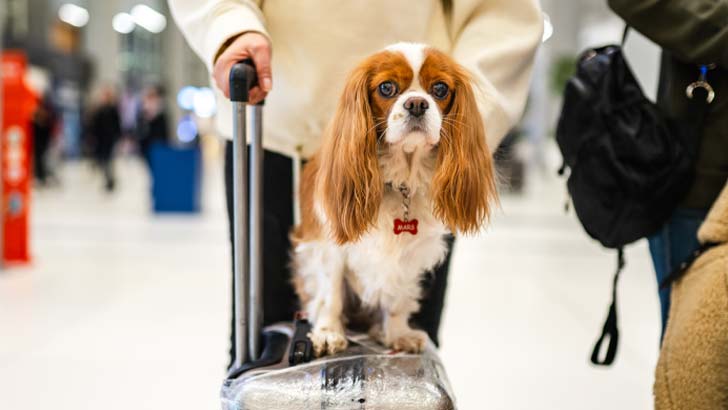
In an Aussie first, Virgin Australia has launched its highly anticipated Pets in Cabin service.
Pet-friendly flights will initially be trialled on routes between Melbourne and the Gold Coast and Melbourne and the Sunshine Coast, with the first pets-on-board planes taking off in mid-October 2025.
A broader rollout of the service is planned for next year.
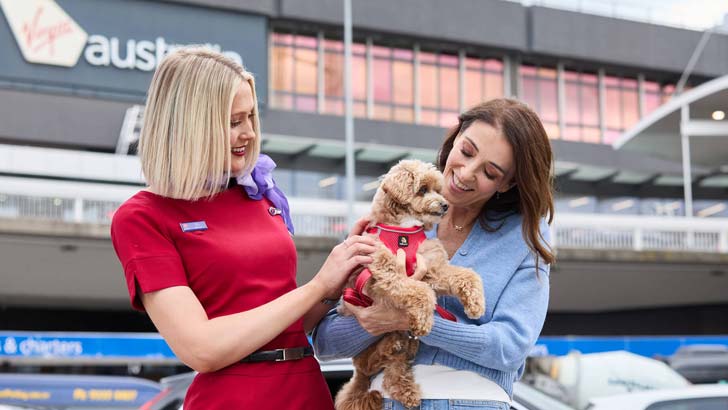
Tickets for furry companions come at an introductory price of $149 per animal, per flight.
While Virgin claims the Pets in Cabin service is set to transform Australia's domestic aviation market, it won't be a game-changer for every pet.
Jet-setting mutts and moggies will face the indignity of being stowed under the seat in front of the owner. Sadly, this rules out larger breeds taking to the skies.
Aisle-seat-loving pet owners may also be disappointed. Pets are restricted to just four window seats on Virgin flights (seats 18A and 18F and 20A and 20F).
Still, it's a step in the right direction for Aussie pets.
And it brings our aviation laws closer to international offerings, with Pets in Cabin services already standard across major carriers in North America and Europe.
Kmart breaches privacy laws with facial recognition technology
For the past three years Kmart has been under investigation by the Office of the Australian Information Commissioner (OAIC), and this week the retail giant was found guilty of breaching privacy laws by using facial recognition technology (FRT) to tackle refund fraud.
The breach occurred between mid-2020 and mid-2022, when Kmart used FRT to capture the faces of every person who entered 28 of its retail stores, as well as every customer who visited the returns counter.
Customers' facial data was cross-checked against a database of people who had committed refund fraud or were suspected of it.
Kmart claimed it didn't need customer consent for the use of FRT because the Privacy Act allows exemptions when organisations are trying to tackle unlawful activity or serious misconduct.
But the Privacy Commissioner Carly Kind wasn't buying it.
Kind says Kmart indiscriminately collected sensitive biometric information, and less intrusive methods could have been used to tackle refund fraud.
Despite this, the OAIC opted not to slap Kmart with a penalty.
Refund fraud is a fast-growing problem for Australian stores.
A report by Loop - a returns management platform, shows attempts at refund fraud jumped 22% between 2023 and 2024.
It turns out, one of the most common forms of refund abuse is 'wardrobing' - trying to return an item after it's been used.
'Ageless workers' - the older Australians who refuse to retire
Plenty of us are ticking off the years until retirement.
But new research by KPMG reveals a growing number of 'ageless workers' - older Australians who are happy to stay in the workforce well beyond what most of us would regard as retirement age.
KPMG Urban Economist Terry Rawnsley explains, "20 years ago, one in 10 men were working at age 70. Today, it's one in four."
Even among men in their late 70s, Rawnsley says almost one in 10 remain in the labour force.
"The growth in ageless workers isn't a recent phenomenon that spiked following the cost-of-living pressures of 2023-24. It is a longer-term trend that suggests a structural change to the concept of retirement," Rawnsley adds.
The increase in white-collar workers who can work longer in life could explain this evolution of retirement.
"Given the physically demanding nature of work faced by blue-collar workers, it is very challenging for them to continue working into their 70s. Pulling out a laptop in your 70s is much easier compared to laying bricks at that age," adds Rawnsley.
Home loan rates starting with a '4' return to market
For the first time since October 2022, a growing number of lenders are offering home loan rates below 5%.
But there's a catch.
The super-cheap rates are typically only available if you lock into a fixed rate.
According to Mozo, close to 30 lenders are offering rates below 5% for one- and two-year fixed terms.
This week saw CommBank break the 5% barrier with a 2-year rate of 4.99%.
The catch is that you'll need a deposit of at least 30%.
Westpac, which has a 4.89% rate - also fixed for two years, requires the same minimum 30% deposit.
If you're happy to fix, it's definitely worth looking at the smaller banks.
BCU Bank, for instance, has a 1-year fixed rate of 4.65%, and you can borrow up to 95% of the property's value including lenders mortgage insurance.
It's now almost impossible to lose money on property
You have to work hard to make a loss on residential property these days.
The latest Pain and Gain report from Cotality shows a mere one in 20 homes re-sold in the June quarter failed to turn a profit.
The long term trend is for one in 10 homes to sell for a loss.
For the overwhelming majority (95%) of properties that re-sold for a profit, the median gain on sale was a healthy $315,000.
Brisbane was the most profitable capital city, with 99.7% of resales making a nominal gain.
But it was the NSW south coast town of Kiama that topped the league table of profits. Homes in the coastal hamlet re-sold for a median nominal gain of $758,000. The profits didn't happen overnight. The average holding period of homes re-sold in Kiama was almost 12 years.
Get stories like this in our newsletters.